
Ever wondered why ice melts or why steam forms when... Mostrar mais
 Science5 visualizações·Atualizado Jun 7, 2026·6 páginas
Exploring the Different States of Matter
1 / 6
1
of 6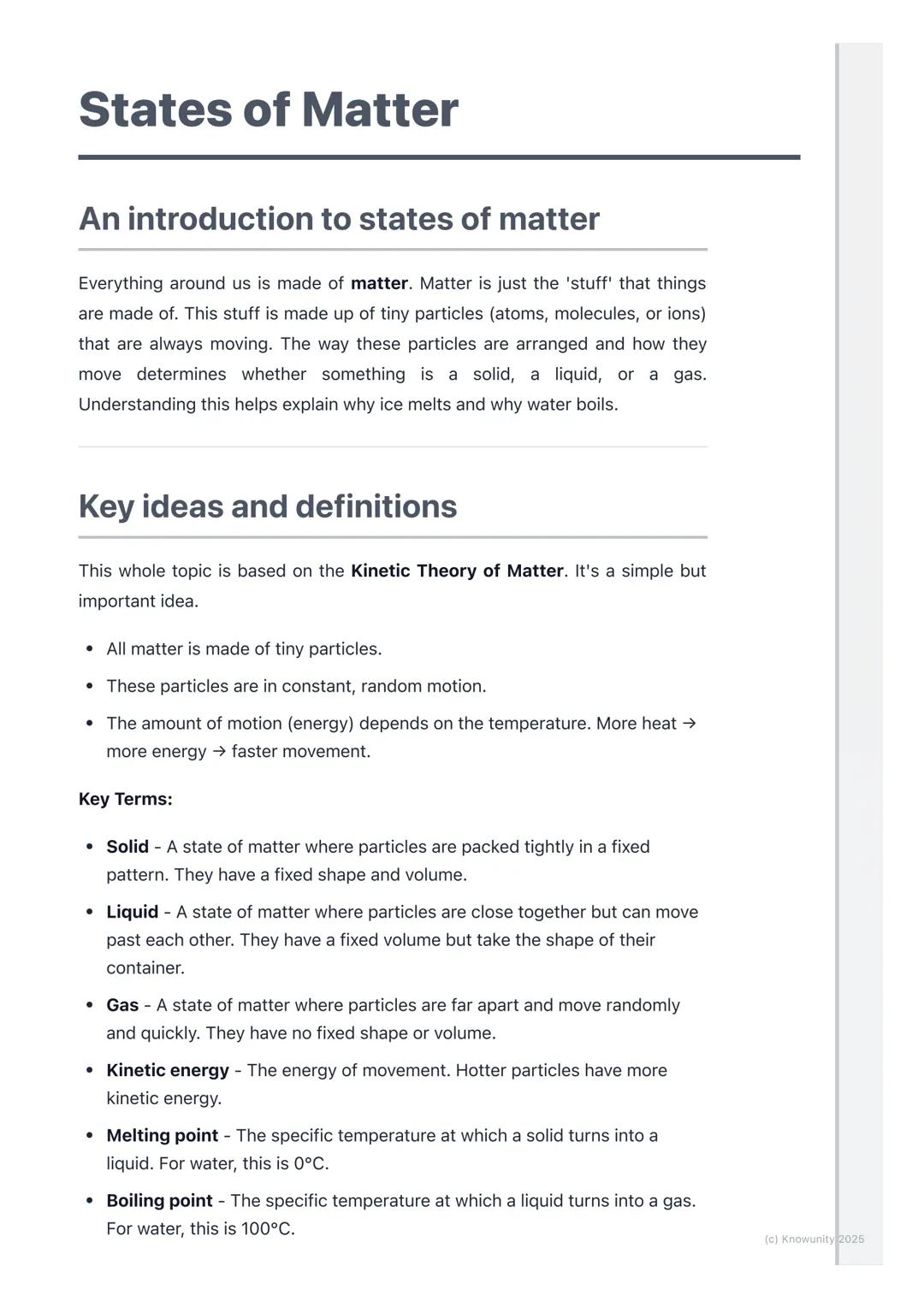
An Introduction to States of Matter
Everything you see, touch, and breathe is made of matter - basically the "stuff" that makes up our world. This matter consists of incredibly tiny particles like atoms and molecules that are constantly jiggling about, even when things look perfectly still.
The way these particles move and arrange themselves determines whether something is a solid, liquid, or gas. When you understand this simple concept, loads of things suddenly make sense - like why your ice lolly melts on a hot day or why you can smell dinner cooking from upstairs.
The Kinetic Theory of Matter explains it all with three key ideas: all matter contains moving particles, these particles never stop moving randomly, and the hotter something gets, the faster its particles move. Think of it like a massive invisible dance party happening inside everything!
Quick Tip: Remember that temperature is just a measure of how fast particles are moving - hotter means faster particle movement!
2
of 6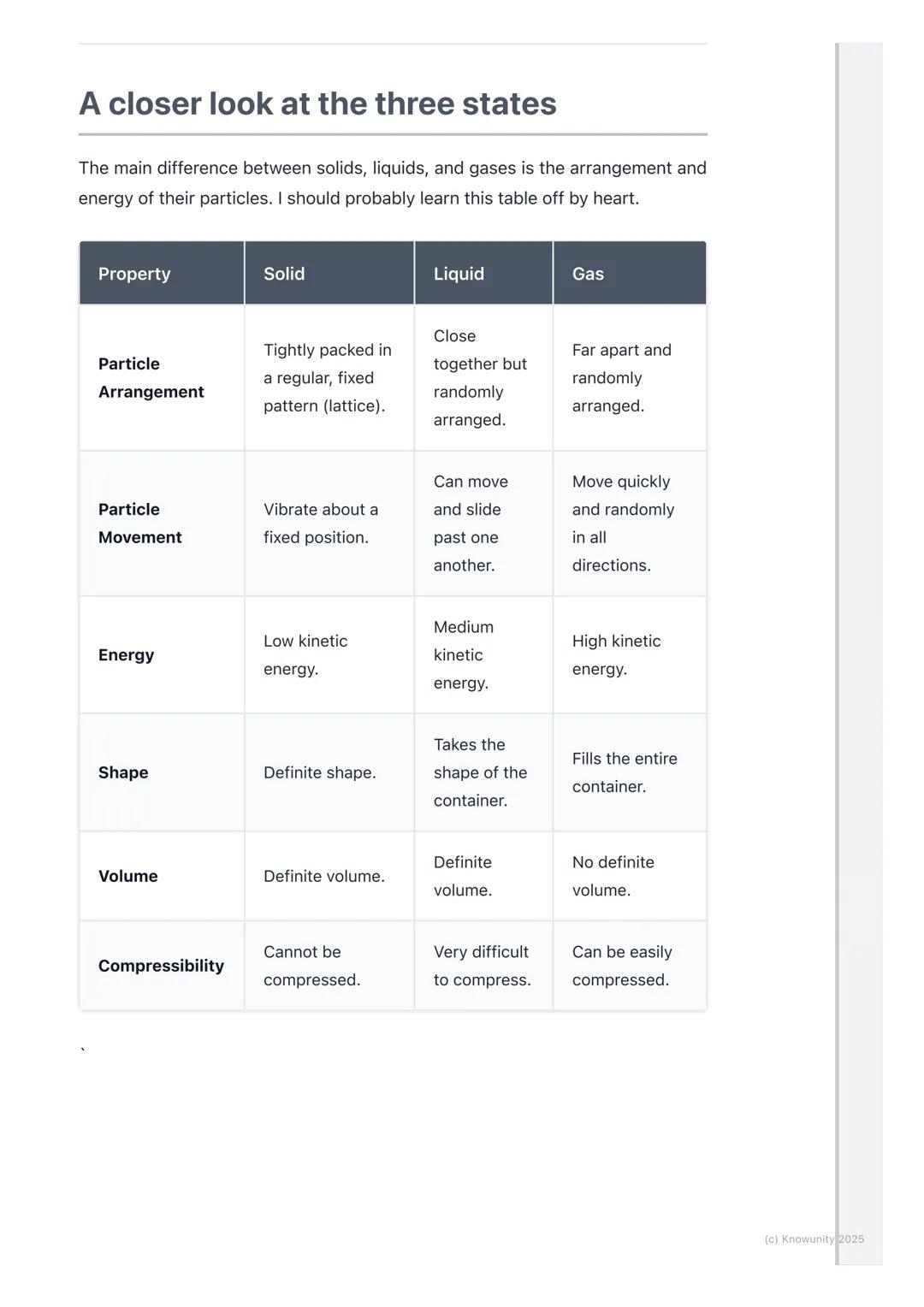
Comparing the Three States
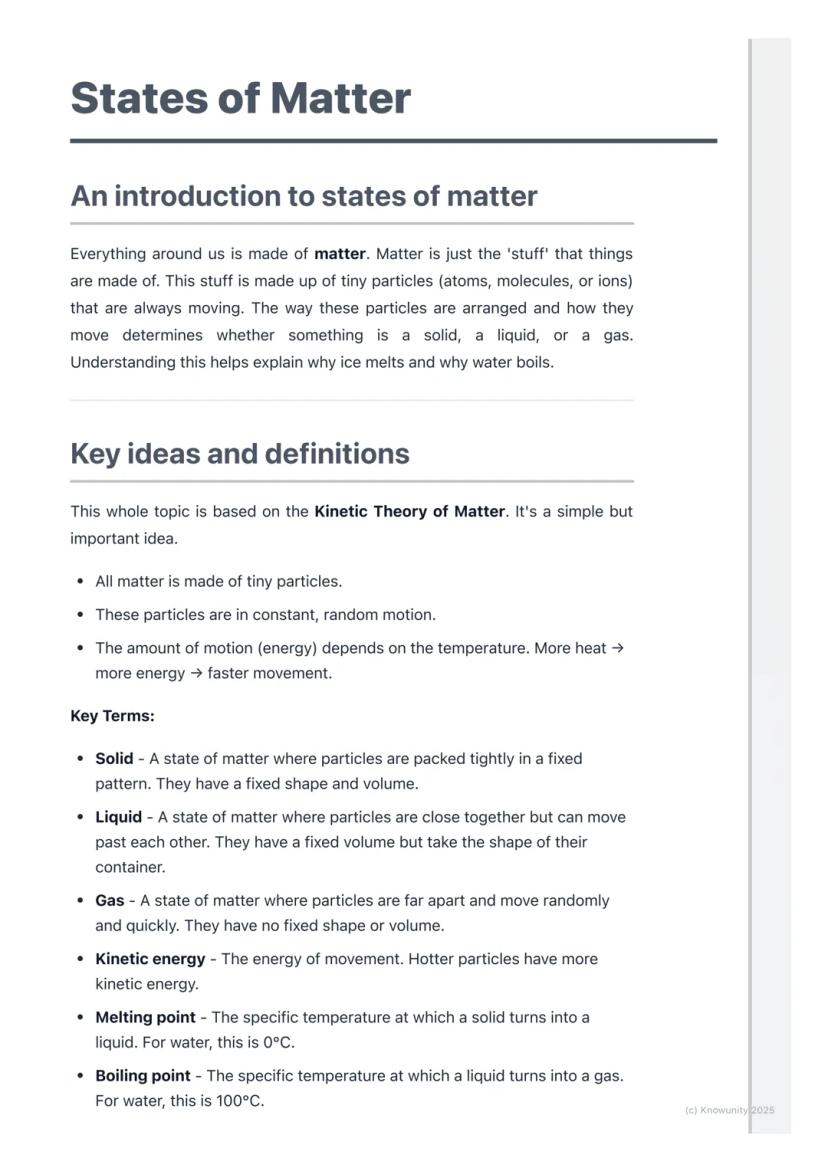
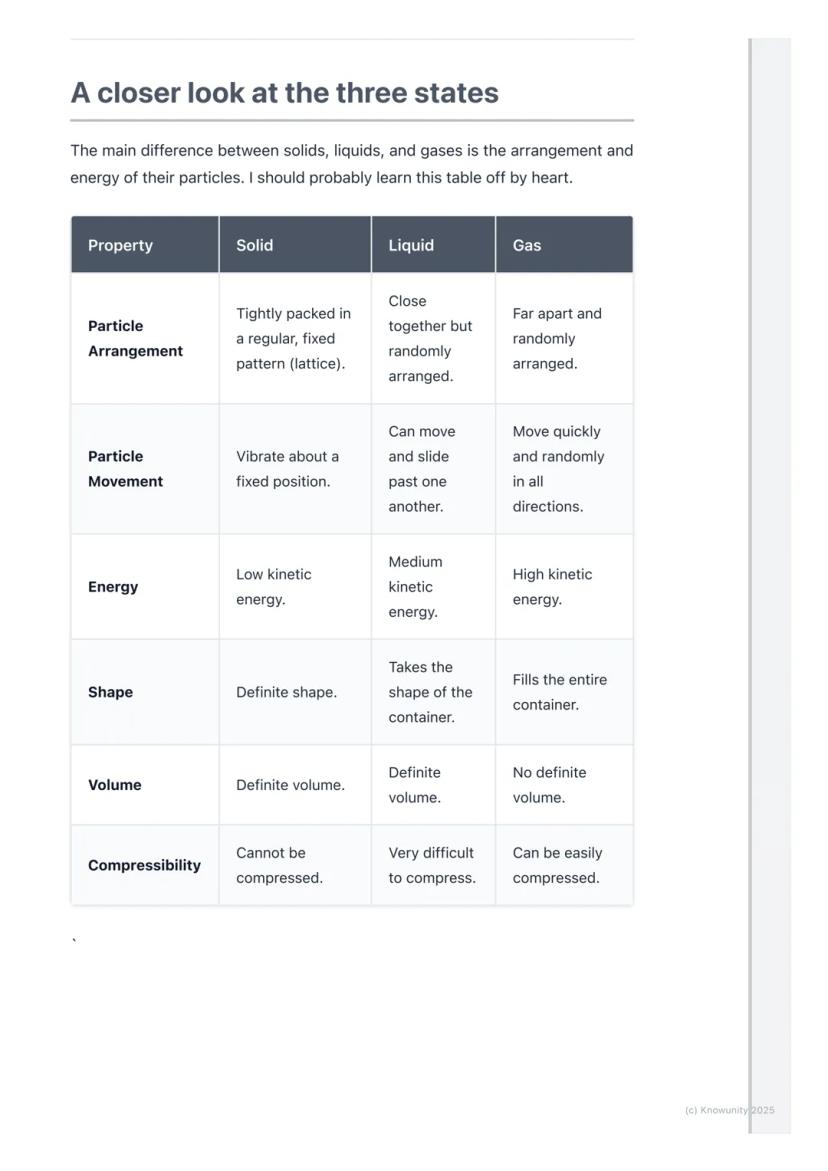
The main difference between solids, liquids, and gases lies in how their particles are arranged and how much freedom they have to move around. In solids, particles are packed tightly in neat, organised rows and can only vibrate in place - like people sitting in assigned cinema seats.
Liquid particles are still close together but can slide past each other, similar to people standing in a crowded room who can shuffle about. Gas particles have loads of space between them and zoom around randomly at high speeds, like people running freely in a massive field.
Solids keep their shape and volume because particles are locked in position. Liquids keep their volume but take the shape of their container since particles can move around each other. Gases expand to fill any container completely because their particles spread out everywhere.
This explains why you can't squash a rock (solid), why water takes the shape of its glass (liquid), and why perfume smell spreads across a room (gas particles moving freely).
Remember: The amount of kinetic energy (movement energy) increases from solid to liquid to gas!
3
of 6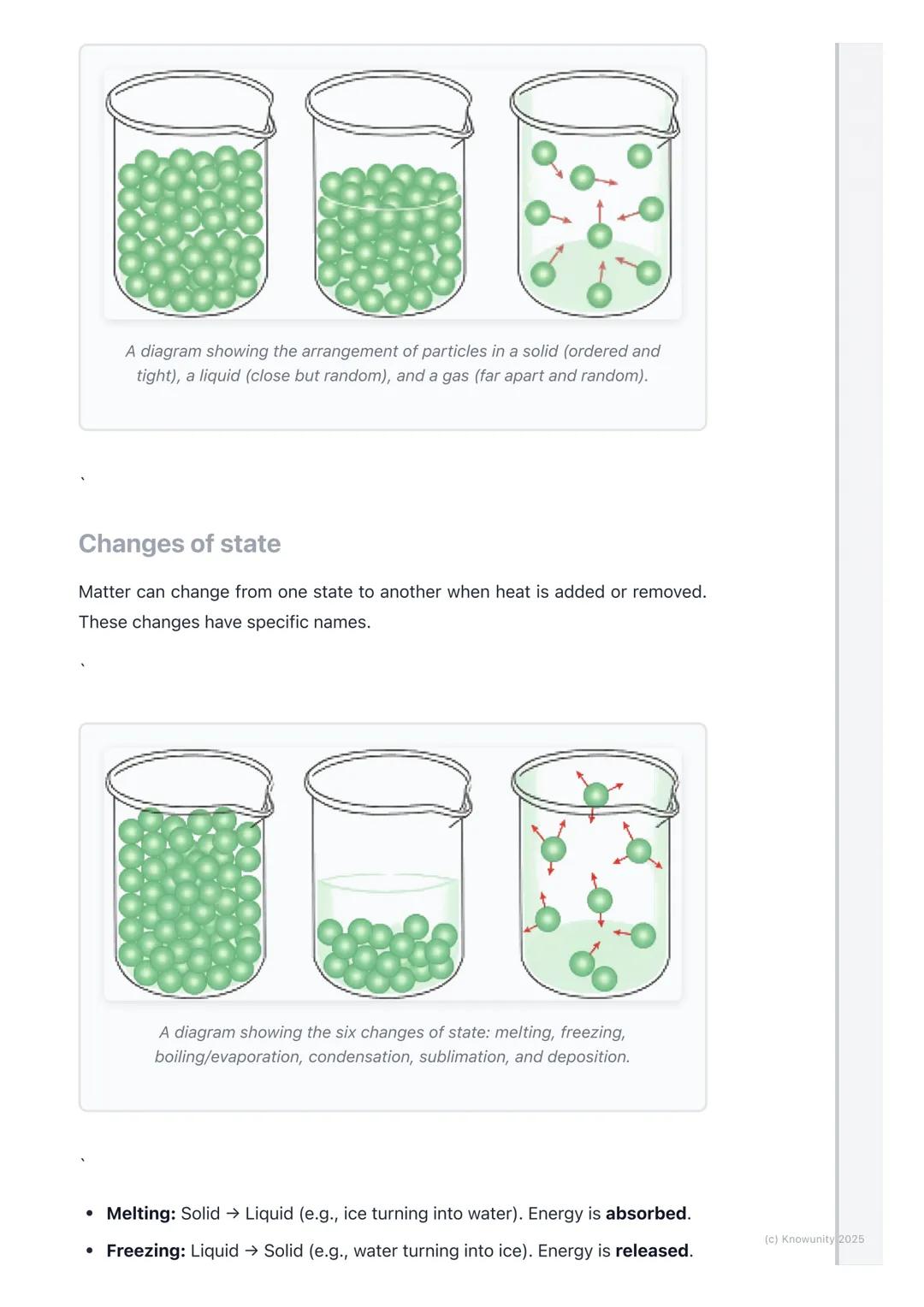
Changes of State
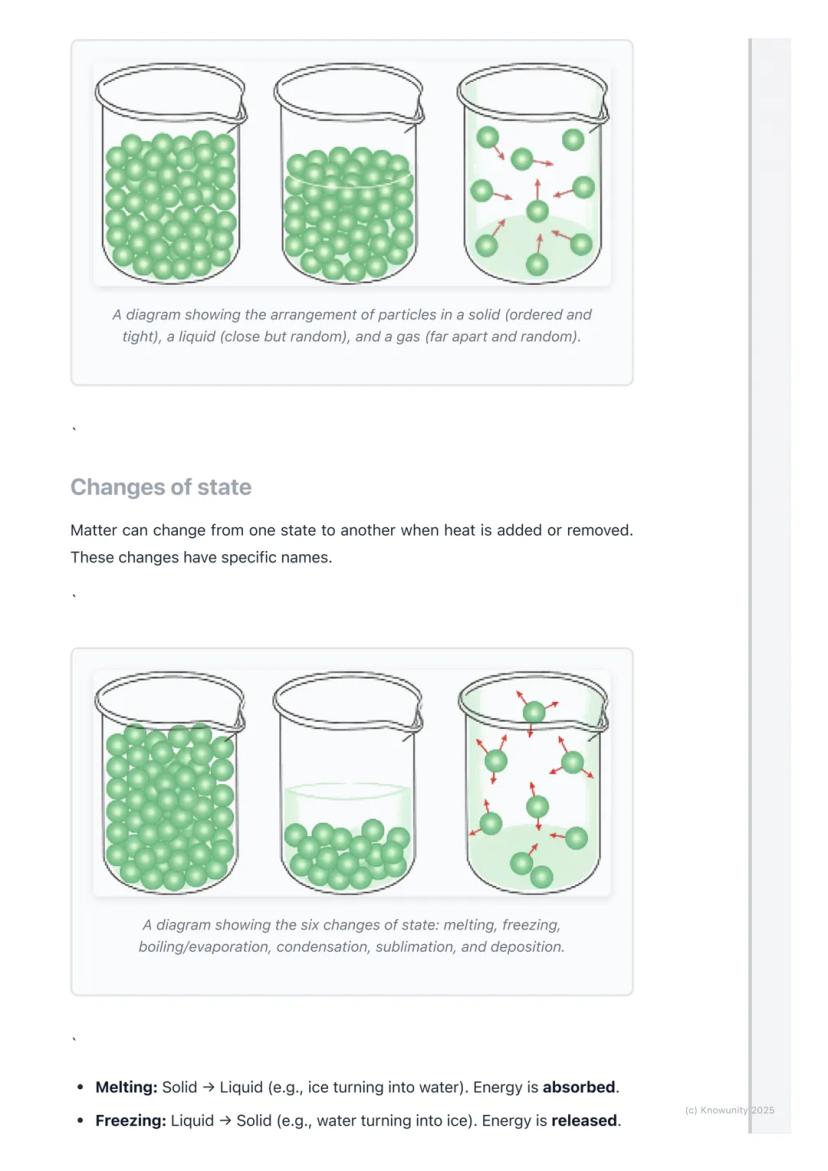
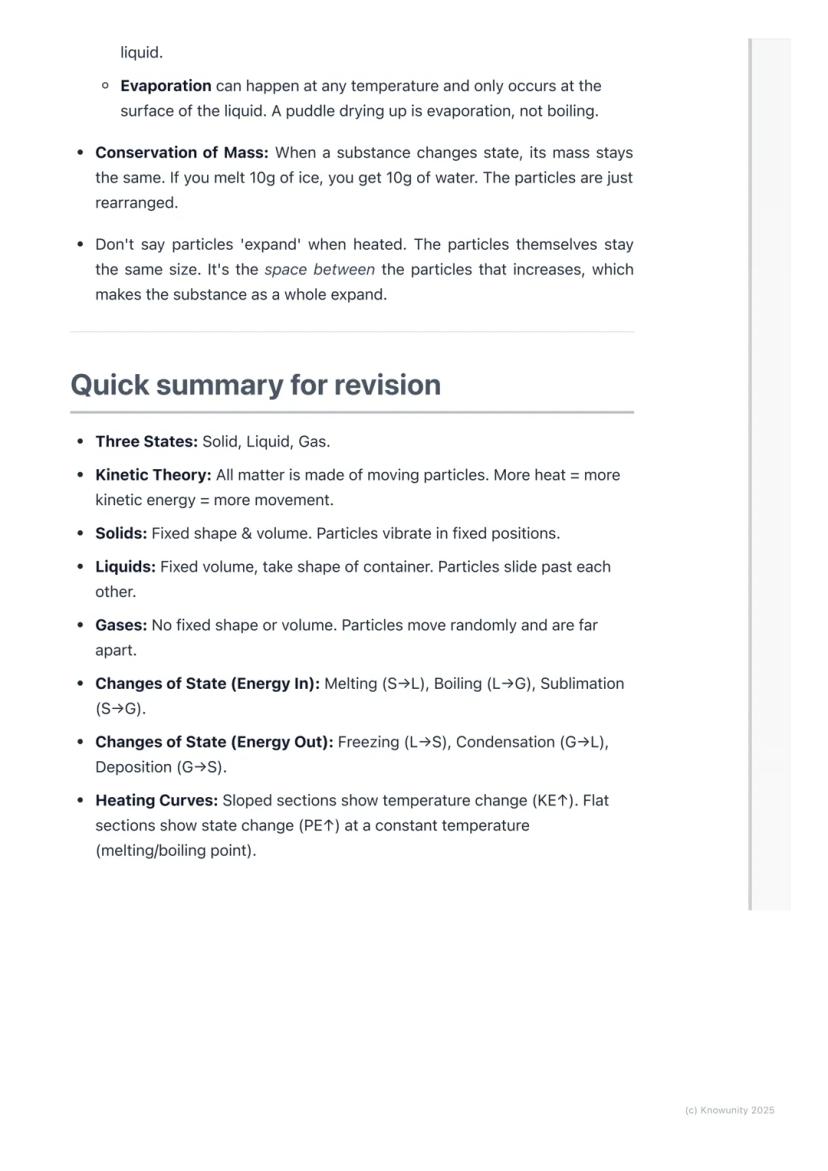
When you add or remove heat from matter, you can make it change from one state to another - these transformations have specific names that you'll need to know. Melting turns solids into liquids (like ice becoming water), whilst freezing does the opposite.
Boiling and evaporation both turn liquids into gases, but they work differently. Boiling happens at a specific temperature throughout the entire liquid, whilst evaporation occurs at any temperature but only at the surface.
Sublimation is the weird one - it's when solids jump straight to gas without becoming liquid first (think dry ice). Deposition reverses this process, like frost forming on your car windscreen on cold mornings.
The key pattern here is that when you add energy, particles move faster and states become less organised (solid → liquid → gas). Remove energy, and everything reverses as particles slow down and get more organised.
Energy Tip: Changes that spread particles out (melting, boiling) absorb energy, whilst changes that bring particles together (freezing, condensing) release energy!
4
of 6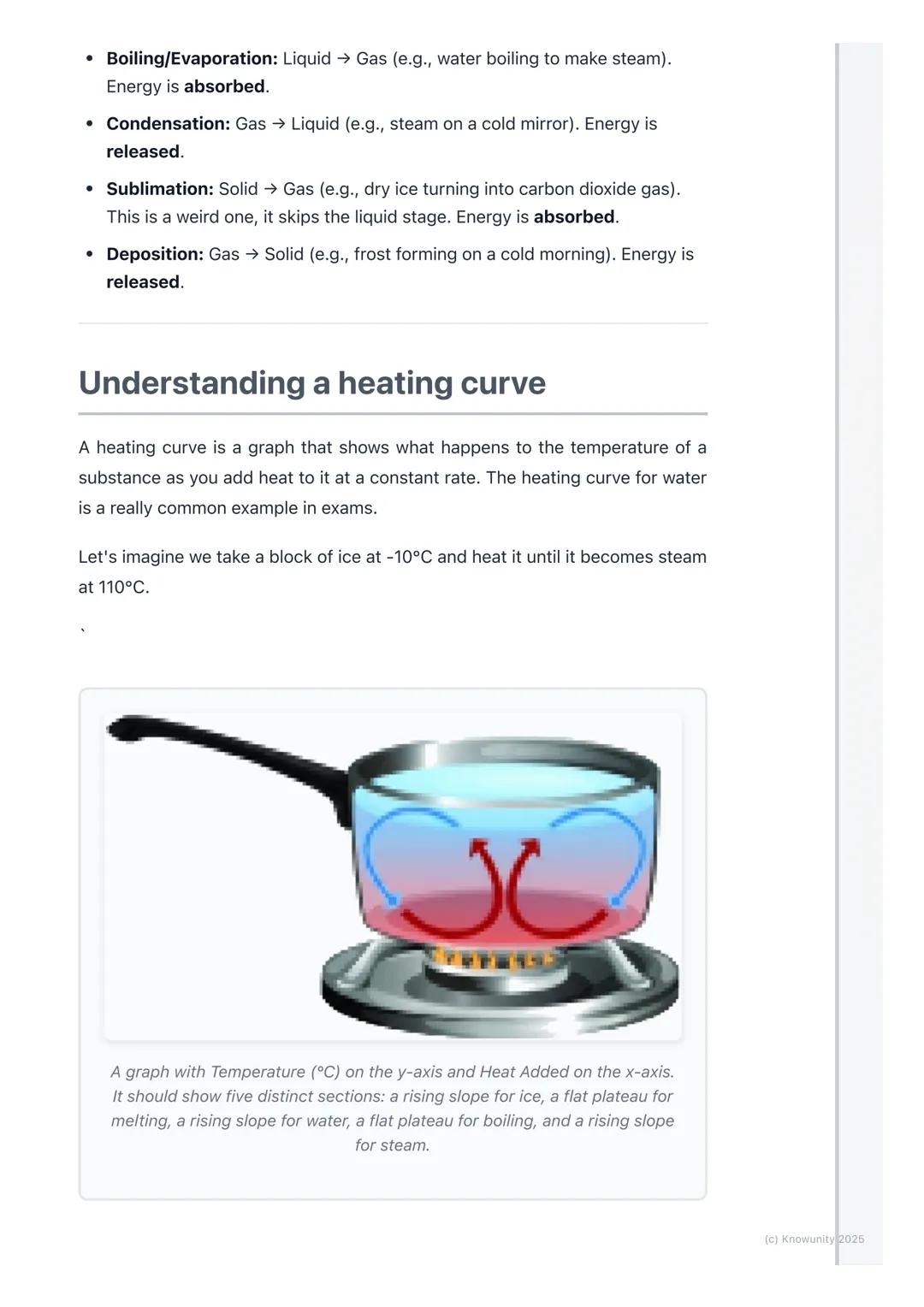
Understanding Heating Curves
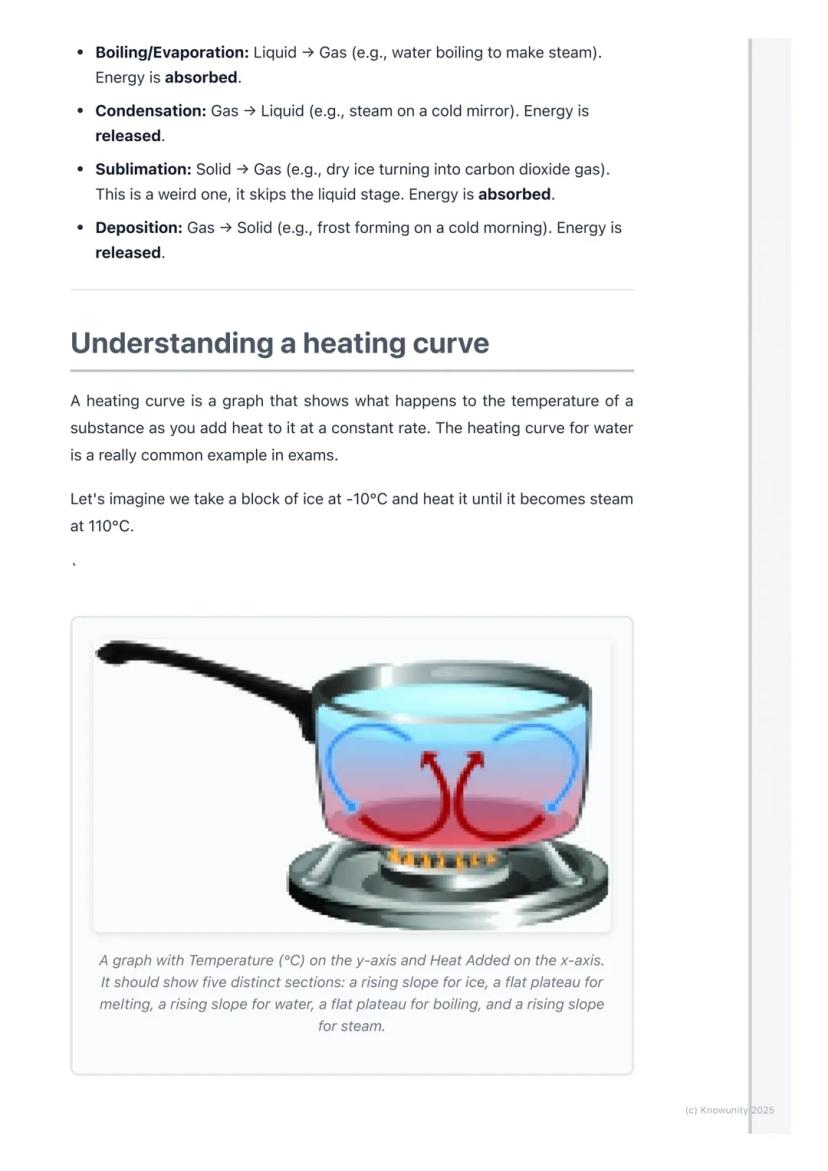
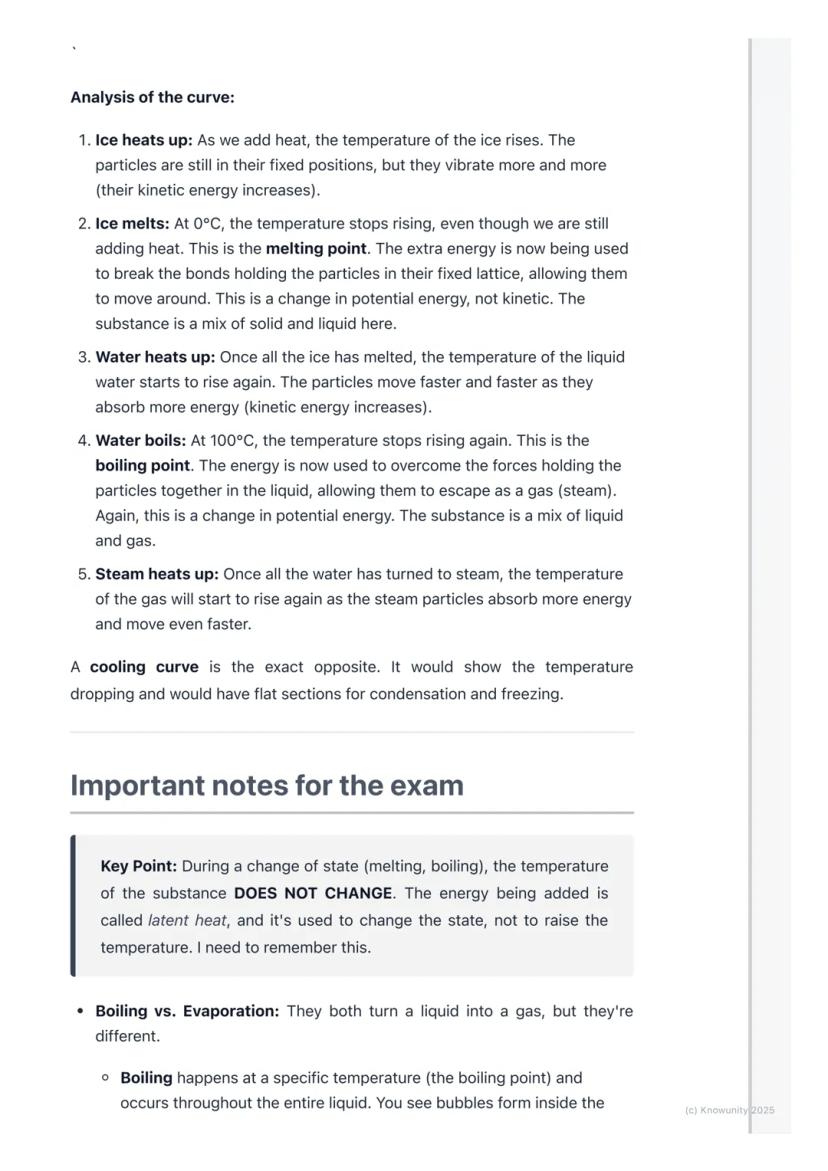
A heating curve shows exactly what happens to temperature when you heat something at a steady rate - and it's not what you might expect! If you heated ice from -10°C to steam at 110°C, the temperature wouldn't rise smoothly.
Instead, you'd see the temperature rise steadily as ice heats up, then suddenly stop climbing at 0°C even though you're still adding heat. This flat section represents melting - all that energy goes into breaking bonds between particles, not making them move faster.
Once melting finishes, temperature rises again as liquid water heats up. Then at 100°C, temperature stops rising again during boiling - energy now breaks the remaining bonds holding liquid particles together, freeing them as gas.
The crucial exam point is that during state changes (those flat sections), temperature stays constant even though you're pumping in energy. This energy, called latent heat, reorganises particles rather than speeding them up.
Exam Alert: Temperature never changes during melting or boiling - this catches loads of students out in tests!
5
of 6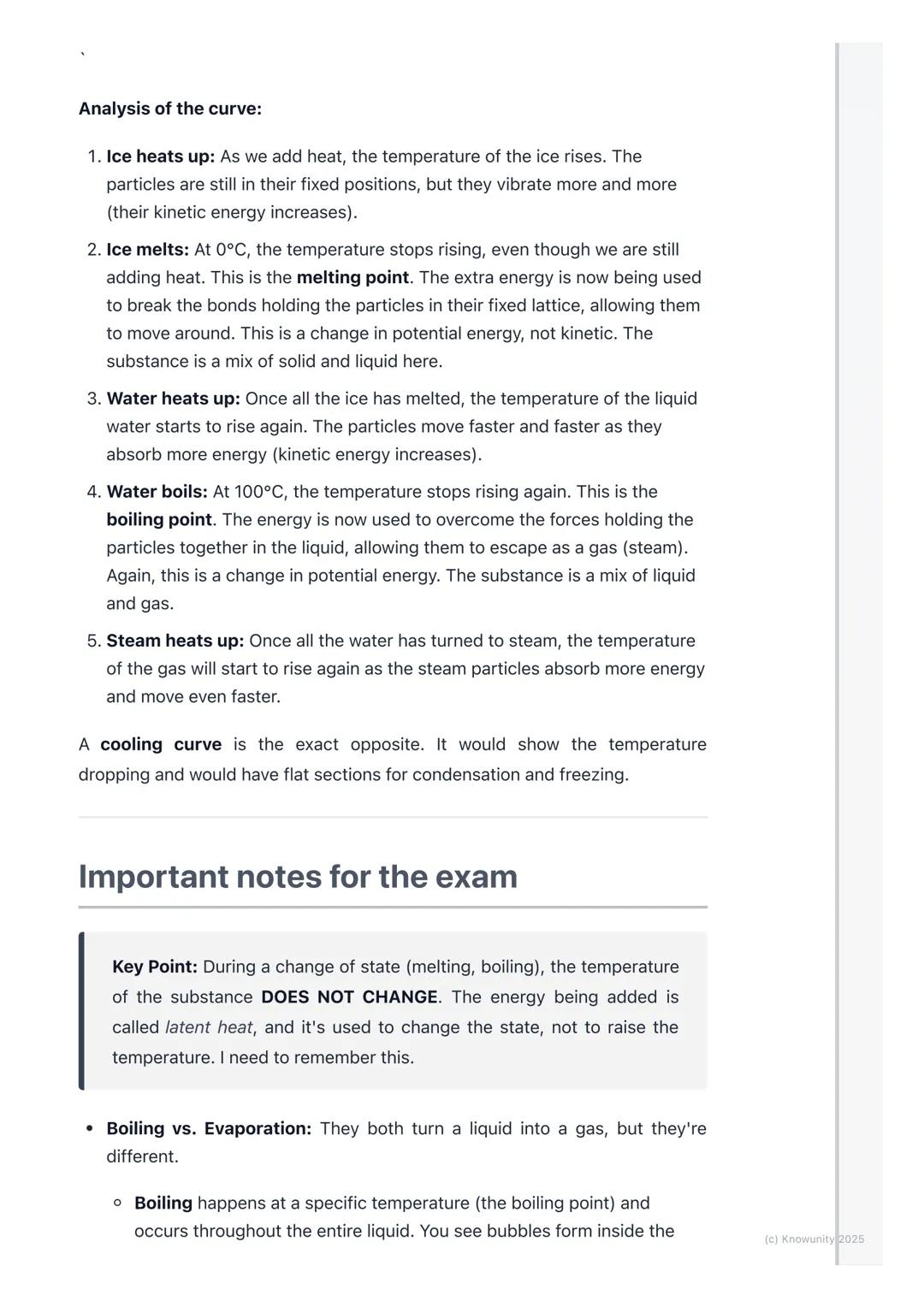
Key Points for Success
During any change of state, the mass stays exactly the same - you're just rearranging particles, not creating or destroying them. If 50g of ice melts, you get exactly 50g of water.
Don't fall into the trap of saying particles themselves expand when heated. The particles stay the same size, but the spaces between them increase, making the overall substance expand.
Evaporation differs from boiling in important ways. Evaporation happens at any temperature and only at surfaces (like puddles drying), whilst boiling occurs at specific temperatures throughout the liquid with bubbles forming inside.
Understanding the kinetic theory helps explain everyday observations. Hot tea cools down because fast-moving hot particles transfer energy to slower-moving cold air particles until everything reaches the same temperature.
Memory Hook: Think "MFBCSD" for the six changes: Melting, Freezing, Boiling, Condensing, Sublimation, Deposition!
6
of 6
Quick Revision Summary
Here's everything you need to remember: solids have fixed shapes and volumes with particles vibrating in place, liquids keep volume but change shape with particles sliding around, and gases fill containers completely with particles moving randomly.
The three key changes that absorb energy are melting (solid→liquid), boiling (liquid→gas), and sublimation (solid→gas). The three that release energy work in reverse: freezing, condensation, and deposition.
Heating curves show sloped sections where temperature rises (particles gaining kinetic energy) and flat sections where state changes occur (particles gaining potential energy) at constant temperature.
Remember that temperature measures particle speed - hotter means faster movement. When particles change state, they're reorganising their arrangements rather than changing speed, which is why temperature stays constant during melting and boiling.
Final Tip: Practice drawing heating curves and labelling the flat sections - they appear in loads of exam questions!
Achamos que você nunca perguntaria...
O que é o assistente de IA da Knowunity?
Nosso companheiro de IA foi criado especificamente para atender às necessidades dos estudantes. Com base nos milhões de conteúdos que temos na plataforma, podemos oferecer respostas realmente relevantes e significativas. Mas não se trata apenas de respostas, o companheiro também está aqui para guiar você pelos desafios diários de aprendizado, com planos de estudo personalizados, quizzes ou conteúdos no chat e 100% de personalização com base nas suas habilidades e desenvolvimentos.
Onde posso baixar o app da Knowunity?
Pode descarregar a aplicação na Google Play Store e na Apple App Store.
Como posso receber meu pagamento? Quanto posso ganhar?
Sim, tem acesso gratuito ao conteúdo da aplicação e ao nosso companheiro de IA. Para desbloquear determinadas funcionalidades da aplicação, pode adquirir o Knowunity Pro.
Conteúdos mais populares de Science
7Conteúdos mais populares
9Não encontrou o que procurava? Explore outras matérias.
Avaliações dos nossos usuários. Eles gostaram de tudo — e você também vai gostar.
4.6/5App Store
4.7/5Google Play
O app é muito fácil de usar e bem projetado. Encontrei tudo o que estava procurando até agora e consegui aprender muito com as apresentações! Definitivamente vou usar o app para uma tarefa de classe! E, claro, também ajuda muito como inspiração.
Stefan Susuário de iOS
Este app é realmente ótimo. Tem muitos materiais de estudo e ajuda [...]. Minha matéria problemática é o francês, por exemplo, e o app tem tantas opções de ajuda. Graças a este app, eu melhorei meu francês. Eu recomendaria para qualquer pessoa.
Samantha Klichusuária de Android
Uau, estou realmente impressionado. Eu experimentei o app porque vi muitos anúncios e fiquei absolutamente maravilhado. Este app é A AJUDA que você quer para a escola e, acima de tudo, oferece muitas coisas, como treinos e resumos, que têm sido MUITO úteis para mim pessoalmente.
Annausuária de iOS
Science5 visualizações·Atualizado Jun 7, 2026·6 páginasExploring the Different States of Matter
Ever wondered why ice melts or why steam forms when you boil water? It's all about the tiny particles that make up everything around us and how they behave when heated or cooled. Understanding states of matter will help you... Mostrar mais
1
of 6Cadastre-se para ver o conteúdo. É grátis!
- Acesso a todos os documentos
- Melhore suas notas
- Junte-se a milhões de estudantes
An Introduction to States of Matter
Everything you see, touch, and breathe is made of matter - basically the "stuff" that makes up our world. This matter consists of incredibly tiny particles like atoms and molecules that are constantly jiggling about, even when things look perfectly still.
The way these particles move and arrange themselves determines whether something is a solid, liquid, or gas. When you understand this simple concept, loads of things suddenly make sense - like why your ice lolly melts on a hot day or why you can smell dinner cooking from upstairs.
The Kinetic Theory of Matter explains it all with three key ideas: all matter contains moving particles, these particles never stop moving randomly, and the hotter something gets, the faster its particles move. Think of it like a massive invisible dance party happening inside everything!
Quick Tip: Remember that temperature is just a measure of how fast particles are moving - hotter means faster particle movement!
2
of 6Cadastre-se para ver o conteúdo. É grátis!
- Acesso a todos os documentos
- Melhore suas notas
- Junte-se a milhões de estudantes
Comparing the Three States
The main difference between solids, liquids, and gases lies in how their particles are arranged and how much freedom they have to move around. In solids, particles are packed tightly in neat, organised rows and can only vibrate in place - like people sitting in assigned cinema seats.
Liquid particles are still close together but can slide past each other, similar to people standing in a crowded room who can shuffle about. Gas particles have loads of space between them and zoom around randomly at high speeds, like people running freely in a massive field.
Solids keep their shape and volume because particles are locked in position. Liquids keep their volume but take the shape of their container since particles can move around each other. Gases expand to fill any container completely because their particles spread out everywhere.
This explains why you can't squash a rock (solid), why water takes the shape of its glass (liquid), and why perfume smell spreads across a room (gas particles moving freely).
Remember: The amount of kinetic energy (movement energy) increases from solid to liquid to gas!
3
of 6Cadastre-se para ver o conteúdo. É grátis!
- Acesso a todos os documentos
- Melhore suas notas
- Junte-se a milhões de estudantes
Changes of State
When you add or remove heat from matter, you can make it change from one state to another - these transformations have specific names that you'll need to know. Melting turns solids into liquids (like ice becoming water), whilst freezing does the opposite.
Boiling and evaporation both turn liquids into gases, but they work differently. Boiling happens at a specific temperature throughout the entire liquid, whilst evaporation occurs at any temperature but only at the surface.
Sublimation is the weird one - it's when solids jump straight to gas without becoming liquid first (think dry ice). Deposition reverses this process, like frost forming on your car windscreen on cold mornings.
The key pattern here is that when you add energy, particles move faster and states become less organised (solid → liquid → gas). Remove energy, and everything reverses as particles slow down and get more organised.
Energy Tip: Changes that spread particles out (melting, boiling) absorb energy, whilst changes that bring particles together (freezing, condensing) release energy!
4
of 6Cadastre-se para ver o conteúdo. É grátis!
- Acesso a todos os documentos
- Melhore suas notas
- Junte-se a milhões de estudantes
Understanding Heating Curves
A heating curve shows exactly what happens to temperature when you heat something at a steady rate - and it's not what you might expect! If you heated ice from -10°C to steam at 110°C, the temperature wouldn't rise smoothly.
Instead, you'd see the temperature rise steadily as ice heats up, then suddenly stop climbing at 0°C even though you're still adding heat. This flat section represents melting - all that energy goes into breaking bonds between particles, not making them move faster.
Once melting finishes, temperature rises again as liquid water heats up. Then at 100°C, temperature stops rising again during boiling - energy now breaks the remaining bonds holding liquid particles together, freeing them as gas.
The crucial exam point is that during state changes (those flat sections), temperature stays constant even though you're pumping in energy. This energy, called latent heat, reorganises particles rather than speeding them up.
Exam Alert: Temperature never changes during melting or boiling - this catches loads of students out in tests!
5
of 6Cadastre-se para ver o conteúdo. É grátis!
- Acesso a todos os documentos
- Melhore suas notas
- Junte-se a milhões de estudantes
Key Points for Success
During any change of state, the mass stays exactly the same - you're just rearranging particles, not creating or destroying them. If 50g of ice melts, you get exactly 50g of water.
Don't fall into the trap of saying particles themselves expand when heated. The particles stay the same size, but the spaces between them increase, making the overall substance expand.
Evaporation differs from boiling in important ways. Evaporation happens at any temperature and only at surfaces (like puddles drying), whilst boiling occurs at specific temperatures throughout the liquid with bubbles forming inside.
Understanding the kinetic theory helps explain everyday observations. Hot tea cools down because fast-moving hot particles transfer energy to slower-moving cold air particles until everything reaches the same temperature.
Memory Hook: Think "MFBCSD" for the six changes: Melting, Freezing, Boiling, Condensing, Sublimation, Deposition!
6
of 6Cadastre-se para ver o conteúdo. É grátis!
- Acesso a todos os documentos
- Melhore suas notas
- Junte-se a milhões de estudantes
Quick Revision Summary
Here's everything you need to remember: solids have fixed shapes and volumes with particles vibrating in place, liquids keep volume but change shape with particles sliding around, and gases fill containers completely with particles moving randomly.
The three key changes that absorb energy are melting (solid→liquid), boiling (liquid→gas), and sublimation (solid→gas). The three that release energy work in reverse: freezing, condensation, and deposition.
Heating curves show sloped sections where temperature rises (particles gaining kinetic energy) and flat sections where state changes occur (particles gaining potential energy) at constant temperature.
Remember that temperature measures particle speed - hotter means faster movement. When particles change state, they're reorganising their arrangements rather than changing speed, which is why temperature stays constant during melting and boiling.
Final Tip: Practice drawing heating curves and labelling the flat sections - they appear in loads of exam questions!
Achamos que você nunca perguntaria...
O que é o assistente de IA da Knowunity?
Nosso companheiro de IA foi criado especificamente para atender às necessidades dos estudantes. Com base nos milhões de conteúdos que temos na plataforma, podemos oferecer respostas realmente relevantes e significativas. Mas não se trata apenas de respostas, o companheiro também está aqui para guiar você pelos desafios diários de aprendizado, com planos de estudo personalizados, quizzes ou conteúdos no chat e 100% de personalização com base nas suas habilidades e desenvolvimentos.
Onde posso baixar o app da Knowunity?
Pode descarregar a aplicação na Google Play Store e na Apple App Store.
Como posso receber meu pagamento? Quanto posso ganhar?
Sim, tem acesso gratuito ao conteúdo da aplicação e ao nosso companheiro de IA. Para desbloquear determinadas funcionalidades da aplicação, pode adquirir o Knowunity Pro.
Conteúdos mais populares de Science
7Conteúdos mais populares
9Não encontrou o que procurava? Explore outras matérias.
Avaliações dos nossos usuários. Eles gostaram de tudo — e você também vai gostar.
4.6/5App Store
4.7/5Google Play
O app é muito fácil de usar e bem projetado. Encontrei tudo o que estava procurando até agora e consegui aprender muito com as apresentações! Definitivamente vou usar o app para uma tarefa de classe! E, claro, também ajuda muito como inspiração.
Stefan Susuário de iOS
Este app é realmente ótimo. Tem muitos materiais de estudo e ajuda [...]. Minha matéria problemática é o francês, por exemplo, e o app tem tantas opções de ajuda. Graças a este app, eu melhorei meu francês. Eu recomendaria para qualquer pessoa.
Samantha Klichusuária de Android
Uau, estou realmente impressionado. Eu experimentei o app porque vi muitos anúncios e fiquei absolutamente maravilhado. Este app é A AJUDA que você quer para a escola e, acima de tudo, oferece muitas coisas, como treinos e resumos, que têm sido MUITO úteis para mim pessoalmente.
Annausuária de iOS