
Ever wondered why everyone around the world agrees on what...
 Mathematics7 visualizações·Atualizado Jun 11, 2026·5 páginas
Understanding Metric Units of Measurement
1 / 5
1
of 5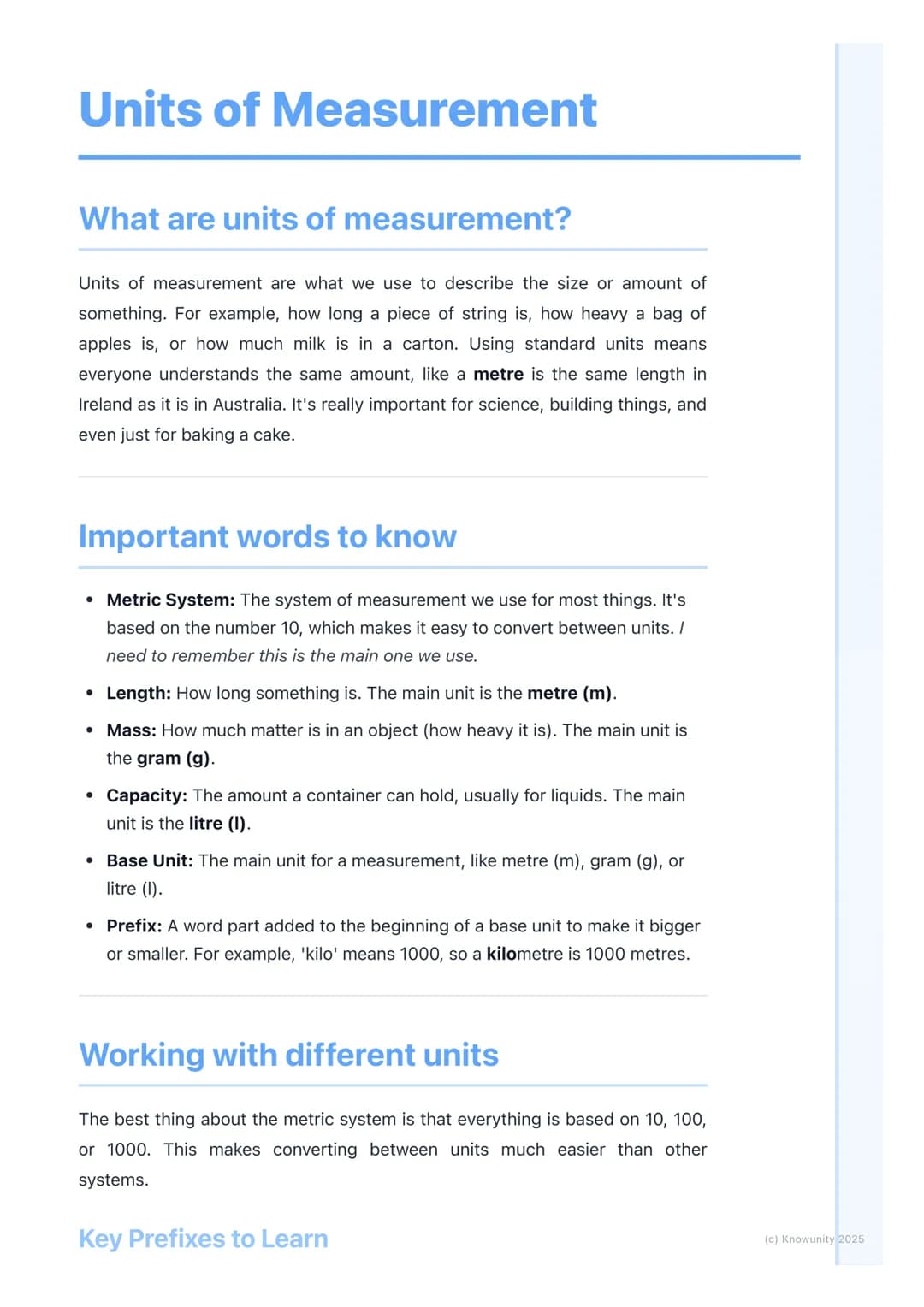
What Are Units of Measurement?
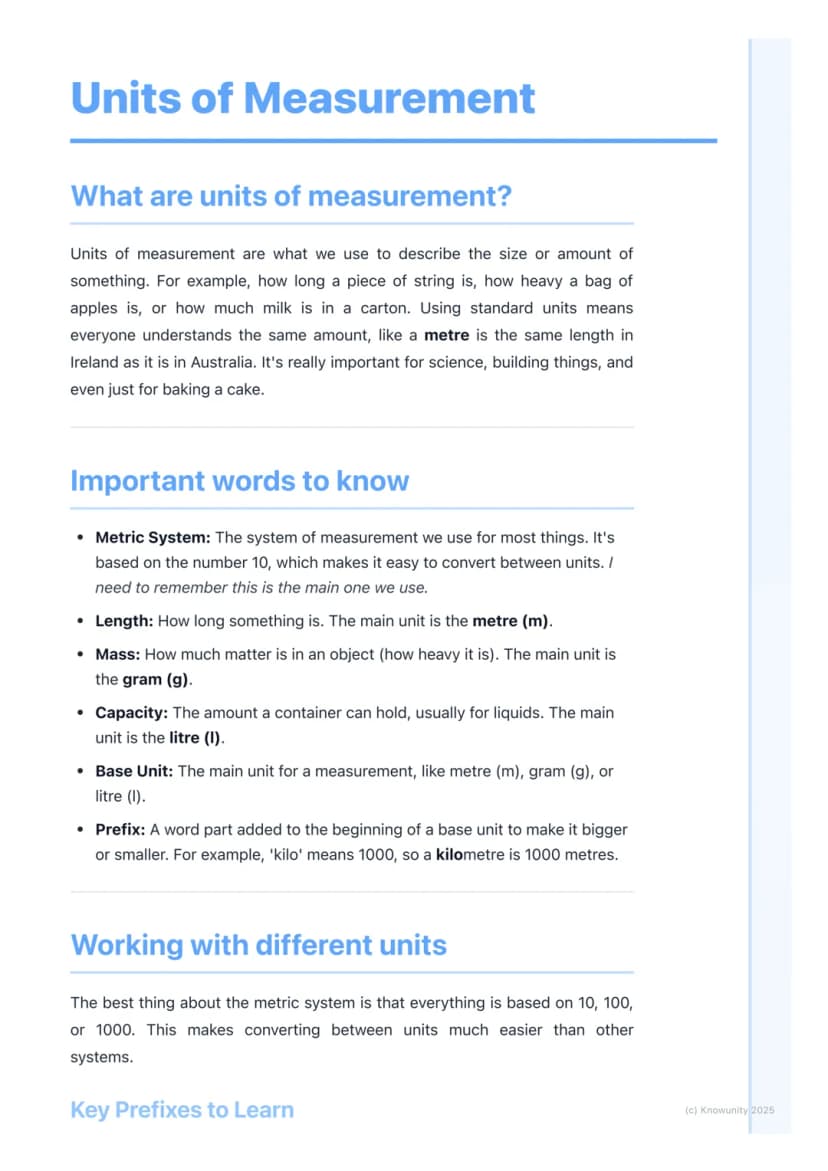
Think about ordering a pizza or buying fabric for a project - without units of measurement, you'd have no clue what size you're getting! These standard measures help everyone understand exactly the same amount, whether you're in Cork or California.
The metric system is your best mate here because it's based on multiples of 10, making conversions dead simple. You'll work with three main types: length (how long something is), mass (how heavy it is), and capacity (how much liquid fits in a container).
Base units are your starting points - metres for length, grams for mass, and litres for capacity. Then you add prefixes like 'kilo-' or 'milli-' to make them bigger or smaller. It's like adding ingredients to change a recipe!
Quick Tip: The metric system's base-10 structure means you're just moving decimal points around - no complicated fractions to worry about!
2
of 5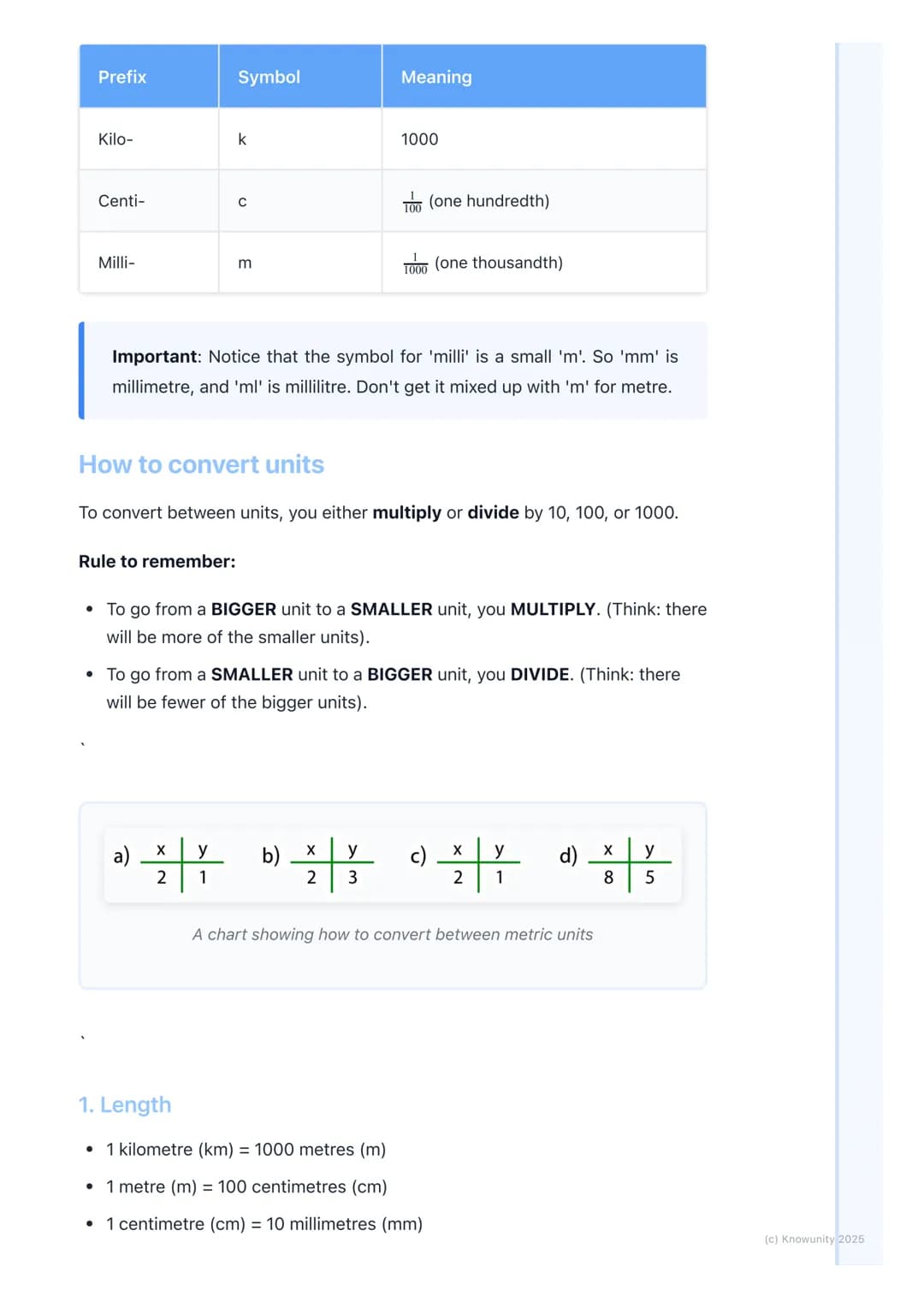
Key Prefixes and Conversion Rules
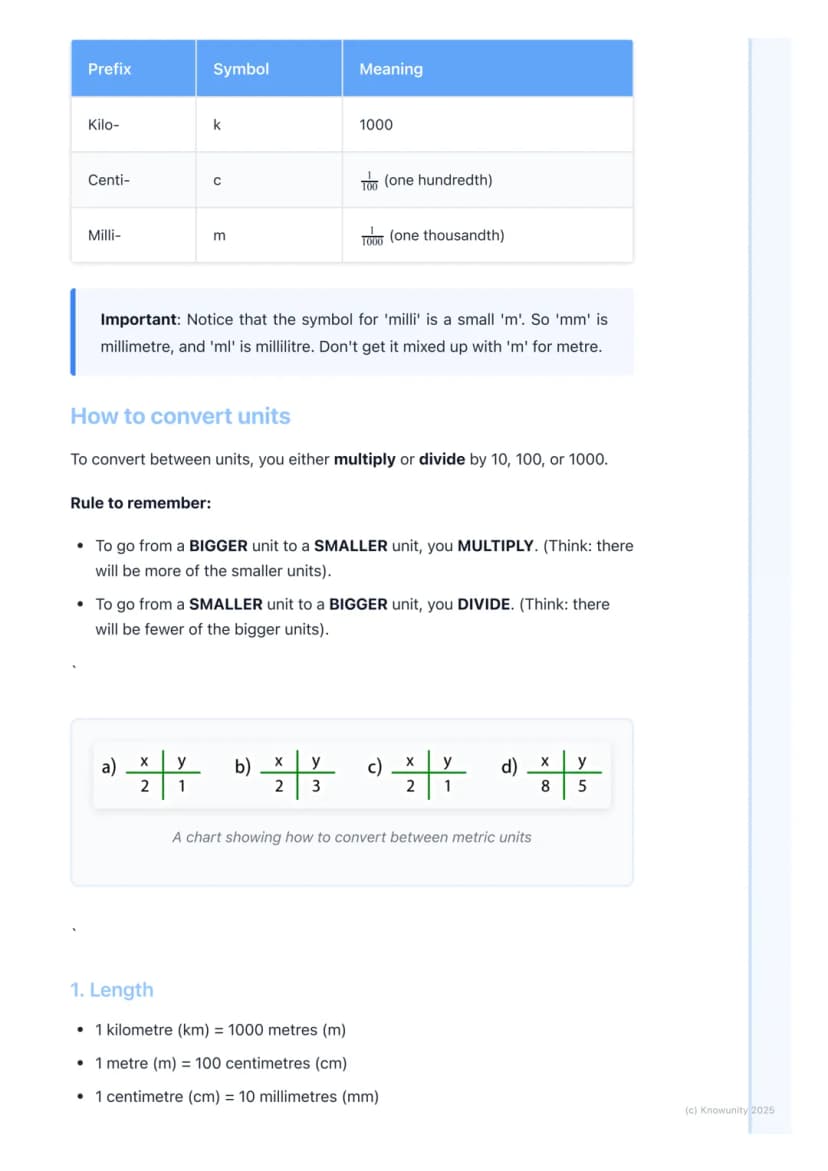
Only three prefixes matter for now: kilo- (1000 times bigger), centi- (100 times smaller), and milli- (1000 times smaller). That's it - you're already most of the way there!
Here's the golden rule that'll save you every time: going from bigger to smaller units means multiply (you'll get more of them), and smaller to bigger means divide (you'll get fewer of them). Picture breaking a chocolate bar into pieces versus combining pieces back together.
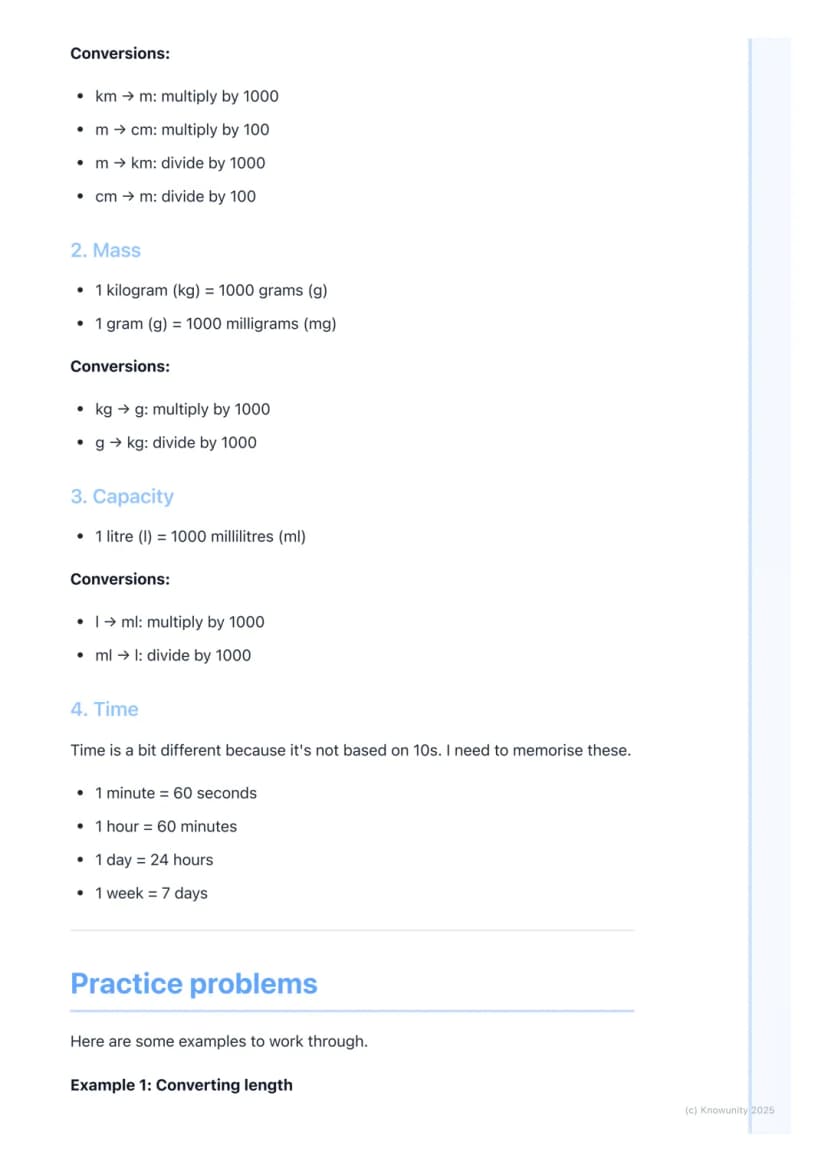
Length conversions follow this pattern: 1 kilometre = 1000 metres, 1 metre = 100 centimetres, 1 centimetre = 10 millimetres. For mass: 1 kilogram = 1000 grams. For capacity: 1 litre = 1000 millilitres.
Time breaks the pattern because it's older than the metric system - 60 seconds in a minute, 60 minutes in an hour, 24 hours in a day. You'll just need to memorise these awkward ones!
Watch Out: Don't mix up 'm' for metres with 'ml' for millilitres - they look similar but measure completely different things!
3
of 5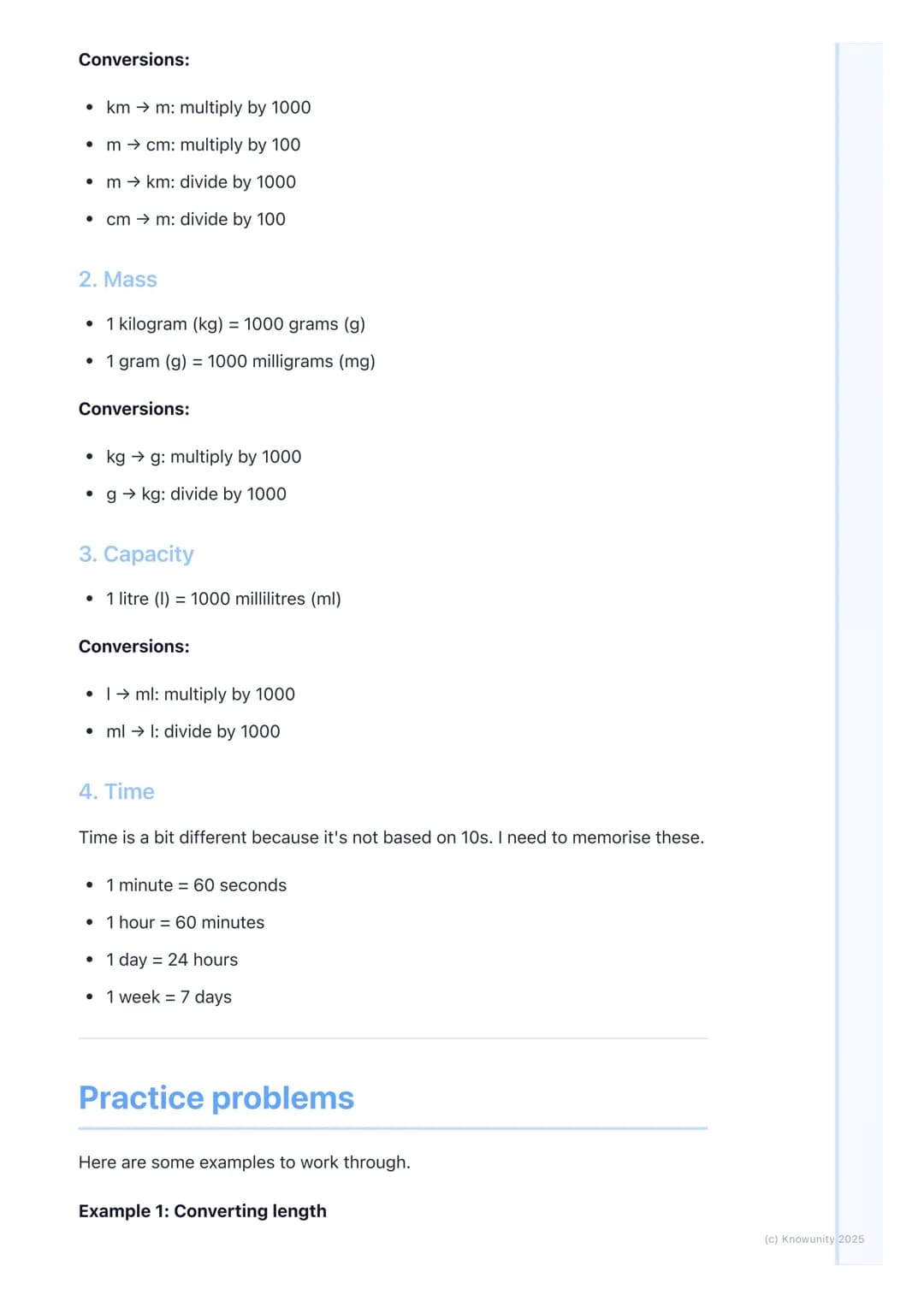
Converting Units Like a Pro
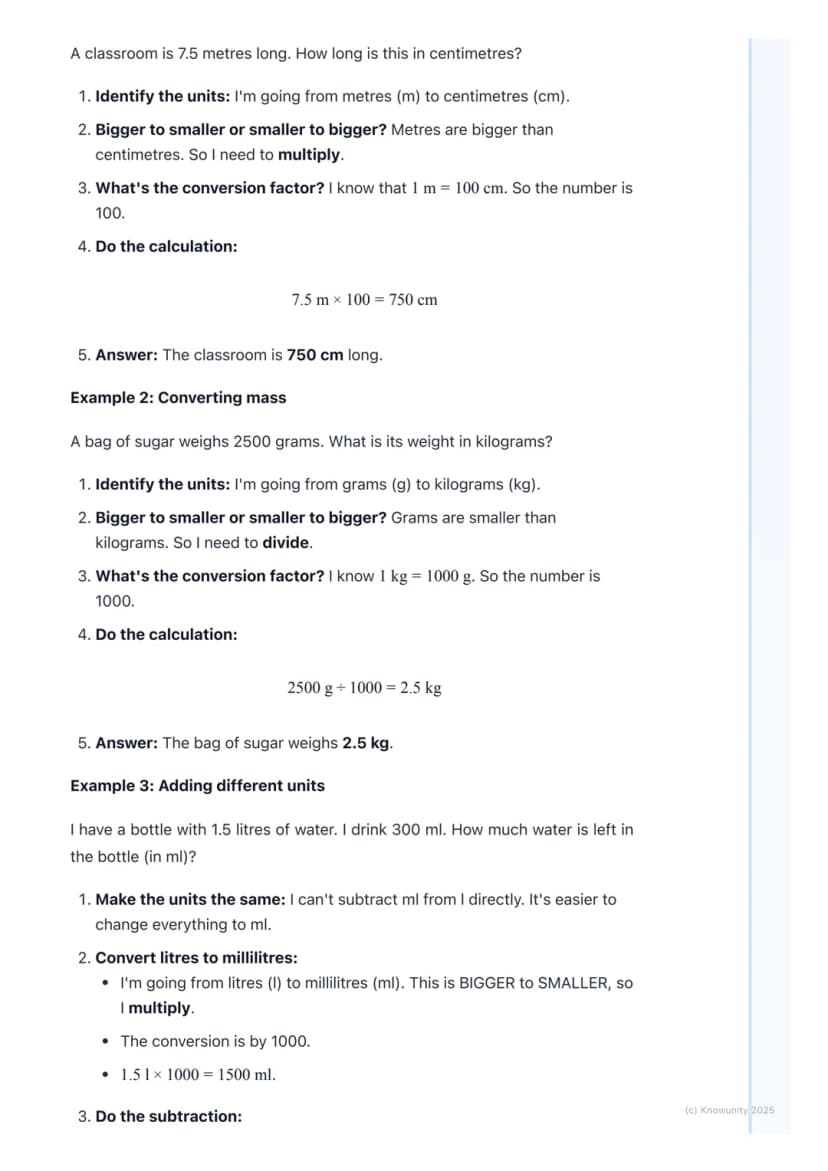
Let's walk through converting 7.5 metres to centimetres. First, identify what you're converting from and to. Metres are bigger than centimetres, so you multiply. Since 1 metre = 100 centimetres, you calculate: 7.5 × 100 = 750 centimetres.
Now try the reverse with 2500 grams to kilograms. Grams are smaller than kilograms, so divide. Since 1 kilogram = 1000 grams: 2500 ÷ 1000 = 2.5 kilograms. See the pattern?
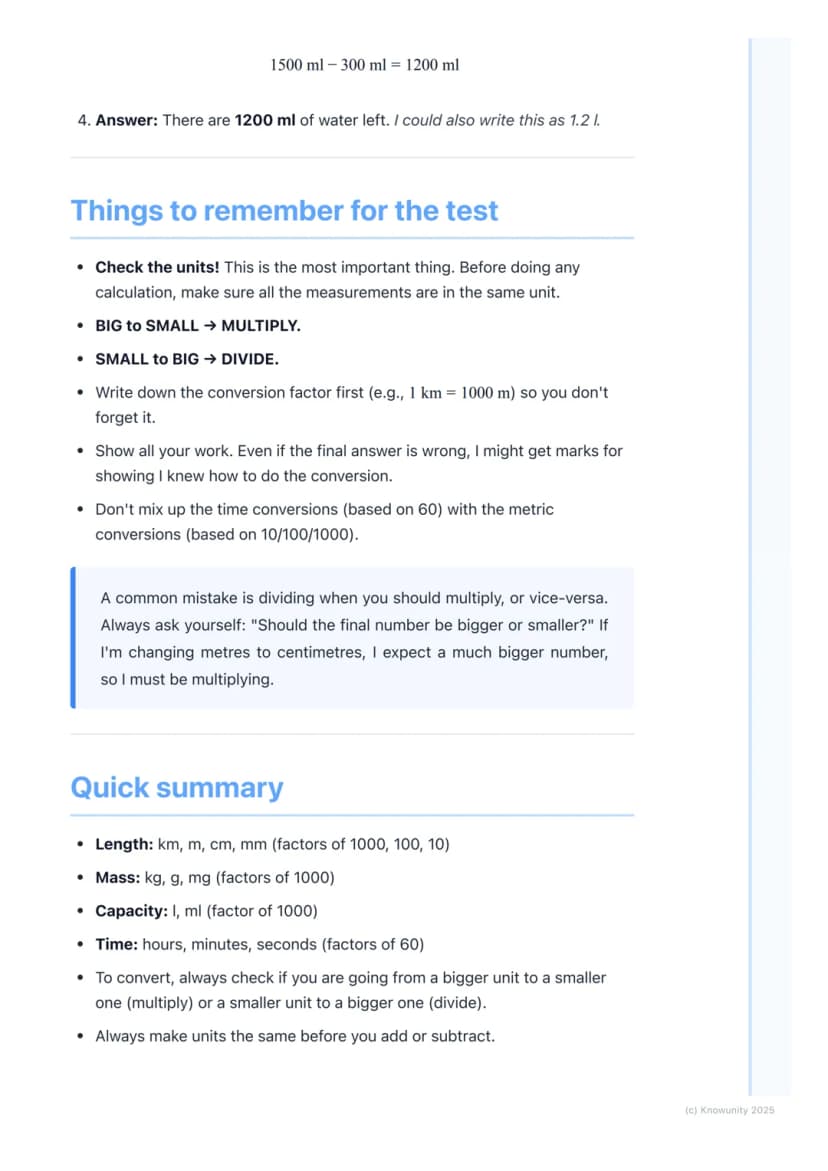
When adding or subtracting different units, convert everything to the same unit first. If you have 1.5 litres and drink 300 millilitres, change the litres to millilitres , then subtract: 1500 - 300 = 1200 ml left.
Pro Strategy: Always ask yourself "Should my answer be bigger or smaller?" If you're converting metres to millimetres, expect a much larger number!
4
of 5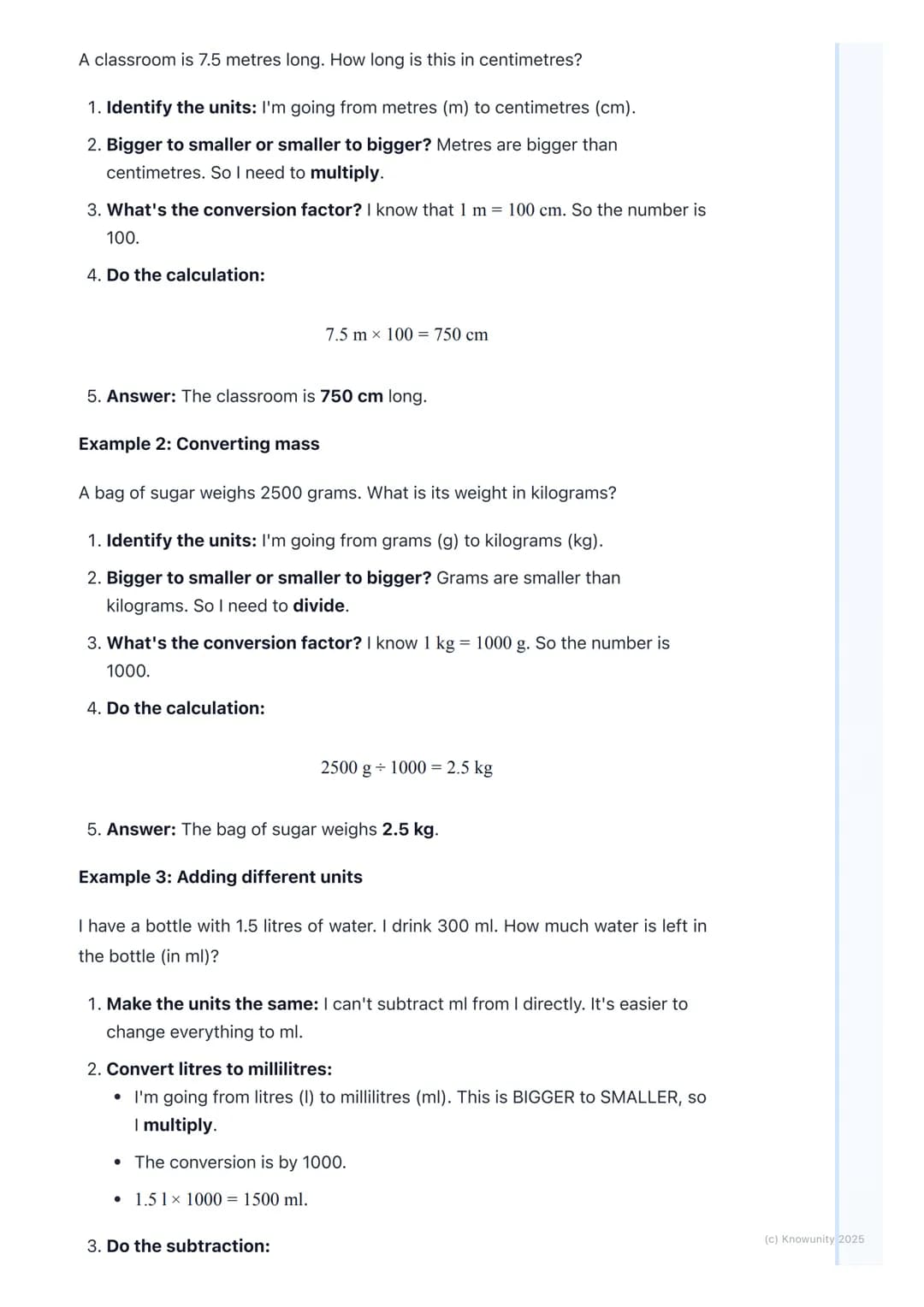
Test Success Tips
The biggest mistake students make isn't wrong calculations - it's mixing up when to multiply or divide. Write down "BIG to SMALL = MULTIPLY" and "SMALL to BIG = DIVIDE" at the top of your test paper.
Always check your units before starting any problem. If you're adding metres and centimetres, convert them to the same unit first. Show your conversion factor so you don't forget it mid-calculation.
Remember that time conversions use 60 and 24, not the metric system's 10, 100, and 1000. Don't let this trip you up when switching between different types of measurements in the same problem.
Show all your working - even if your final answer is wrong, you can still get marks for using the right method. Plus, writing out each step helps you catch mistakes before they happen.
Reality Check: Before writing your final answer, ask yourself if it makes sense. Does 5 metres really equal 50 centimetres? (Hint: it doesn't!)
5
of 5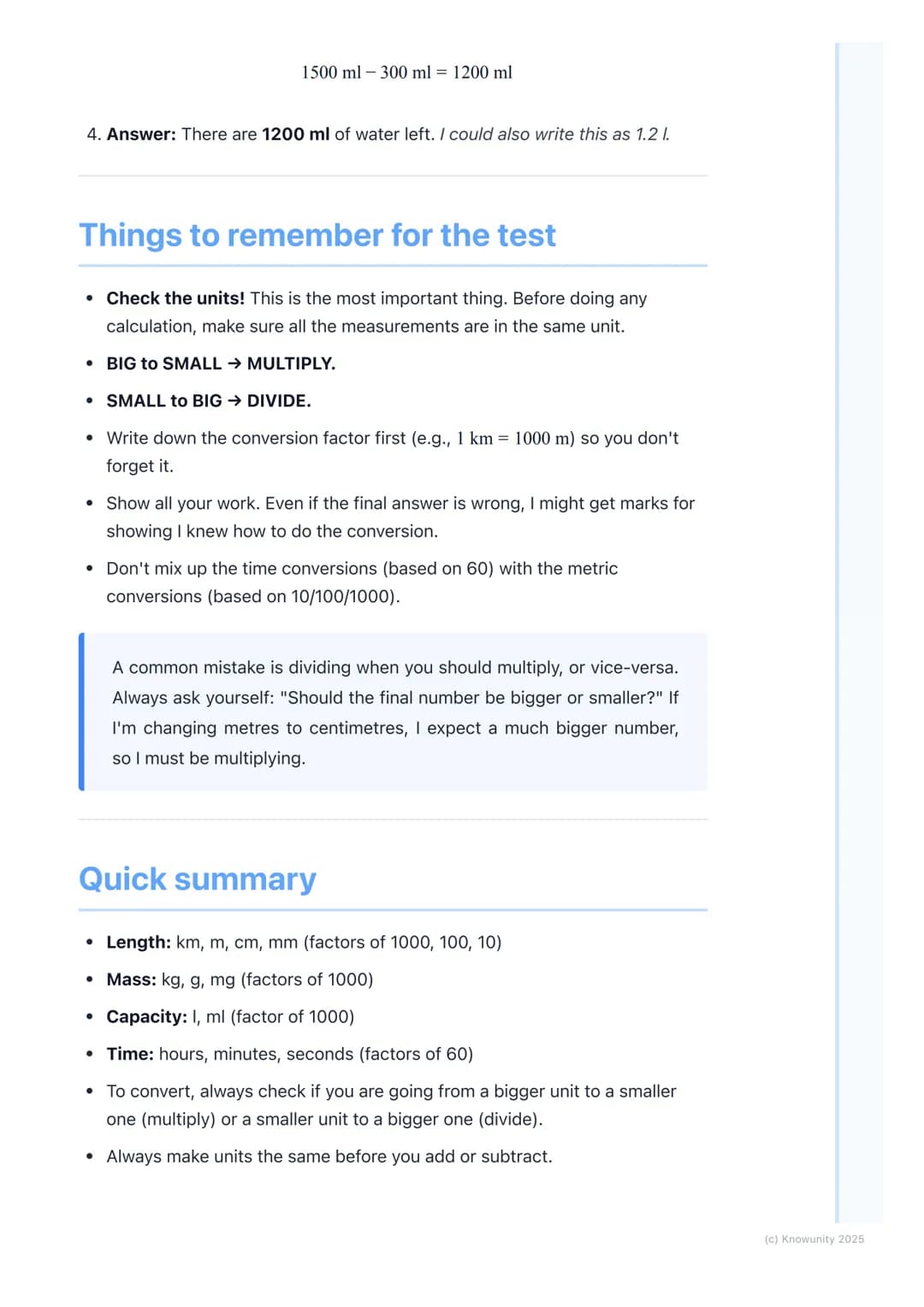
Quick Reference Summary
Your measurement toolkit includes length (km, m, cm, mm), mass (kg, g, mg), capacity (l, ml), and time (hours, minutes, seconds). Most follow the metric pattern of 1000, 100, or 10 - except time, which does its own thing.
Converting units becomes automatic once you remember the multiply for bigger-to-smaller, divide for smaller-to-bigger rule. Write your conversion factors clearly and double-check whether your answer should be larger or smaller than what you started with.
Before adding or subtracting measurements, make sure everything's in the same units. It's like trying to add apples and oranges - convert them to the same 'fruit' first!
Practice these conversions until they feel natural, because you'll use them constantly in science, cooking, sports, and loads of other real-life situations.
Final Wisdom: Units of measurement aren't just school stuff - they're life skills that help you navigate everything from recipe adjustments to understanding sports statistics!
Achamos que você nunca perguntaria...
O que é o assistente de IA da Knowunity?
Nosso companheiro de IA foi criado especificamente para atender às necessidades dos estudantes. Com base nos milhões de conteúdos que temos na plataforma, podemos oferecer respostas realmente relevantes e significativas. Mas não se trata apenas de respostas, o companheiro também está aqui para guiar você pelos desafios diários de aprendizado, com planos de estudo personalizados, quizzes ou conteúdos no chat e 100% de personalização com base nas suas habilidades e desenvolvimentos.
Onde posso baixar o app da Knowunity?
Pode descarregar a aplicação na Google Play Store e na Apple App Store.
Como posso receber meu pagamento? Quanto posso ganhar?
Sim, tem acesso gratuito ao conteúdo da aplicação e ao nosso companheiro de IA. Para desbloquear determinadas funcionalidades da aplicação, pode adquirir o Knowunity Pro.
Conteúdos mais populares de Mathematics
8MathematicsAlgebra
Algebra
5th Year91
MathematicsAlgebra 2
Algebra notes focusing on the factor theorem, completing the square, -b formula, graphs of polynomials
5th Year130
MathematicsSolving Equations
This section focuses on solving one-step and two-step linear equations to find the value of an unknown variable.
1st Year131
MathematicsArithmetic sequences and series
With examples
5th Year130
MathematicsIntroduction to Probability
This topic introduces basic probability concepts, including calculating the probability of simple events and understanding the difference between experimental and theoretical probability.
2nd Year91
MathematicsMaths jc algebra
Maths jc
1st Year230
MathematicsNatural Numbers and Integers
Students will learn about positive whole numbers, zero, and negative whole numbers, and how to add, subtract, multiply, and divide them correctly.
1st Year131
MathematicsDifferential Calculus
Calculus is a topic that comes up nearly everywhere on your maths LC. This is just starter notes that could be useful end of 5th year or start of 6th year
5th Year271
Conteúdos mais populares
9 Irish
IrishIrish oral questions and answers
Questions and answers for the leaving cert oral
5th Year4264
 English
Key Quotes : Sive
Key Quotes and explanations: Sive
6th Year2842
IrishIrish oral questions
Outline of oral questions
5th Year2055
IrishIníon- le hÁine Durkin
Aine Durkin’s poem, Iníon: Themes & summary
5th Year890
IrishIrish poetry 2027
Iníon + Dínit an Bhróin
5th Year1153
IrishLC HL notes- Iníon (poem)
Includes poem in English and Irish, theme, key words & phrases
5th Year2304
EnglishCultural Context : Shawshank Redemption : Sive : Small Things Like These
Comparative Study : Cultural Context : Shawshank Redemption, Sive and Small Things Like These
6th Year1430
IrishMo Ghrá-sa (Idir Lúibíní)
Notes on mo ghrá-sa
5th Year380
IrishAn Gaeilge Aiste
Irish Language essay
6th Year1320
Não encontrou o que procurava? Explore outras matérias.
Avaliações dos nossos usuários. Eles gostaram de tudo — e você também vai gostar.
4.6/5App Store
4.7/5Google Play
O app é muito fácil de usar e bem projetado. Encontrei tudo o que estava procurando até agora e consegui aprender muito com as apresentações! Definitivamente vou usar o app para uma tarefa de classe! E, claro, também ajuda muito como inspiração.
Stefan Susuário de iOS
Este app é realmente ótimo. Tem muitos materiais de estudo e ajuda [...]. Minha matéria problemática é o francês, por exemplo, e o app tem tantas opções de ajuda. Graças a este app, eu melhorei meu francês. Eu recomendaria para qualquer pessoa.
Samantha Klichusuária de Android
Uau, estou realmente impressionado. Eu experimentei o app porque vi muitos anúncios e fiquei absolutamente maravilhado. Este app é A AJUDA que você quer para a escola e, acima de tudo, oferece muitas coisas, como treinos e resumos, que têm sido MUITO úteis para mim pessoalmente.
Annausuária de iOS
Mathematics7 visualizações·Atualizado Jun 11, 2026·5 páginasUnderstanding Metric Units of Measurement
Ever wondered why everyone around the world agrees on what a metre actually is? Units of measurement are the universal language we use to describe how long, heavy, or full something is - and mastering them will make your maths...
1
of 5
Cadastre-se para ver o conteúdo. É grátis!
- Acesso a todos os documentos
- Melhore suas notas
- Junte-se a milhões de estudantes
What Are Units of Measurement?
Think about ordering a pizza or buying fabric for a project - without units of measurement, you'd have no clue what size you're getting! These standard measures help everyone understand exactly the same amount, whether you're in Cork or California.
The metric system is your best mate here because it's based on multiples of 10, making conversions dead simple. You'll work with three main types: length (how long something is), mass (how heavy it is), and capacity (how much liquid fits in a container).
Base units are your starting points - metres for length, grams for mass, and litres for capacity. Then you add prefixes like 'kilo-' or 'milli-' to make them bigger or smaller. It's like adding ingredients to change a recipe!
Quick Tip: The metric system's base-10 structure means you're just moving decimal points around - no complicated fractions to worry about!
2
of 5Cadastre-se para ver o conteúdo. É grátis!
- Acesso a todos os documentos
- Melhore suas notas
- Junte-se a milhões de estudantes
Key Prefixes and Conversion Rules
Only three prefixes matter for now: kilo- (1000 times bigger), centi- (100 times smaller), and milli- (1000 times smaller). That's it - you're already most of the way there!
Here's the golden rule that'll save you every time: going from bigger to smaller units means multiply (you'll get more of them), and smaller to bigger means divide (you'll get fewer of them). Picture breaking a chocolate bar into pieces versus combining pieces back together.
Length conversions follow this pattern: 1 kilometre = 1000 metres, 1 metre = 100 centimetres, 1 centimetre = 10 millimetres. For mass: 1 kilogram = 1000 grams. For capacity: 1 litre = 1000 millilitres.
Time breaks the pattern because it's older than the metric system - 60 seconds in a minute, 60 minutes in an hour, 24 hours in a day. You'll just need to memorise these awkward ones!
Watch Out: Don't mix up 'm' for metres with 'ml' for millilitres - they look similar but measure completely different things!
3
of 5Cadastre-se para ver o conteúdo. É grátis!
- Acesso a todos os documentos
- Melhore suas notas
- Junte-se a milhões de estudantes
Converting Units Like a Pro
Let's walk through converting 7.5 metres to centimetres. First, identify what you're converting from and to. Metres are bigger than centimetres, so you multiply. Since 1 metre = 100 centimetres, you calculate: 7.5 × 100 = 750 centimetres.
Now try the reverse with 2500 grams to kilograms. Grams are smaller than kilograms, so divide. Since 1 kilogram = 1000 grams: 2500 ÷ 1000 = 2.5 kilograms. See the pattern?
When adding or subtracting different units, convert everything to the same unit first. If you have 1.5 litres and drink 300 millilitres, change the litres to millilitres , then subtract: 1500 - 300 = 1200 ml left.
Pro Strategy: Always ask yourself "Should my answer be bigger or smaller?" If you're converting metres to millimetres, expect a much larger number!
4
of 5Cadastre-se para ver o conteúdo. É grátis!
- Acesso a todos os documentos
- Melhore suas notas
- Junte-se a milhões de estudantes
Test Success Tips
The biggest mistake students make isn't wrong calculations - it's mixing up when to multiply or divide. Write down "BIG to SMALL = MULTIPLY" and "SMALL to BIG = DIVIDE" at the top of your test paper.
Always check your units before starting any problem. If you're adding metres and centimetres, convert them to the same unit first. Show your conversion factor so you don't forget it mid-calculation.
Remember that time conversions use 60 and 24, not the metric system's 10, 100, and 1000. Don't let this trip you up when switching between different types of measurements in the same problem.
Show all your working - even if your final answer is wrong, you can still get marks for using the right method. Plus, writing out each step helps you catch mistakes before they happen.
Reality Check: Before writing your final answer, ask yourself if it makes sense. Does 5 metres really equal 50 centimetres? (Hint: it doesn't!)
5
of 5Cadastre-se para ver o conteúdo. É grátis!
- Acesso a todos os documentos
- Melhore suas notas
- Junte-se a milhões de estudantes
Quick Reference Summary
Your measurement toolkit includes length (km, m, cm, mm), mass (kg, g, mg), capacity (l, ml), and time (hours, minutes, seconds). Most follow the metric pattern of 1000, 100, or 10 - except time, which does its own thing.
Converting units becomes automatic once you remember the multiply for bigger-to-smaller, divide for smaller-to-bigger rule. Write your conversion factors clearly and double-check whether your answer should be larger or smaller than what you started with.
Before adding or subtracting measurements, make sure everything's in the same units. It's like trying to add apples and oranges - convert them to the same 'fruit' first!
Practice these conversions until they feel natural, because you'll use them constantly in science, cooking, sports, and loads of other real-life situations.
Final Wisdom: Units of measurement aren't just school stuff - they're life skills that help you navigate everything from recipe adjustments to understanding sports statistics!
Achamos que você nunca perguntaria...
O que é o assistente de IA da Knowunity?
Nosso companheiro de IA foi criado especificamente para atender às necessidades dos estudantes. Com base nos milhões de conteúdos que temos na plataforma, podemos oferecer respostas realmente relevantes e significativas. Mas não se trata apenas de respostas, o companheiro também está aqui para guiar você pelos desafios diários de aprendizado, com planos de estudo personalizados, quizzes ou conteúdos no chat e 100% de personalização com base nas suas habilidades e desenvolvimentos.
Onde posso baixar o app da Knowunity?
Pode descarregar a aplicação na Google Play Store e na Apple App Store.
Como posso receber meu pagamento? Quanto posso ganhar?
Sim, tem acesso gratuito ao conteúdo da aplicação e ao nosso companheiro de IA. Para desbloquear determinadas funcionalidades da aplicação, pode adquirir o Knowunity Pro.
Conteúdos mais populares de Mathematics
8MathematicsAlgebra
Algebra
5th Year91
MathematicsAlgebra 2
Algebra notes focusing on the factor theorem, completing the square, -b formula, graphs of polynomials
5th Year130
MathematicsSolving Equations
This section focuses on solving one-step and two-step linear equations to find the value of an unknown variable.
1st Year131
MathematicsArithmetic sequences and series
With examples
5th Year130
MathematicsIntroduction to Probability
This topic introduces basic probability concepts, including calculating the probability of simple events and understanding the difference between experimental and theoretical probability.
2nd Year91
MathematicsMaths jc algebra
Maths jc
1st Year230
MathematicsNatural Numbers and Integers
Students will learn about positive whole numbers, zero, and negative whole numbers, and how to add, subtract, multiply, and divide them correctly.
1st Year131
MathematicsDifferential Calculus
Calculus is a topic that comes up nearly everywhere on your maths LC. This is just starter notes that could be useful end of 5th year or start of 6th year
5th Year271
Conteúdos mais populares
9IrishIrish oral questions and answers
Questions and answers for the leaving cert oral
5th Year4264
EnglishKey Quotes : Sive
Key Quotes and explanations: Sive
6th Year2842
IrishIrish oral questions
Outline of oral questions
5th Year2055
IrishIníon- le hÁine Durkin
Aine Durkin’s poem, Iníon: Themes & summary
5th Year890
IrishIrish poetry 2027
Iníon + Dínit an Bhróin
5th Year1153
IrishLC HL notes- Iníon (poem)
Includes poem in English and Irish, theme, key words & phrases
5th Year2304
EnglishCultural Context : Shawshank Redemption : Sive : Small Things Like These
Comparative Study : Cultural Context : Shawshank Redemption, Sive and Small Things Like These
6th Year1430
IrishMo Ghrá-sa (Idir Lúibíní)
Notes on mo ghrá-sa
5th Year380
IrishAn Gaeilge Aiste
Irish Language essay
6th Year1320
Não encontrou o que procurava? Explore outras matérias.
Avaliações dos nossos usuários. Eles gostaram de tudo — e você também vai gostar.
4.6/5App Store
4.7/5Google Play
O app é muito fácil de usar e bem projetado. Encontrei tudo o que estava procurando até agora e consegui aprender muito com as apresentações! Definitivamente vou usar o app para uma tarefa de classe! E, claro, também ajuda muito como inspiração.
Stefan Susuário de iOS
Este app é realmente ótimo. Tem muitos materiais de estudo e ajuda [...]. Minha matéria problemática é o francês, por exemplo, e o app tem tantas opções de ajuda. Graças a este app, eu melhorei meu francês. Eu recomendaria para qualquer pessoa.
Samantha Klichusuária de Android
Uau, estou realmente impressionado. Eu experimentei o app porque vi muitos anúncios e fiquei absolutamente maravilhado. Este app é A AJUDA que você quer para a escola e, acima de tudo, oferece muitas coisas, como treinos e resumos, que têm sido MUITO úteis para mim pessoalmente.
Annausuária de iOS