
Ever wondered why footballers curve their shots or why basketball... Mostrar mais
 LCPE3 visualizações·Atualizado Jun 9, 2026·5 páginas
Understanding the Basics of Projectile Motion



1 / 5
1
of 5
What is Projectile Motion?
Think about every time you've kicked a football or thrown something - you've created projectile motion. This describes how objects move through the air once they've been launched, with only gravity pulling them down.
The most important thing to remember? Once an object is airborne, gravity is the main force affecting it (we'll ignore air resistance to keep things simple). This creates that curved path you always see when balls fly through the air.
Key terms you absolutely need to know:
- Projectile - the object in the air (could be a ball, or even a person jumping)
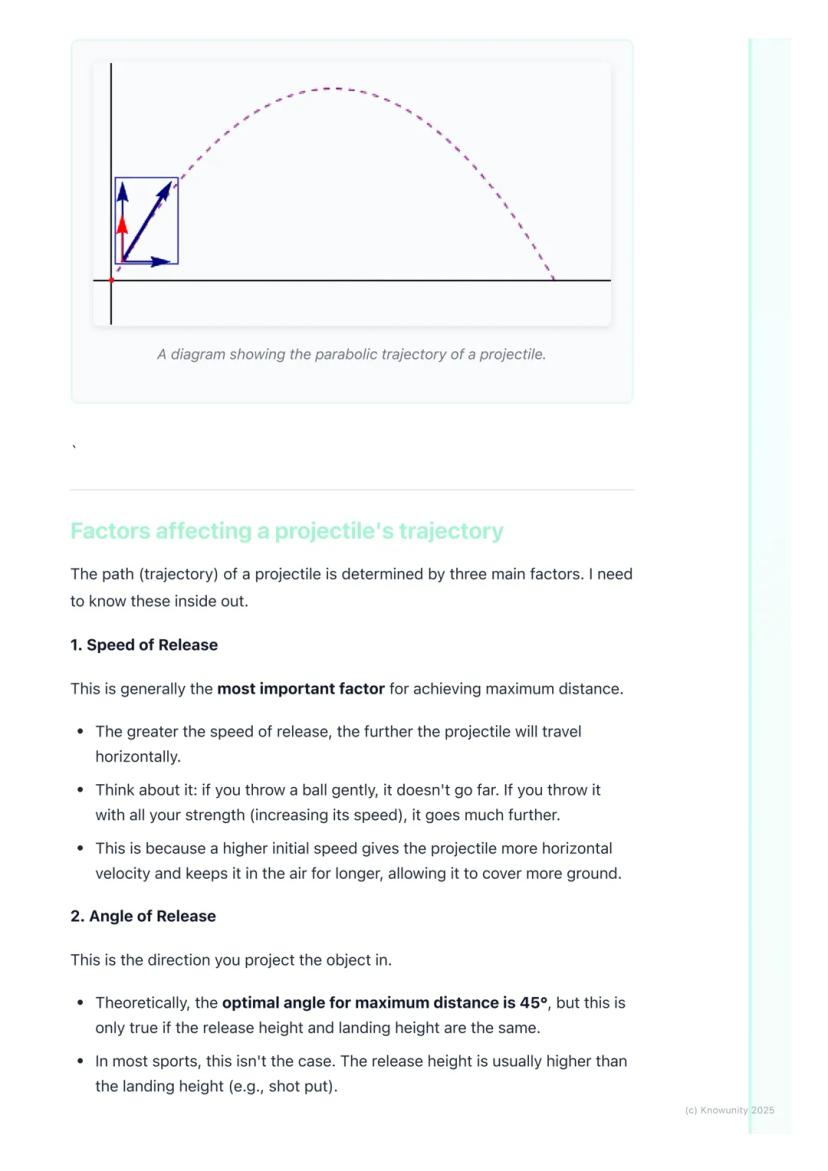
- Trajectory - the curved flight path, always shaped like a parabola
- Gravity - pulls everything down at 9.8 m/s², but only affects vertical movement
- Angle of release - the direction you launch the object (measured in degrees from horizontal)
Remember: Air resistance exists in real life, but we usually ignore it in physics problems to make calculations easier!
2
of 5
The Three Key Factors
Your projectile's path depends on three main factors that you need to master. Get these right and you'll ace any exam question about projectile motion.
Speed of release is usually the most important factor. Launch something faster and it travels further horizontally - simple as that. It's like the difference between gently tossing a ball versus hurling it with all your strength.
Angle of release determines the direction. Here's the crucial bit: whilst 45° gives maximum distance in theory, this only works when you're launching and landing at the same height. In most sports, you're releasing from a different height than where it lands.
If you're releasing higher than the landing point (like shot put), aim slightly lower than 45°. If you're aiming upwards (like chipping a football over a goalkeeper), go slightly higher than 45°.
Top tip: Don't just memorise "45° is optimal" - explain why it changes in real sports situations!
3
of 5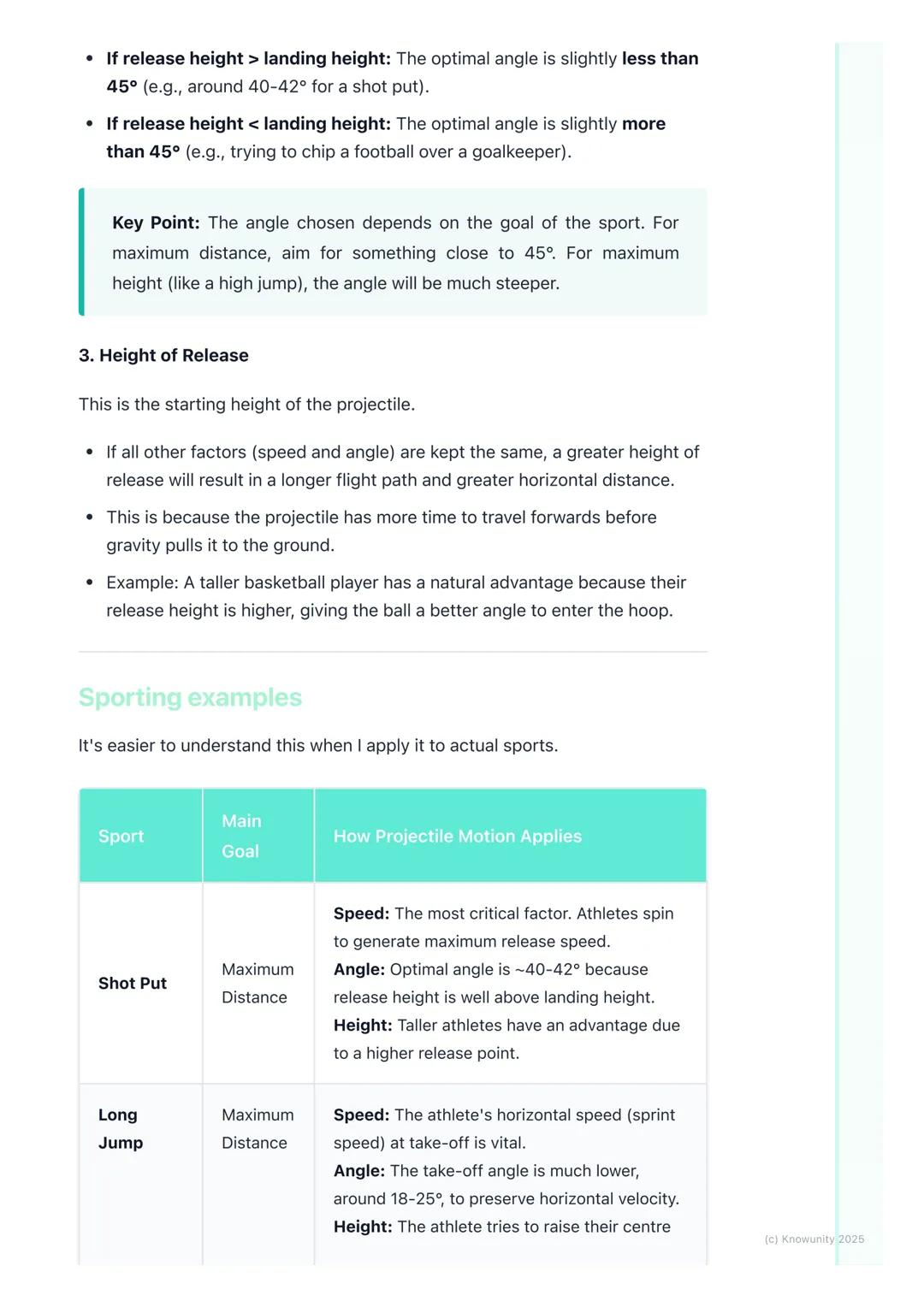
Height of Release Matters
Height of release gives you a massive advantage in many sports. Release something from higher up, and it has more time to travel forward before gravity brings it down to earth.
This explains why taller basketball players have natural advantages - their higher release point gives the ball a better angle into the hoop. It's also why shot putters try to release the shot as high as possible during their throw.
Real sporting examples make this clearer:
- Basketball shots need controlled speed, high angles (50-55°), and maximum release height
- Shot put requires maximum speed, optimal angles around 40-42°, and releasing as high as possible
- Long jump focuses on speed and getting your centre of mass as high as possible at take-off
The beauty of projectile motion is that you can split it into two parts: horizontal movement (constant speed) and vertical movement (constantly changing due to gravity).
Exam gold: Always mention that you're ignoring air resistance - it shows you understand the assumptions we make!
4
of 5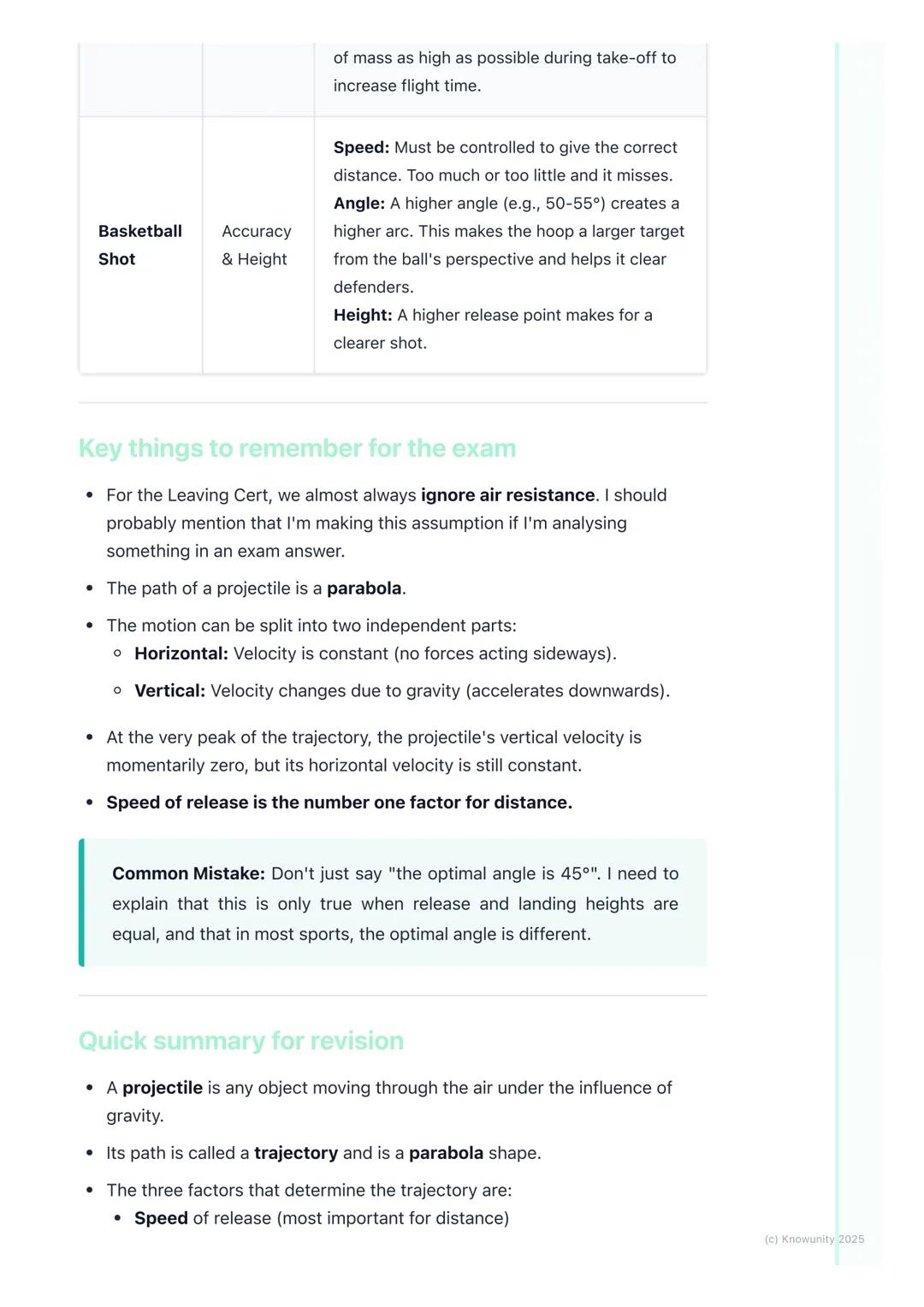
Essential Points for Success
At the peak of any trajectory, something interesting happens - the vertical speed becomes zero for a split second, but horizontal speed stays constant throughout the entire flight.
Gravity only affects the up-and-down motion, never the side-to-side movement. This is why projectiles follow that characteristic parabola shape every single time.
For your exams, remember that speed of release trumps everything else when you want maximum distance. Angle and height matter, but getting that initial speed right is crucial.
Don't fall into the common trap of saying "45° is always optimal" without explaining the conditions. Show you understand that real sports rarely have equal release and landing heights.
Quick revision checklist:
- Projectile = object in air under gravity's influence
- Trajectory = parabola-shaped flight path
- Three factors: speed (most important), angle, and height of release
- Horizontal motion = constant velocity
- Vertical motion = changes due to gravity
Confidence booster: You've got this! These concepts appear everywhere in sport, so you already have intuitive understanding from watching games.
5
of 5
Achamos que você nunca perguntaria...
O que é o assistente de IA da Knowunity?
Nosso companheiro de IA foi criado especificamente para atender às necessidades dos estudantes. Com base nos milhões de conteúdos que temos na plataforma, podemos oferecer respostas realmente relevantes e significativas. Mas não se trata apenas de respostas, o companheiro também está aqui para guiar você pelos desafios diários de aprendizado, com planos de estudo personalizados, quizzes ou conteúdos no chat e 100% de personalização com base nas suas habilidades e desenvolvimentos.
Onde posso baixar o app da Knowunity?
Pode descarregar a aplicação na Google Play Store e na Apple App Store.
Como posso receber meu pagamento? Quanto posso ganhar?
Sim, tem acesso gratuito ao conteúdo da aplicação e ao nosso companheiro de IA. Para desbloquear determinadas funcionalidades da aplicação, pode adquirir o Knowunity Pro.
Conteúdos mais populares de LCPE
4Conteúdos mais populares
9Não encontrou o que procurava? Explore outras matérias.
Avaliações dos nossos usuários. Eles gostaram de tudo — e você também vai gostar.
4.6/5App Store
4.7/5Google Play
O app é muito fácil de usar e bem projetado. Encontrei tudo o que estava procurando até agora e consegui aprender muito com as apresentações! Definitivamente vou usar o app para uma tarefa de classe! E, claro, também ajuda muito como inspiração.
Stefan Susuário de iOS
Este app é realmente ótimo. Tem muitos materiais de estudo e ajuda [...]. Minha matéria problemática é o francês, por exemplo, e o app tem tantas opções de ajuda. Graças a este app, eu melhorei meu francês. Eu recomendaria para qualquer pessoa.
Samantha Klichusuária de Android
Uau, estou realmente impressionado. Eu experimentei o app porque vi muitos anúncios e fiquei absolutamente maravilhado. Este app é A AJUDA que você quer para a escola e, acima de tudo, oferece muitas coisas, como treinos e resumos, que têm sido MUITO úteis para mim pessoalmente.
Annausuária de iOS
LCPE3 visualizações·Atualizado Jun 9, 2026·5 páginasUnderstanding the Basics of Projectile Motion
Ever wondered why footballers curve their shots or why basketball players aim high? Projectile motionexplains the path of any object flying through the air - from a sliotar in hurling to a long jumper soaring through the air. Once... Mostrar mais
1
of 5Cadastre-se para ver o conteúdo. É grátis!
- Acesso a todos os documentos
- Melhore suas notas
- Junte-se a milhões de estudantes
What is Projectile Motion?
Think about every time you've kicked a football or thrown something - you've created projectile motion. This describes how objects move through the air once they've been launched, with only gravity pulling them down.
The most important thing to remember? Once an object is airborne, gravity is the main force affecting it (we'll ignore air resistance to keep things simple). This creates that curved path you always see when balls fly through the air.
Key terms you absolutely need to know:
- Projectile - the object in the air (could be a ball, or even a person jumping)
- Trajectory - the curved flight path, always shaped like a parabola
- Gravity - pulls everything down at 9.8 m/s², but only affects vertical movement
- Angle of release - the direction you launch the object (measured in degrees from horizontal)
Remember: Air resistance exists in real life, but we usually ignore it in physics problems to make calculations easier!
2
of 5Cadastre-se para ver o conteúdo. É grátis!
- Acesso a todos os documentos
- Melhore suas notas
- Junte-se a milhões de estudantes
The Three Key Factors
Your projectile's path depends on three main factors that you need to master. Get these right and you'll ace any exam question about projectile motion.
Speed of release is usually the most important factor. Launch something faster and it travels further horizontally - simple as that. It's like the difference between gently tossing a ball versus hurling it with all your strength.
Angle of release determines the direction. Here's the crucial bit: whilst 45° gives maximum distance in theory, this only works when you're launching and landing at the same height. In most sports, you're releasing from a different height than where it lands.
If you're releasing higher than the landing point (like shot put), aim slightly lower than 45°. If you're aiming upwards (like chipping a football over a goalkeeper), go slightly higher than 45°.
Top tip: Don't just memorise "45° is optimal" - explain why it changes in real sports situations!
3
of 5Cadastre-se para ver o conteúdo. É grátis!
- Acesso a todos os documentos
- Melhore suas notas
- Junte-se a milhões de estudantes
Height of Release Matters
Height of release gives you a massive advantage in many sports. Release something from higher up, and it has more time to travel forward before gravity brings it down to earth.
This explains why taller basketball players have natural advantages - their higher release point gives the ball a better angle into the hoop. It's also why shot putters try to release the shot as high as possible during their throw.
Real sporting examples make this clearer:
- Basketball shots need controlled speed, high angles (50-55°), and maximum release height
- Shot put requires maximum speed, optimal angles around 40-42°, and releasing as high as possible
- Long jump focuses on speed and getting your centre of mass as high as possible at take-off
The beauty of projectile motion is that you can split it into two parts: horizontal movement (constant speed) and vertical movement (constantly changing due to gravity).
Exam gold: Always mention that you're ignoring air resistance - it shows you understand the assumptions we make!
4
of 5Cadastre-se para ver o conteúdo. É grátis!
- Acesso a todos os documentos
- Melhore suas notas
- Junte-se a milhões de estudantes
Essential Points for Success
At the peak of any trajectory, something interesting happens - the vertical speed becomes zero for a split second, but horizontal speed stays constant throughout the entire flight.
Gravity only affects the up-and-down motion, never the side-to-side movement. This is why projectiles follow that characteristic parabola shape every single time.
For your exams, remember that speed of release trumps everything else when you want maximum distance. Angle and height matter, but getting that initial speed right is crucial.
Don't fall into the common trap of saying "45° is always optimal" without explaining the conditions. Show you understand that real sports rarely have equal release and landing heights.
Quick revision checklist:
- Projectile = object in air under gravity's influence
- Trajectory = parabola-shaped flight path
- Three factors: speed (most important), angle, and height of release
- Horizontal motion = constant velocity
- Vertical motion = changes due to gravity
Confidence booster: You've got this! These concepts appear everywhere in sport, so you already have intuitive understanding from watching games.
5
of 5Cadastre-se para ver o conteúdo. É grátis!
- Acesso a todos os documentos
- Melhore suas notas
- Junte-se a milhões de estudantes
Achamos que você nunca perguntaria...
O que é o assistente de IA da Knowunity?
Nosso companheiro de IA foi criado especificamente para atender às necessidades dos estudantes. Com base nos milhões de conteúdos que temos na plataforma, podemos oferecer respostas realmente relevantes e significativas. Mas não se trata apenas de respostas, o companheiro também está aqui para guiar você pelos desafios diários de aprendizado, com planos de estudo personalizados, quizzes ou conteúdos no chat e 100% de personalização com base nas suas habilidades e desenvolvimentos.
Onde posso baixar o app da Knowunity?
Pode descarregar a aplicação na Google Play Store e na Apple App Store.
Como posso receber meu pagamento? Quanto posso ganhar?
Sim, tem acesso gratuito ao conteúdo da aplicação e ao nosso companheiro de IA. Para desbloquear determinadas funcionalidades da aplicação, pode adquirir o Knowunity Pro.
Conteúdos mais populares de LCPE
4Conteúdos mais populares
9Não encontrou o que procurava? Explore outras matérias.
Avaliações dos nossos usuários. Eles gostaram de tudo — e você também vai gostar.
4.6/5App Store
4.7/5Google Play
O app é muito fácil de usar e bem projetado. Encontrei tudo o que estava procurando até agora e consegui aprender muito com as apresentações! Definitivamente vou usar o app para uma tarefa de classe! E, claro, também ajuda muito como inspiração.
Stefan Susuário de iOS
Este app é realmente ótimo. Tem muitos materiais de estudo e ajuda [...]. Minha matéria problemática é o francês, por exemplo, e o app tem tantas opções de ajuda. Graças a este app, eu melhorei meu francês. Eu recomendaria para qualquer pessoa.
Samantha Klichusuária de Android
Uau, estou realmente impressionado. Eu experimentei o app porque vi muitos anúncios e fiquei absolutamente maravilhado. Este app é A AJUDA que você quer para a escola e, acima de tudo, oferece muitas coisas, como treinos e resumos, que têm sido MUITO úteis para mim pessoalmente.
Annausuária de iOS