
Learning to write diary entries (dialann) in Irish is essential... Mostrar mais
 Irish6 visualizações·Atualizado Jun 5, 2026·6 páginas
Dialann: Ag Scríobh faoin gCéadfaí laethúil
1 / 6
1
of 6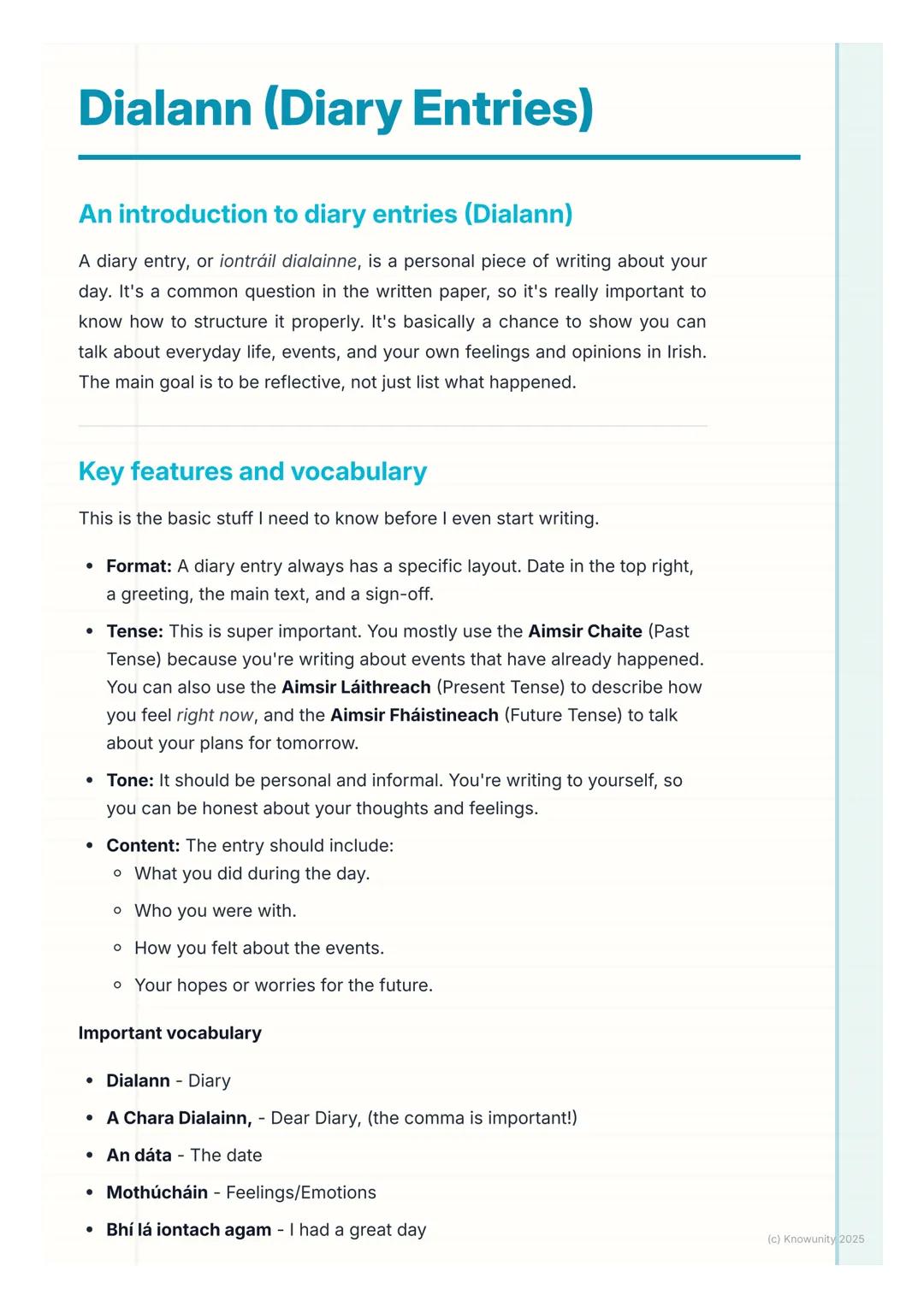
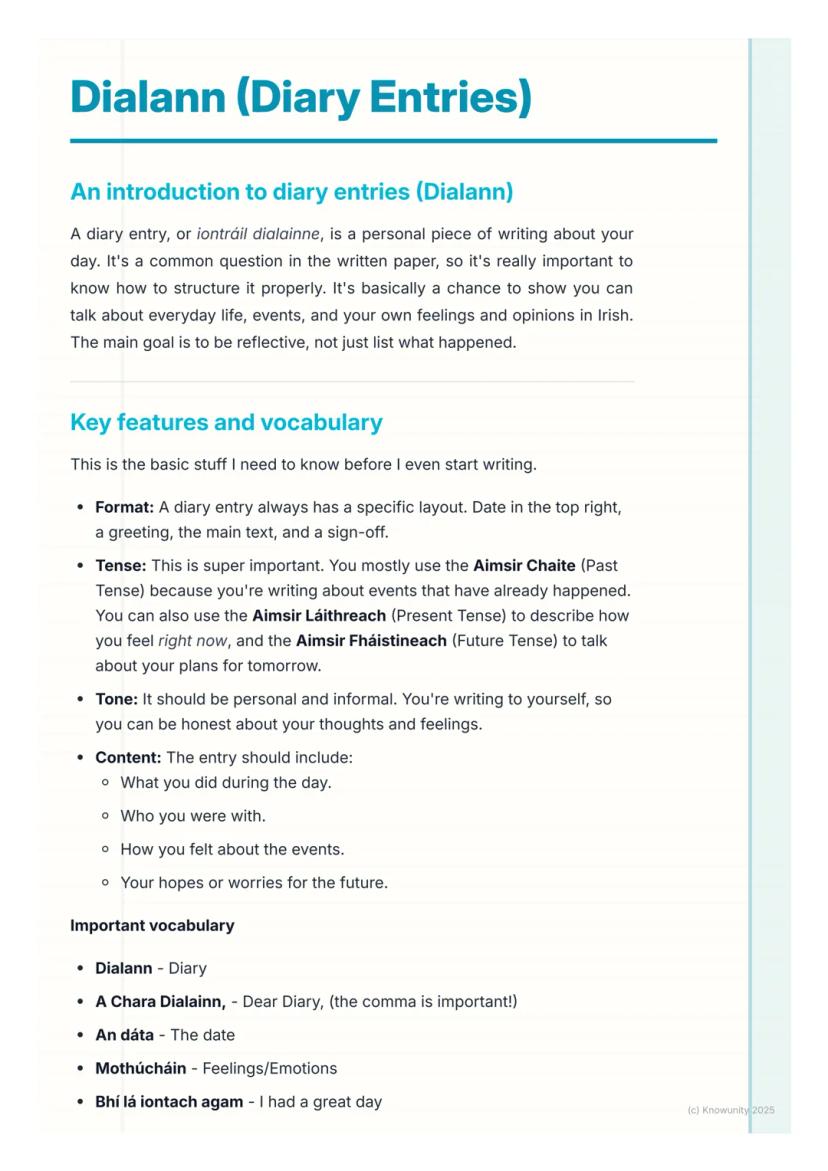
What is a Dialann?
Think of diary entries as your personal chat with yourself about the day - but in Irish! They're dead common in exams, so getting the hang of them is crucial for your marks.
The whole point isn't just listing what you did (that's boring). You need to be reflective and share your feelings about events. It's like having a proper conversation with your diary about what mattered to you.
Key things to remember: You'll mainly use the Aimsir Chaite (past tense) for events that happened, but you can switch to present tense for current feelings and future tense for tomorrow's plans. Keep it personal and informal - you're writing to yourself, so be honest!
Pro tip: Always include how you felt about events, not just what happened. This is where you'll pick up extra marks!
2
of 6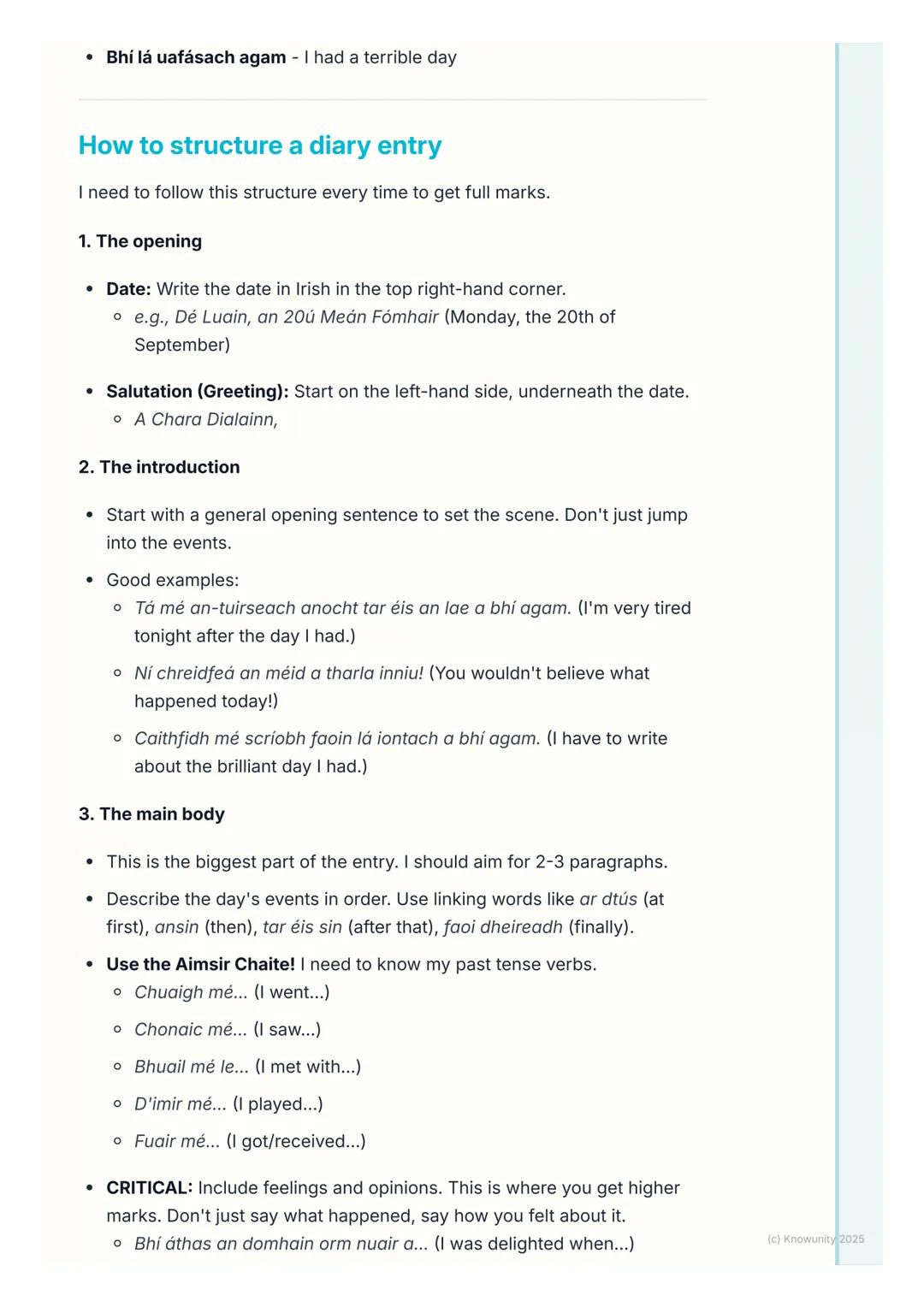
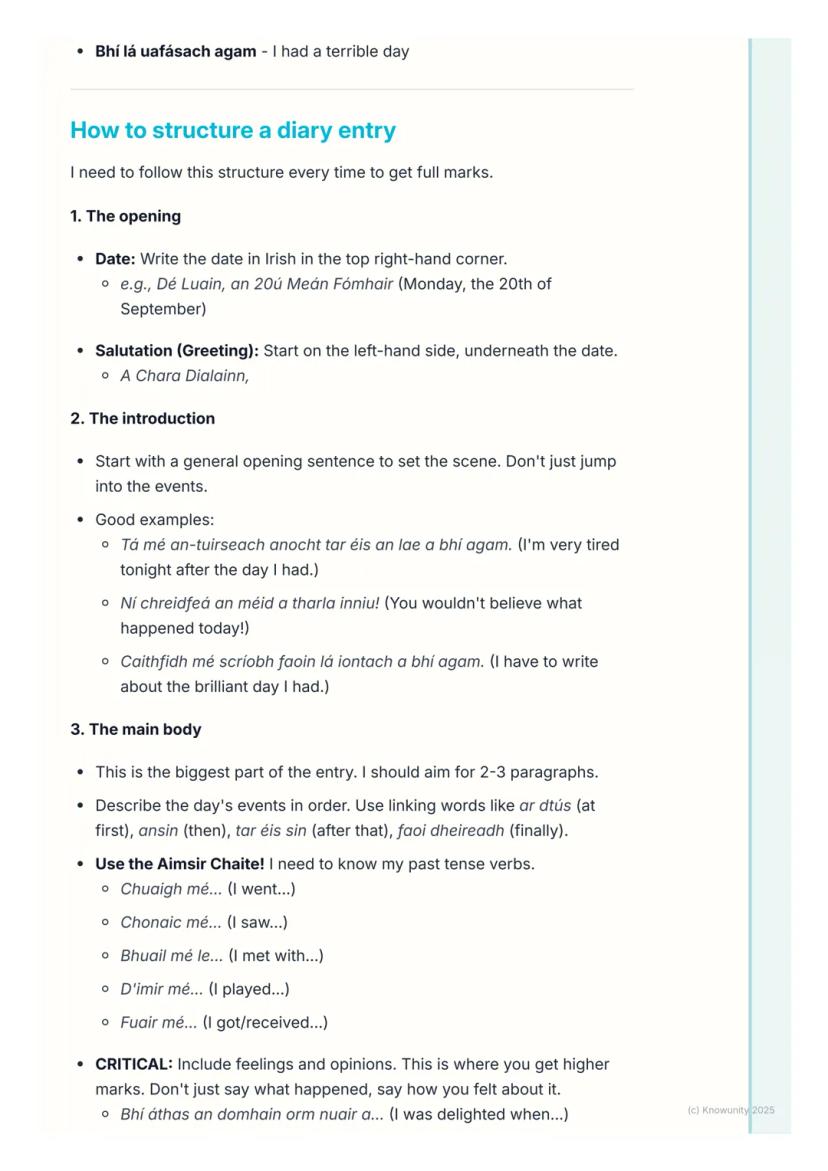
Essential Structure You Must Follow
Every diary entry needs the exact same layout - miss any part and you'll lose marks straight away!
The opening starts with the date in Irish (top right corner) like "Dé Luain, an 20ú Meán Fómhair", then your greeting "A Chara Dialainn," on the left underneath.
Your introduction should grab attention immediately. Don't dive straight into events - set the scene first! Try something like "Ní chreidfeá an méid a tharla inniu!" (You wouldn't believe what happened today!)
The main body is where you shine. Use 2-3 paragraphs describing your day in order with linking words like ar dtús, ansin, tar éis sin. Most importantly, master your Aimsir Chaite verbs: chuaigh mé, chonaic mé, bhuail mé le.
Critical point: For every event you mention, add how it made you feel. "Bhí áthas an domhain orm nuair a..." shows much better Irish than just listing facts!
3
of 6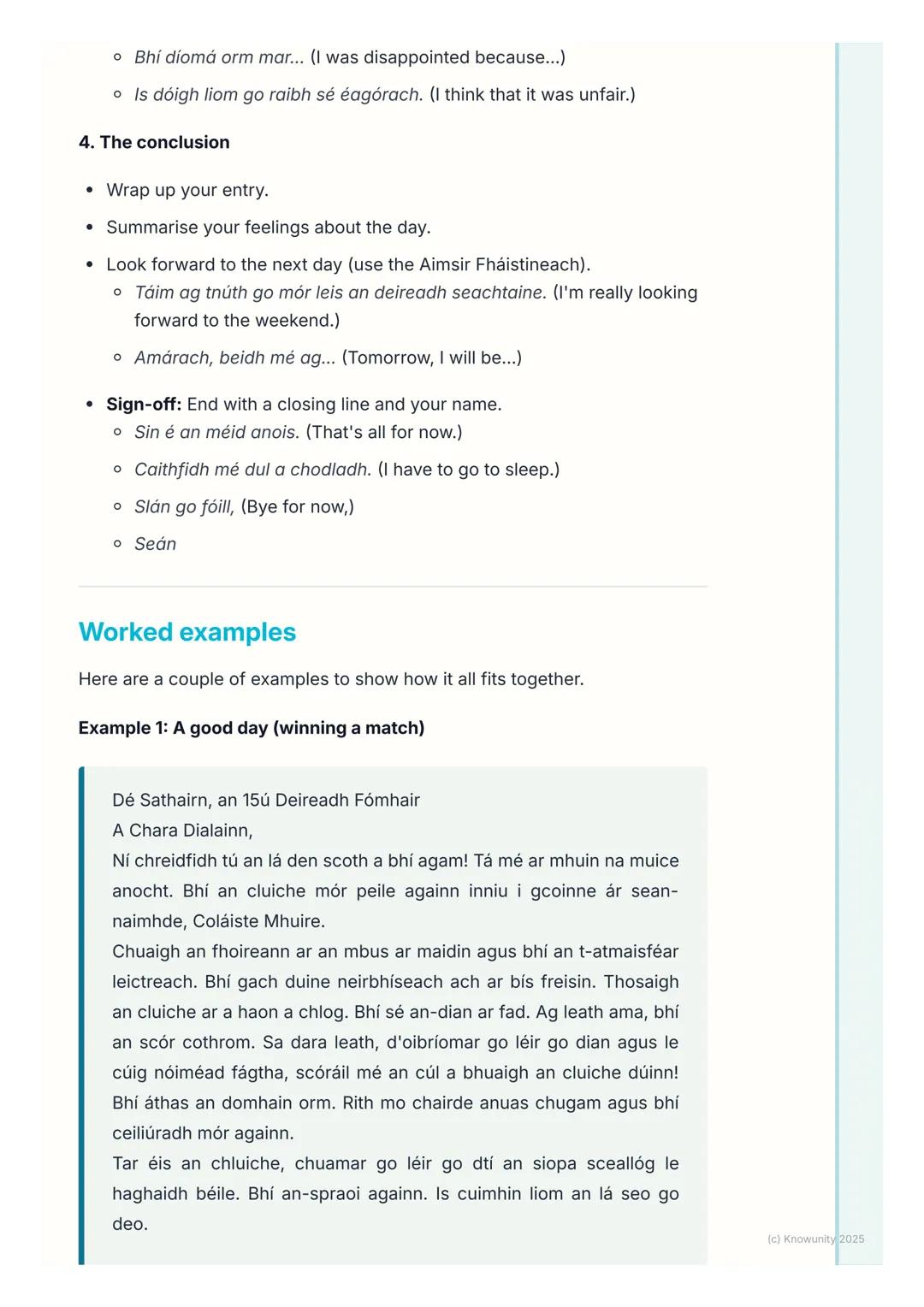
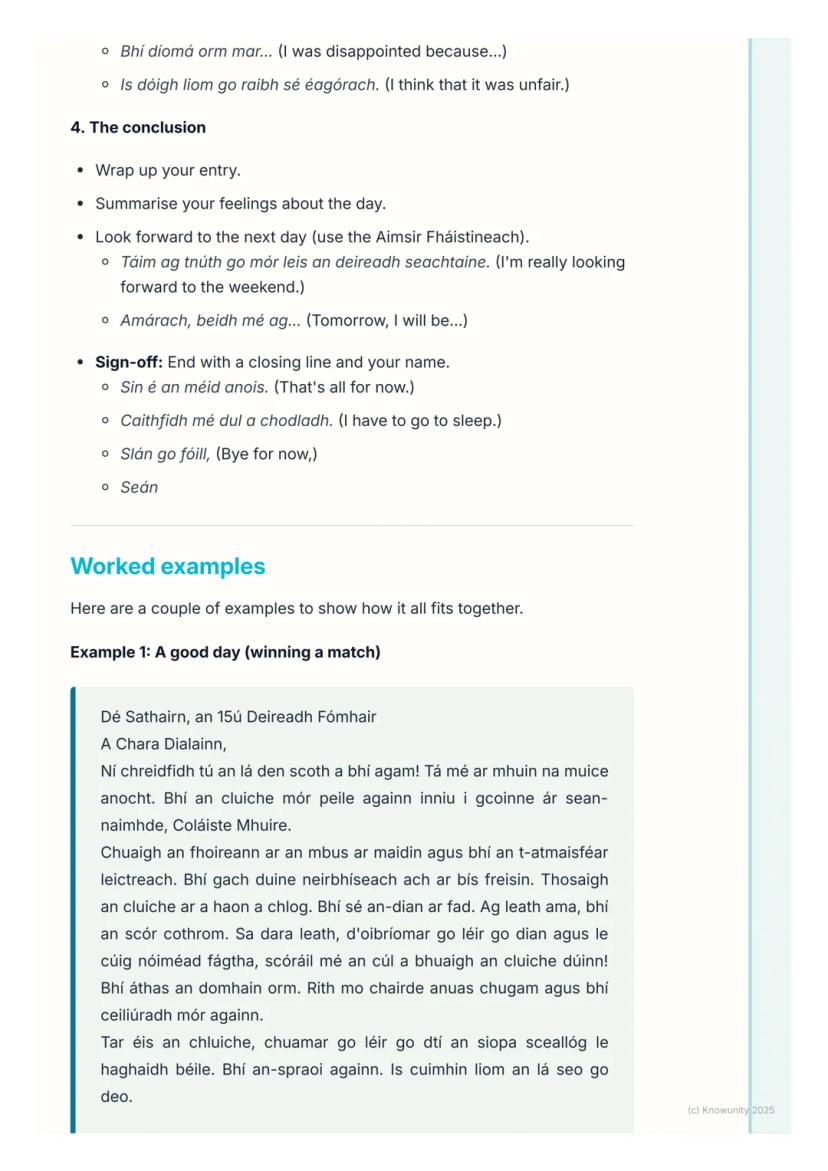
Nailing Your Conclusion and Examples
Wrap up your diary entry by summarising your feelings about the day and looking ahead. Use the Aimsir Fháistineach here: "Amárach, beidh mé ag..." or "Táim ag tnúth go mór leis an deireadh seachtaine."
Always end with a proper sign-off like "Sin é an méid anois" followed by "Slán go fóill," and your name. Simple but essential!
Looking at the examples, notice how the good day entry flows naturally from events to feelings. The football match example doesn't just say "we won" - it captures the electric atmosphere, the nervousness, and that pure joy of scoring the winning goal.
The stressful day example works brilliantly too because it's honest about feelings. Failed maths exam, dropped dinner, everyone laughing - we've all been there! The key is showing how these events affected the writer emotionally.
4
of 6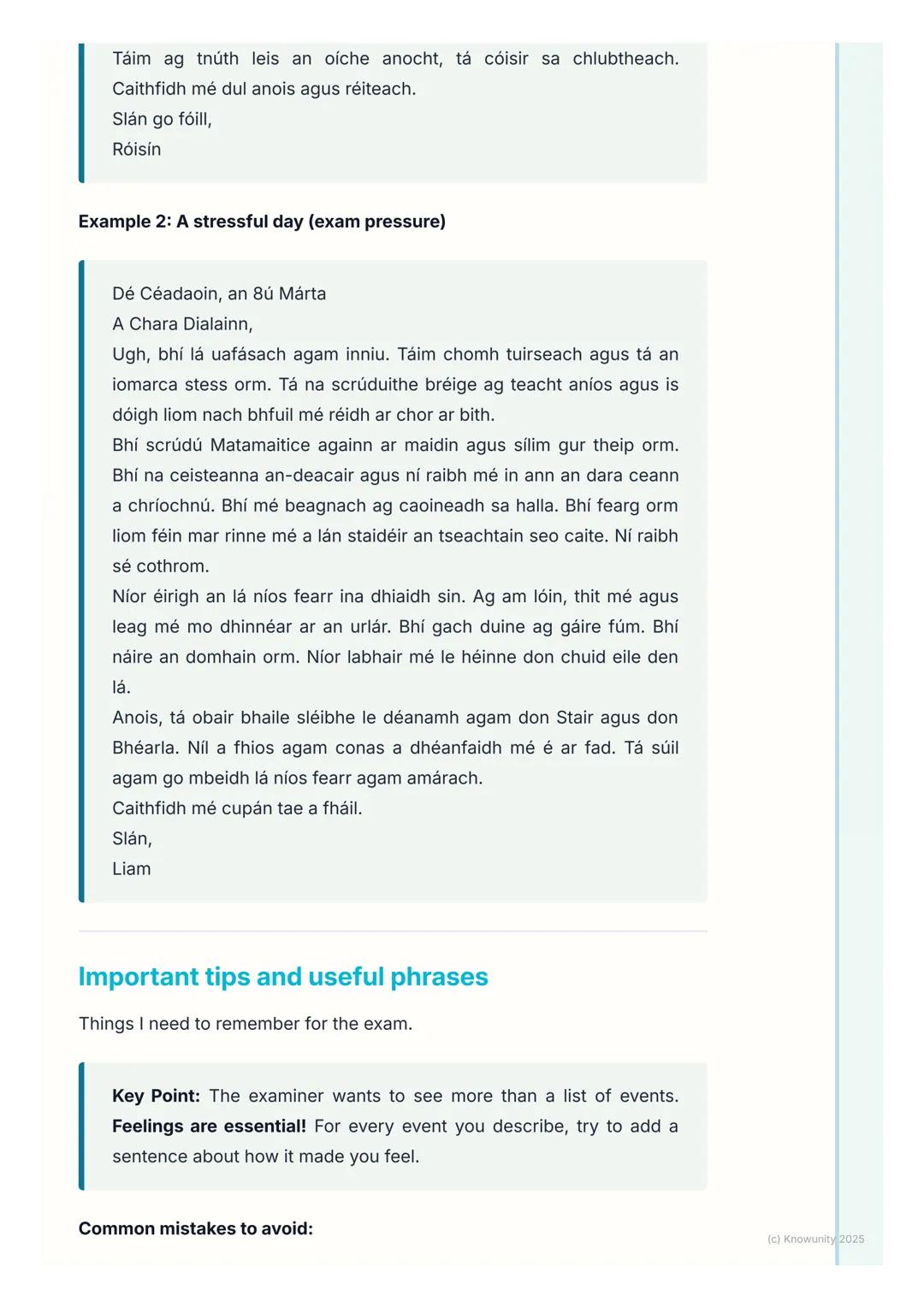
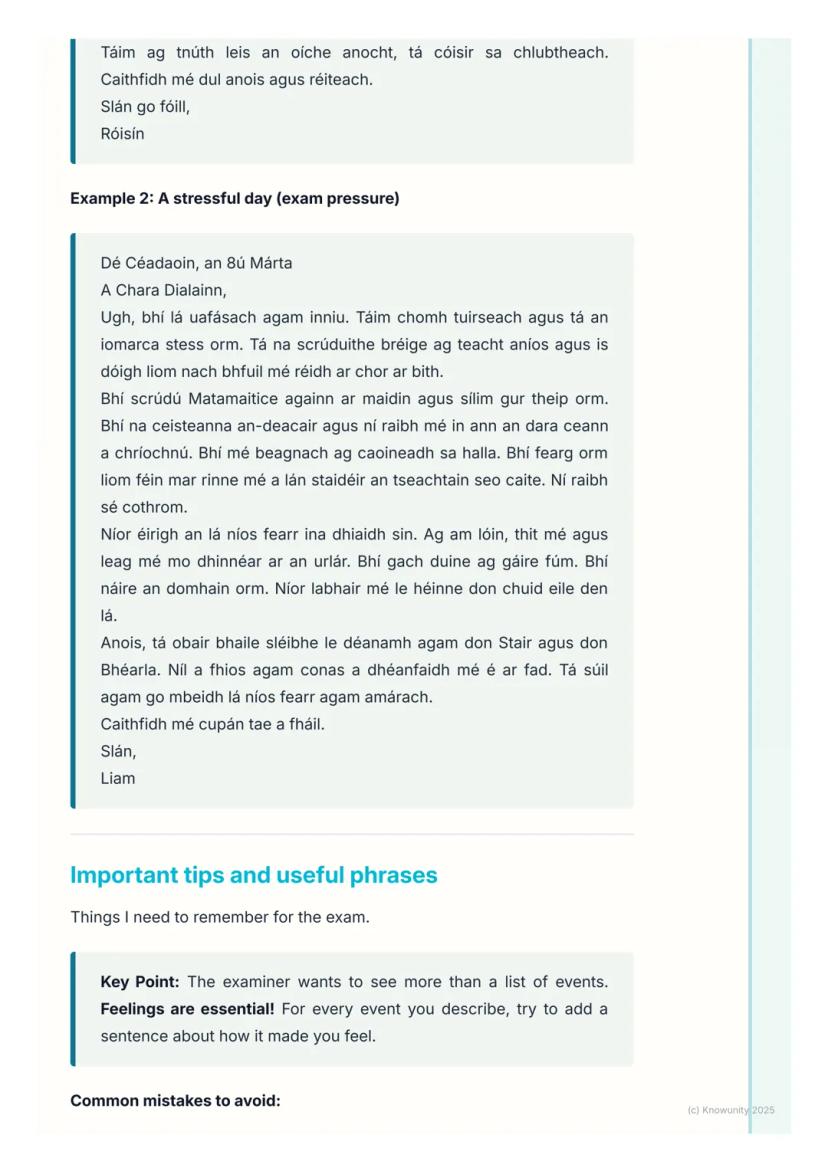
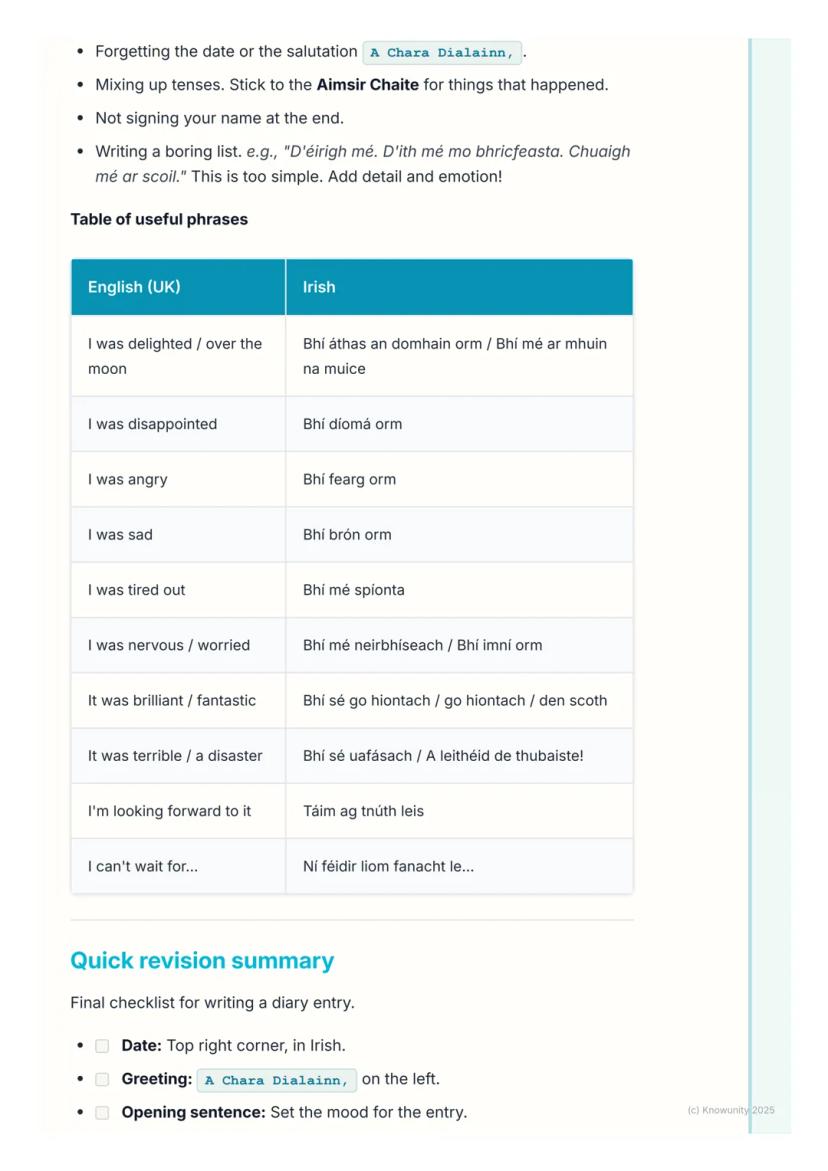
Common Mistakes and Winning Phrases
Avoid these exam disasters: forgetting your date or "A Chara Dialainn," mixing up your tenses, not signing your name, or writing boring lists like "D'éirigh mé. D'ith mé. Chuaigh mé." Add detail and emotion instead!
Essential feeling phrases you need to memorise: "Bhí áthas an domhain orm" (I was over the moon), "Bhí díomá orm" (I was disappointed), "Bhí mé spíonta" (I was tired out). These will instantly improve your writing.
Time and mood phrases like "Bhí sé go hiontach" (It was brilliant) or "A leithéid de thubaiste!" (What a disaster!) add personality to your entries. Don't just tell what happened - show how you felt about it.
The examiner wants to see you can express complex emotions, not just describe events. Think of it as telling your best mate about your day rather than writing a boring report.
Game changer: Every event needs an emotional reaction. This single tip will boost your marks significantly!
5
of 6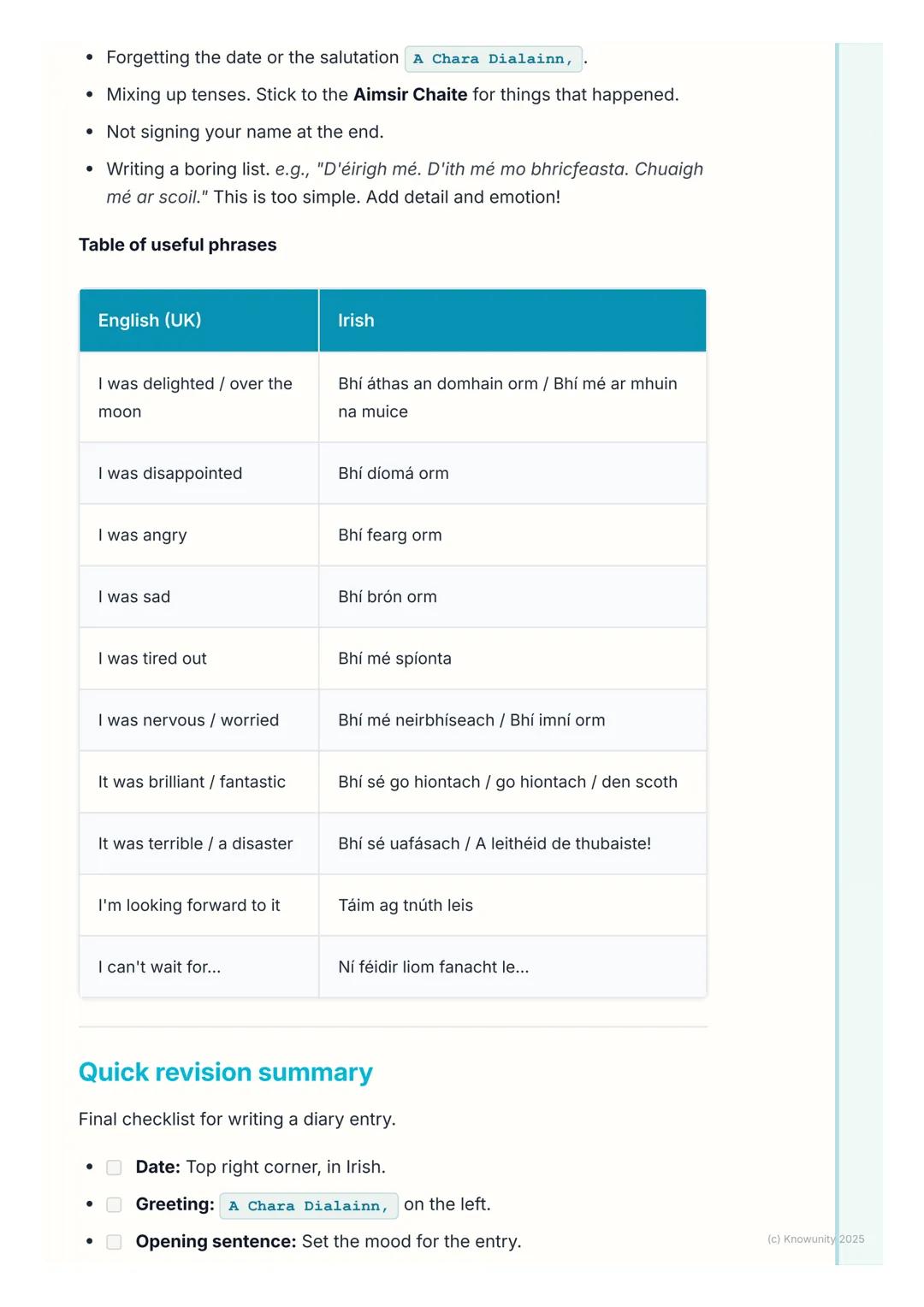
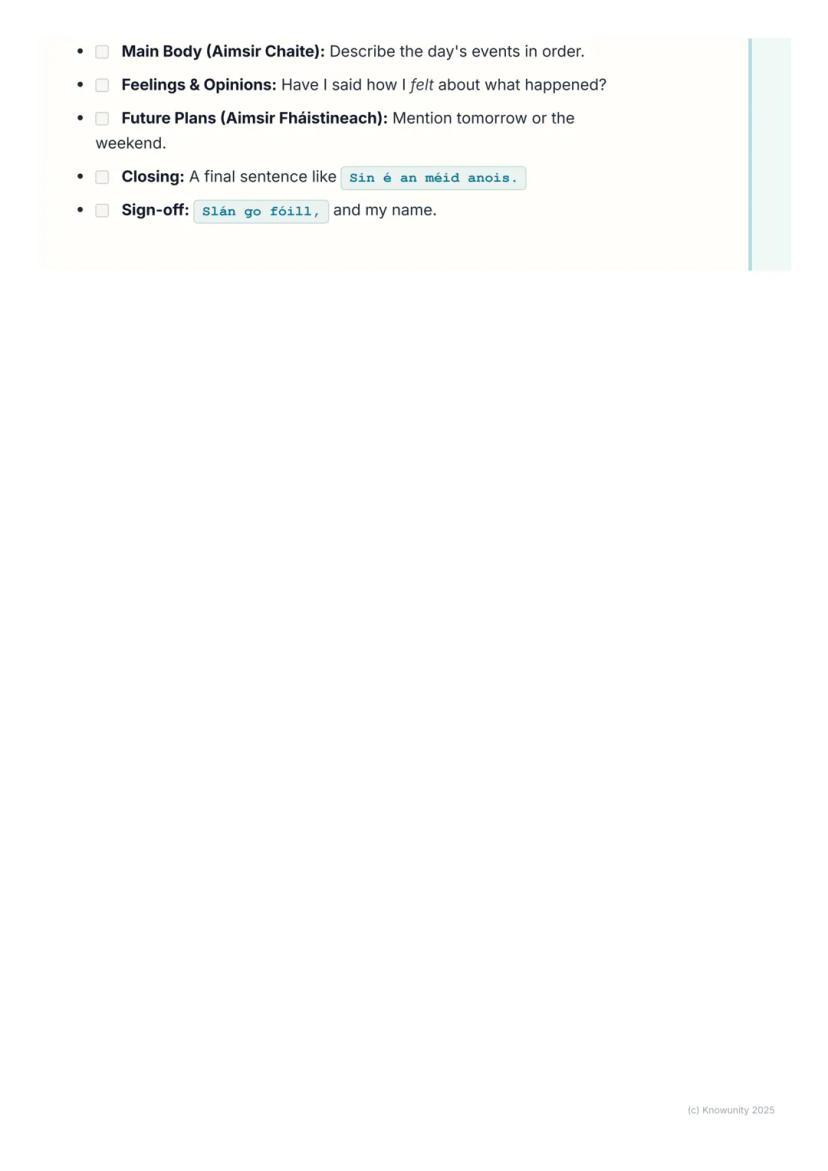
Your Final Exam Checklist
Before you hand in any diary entry, run through this essential checklist to guarantee you haven't missed anything crucial.
Format basics: Date in Irish (top right), "A Chara Dialainn," (left side), engaging opening sentence that sets the mood for your entire entry.
Content structure: Main body using Aimsir Chaite, clear feelings and opinions expressed throughout, future plans mentioned using Aimsir Fháistineach.
Proper ending: Closing sentence like "Sin é an méid anois," sign-off "Slán go fóill," and your name. Dead simple but absolutely essential.
Remember, diary entries are about showing you can use Irish naturally to express real thoughts and feelings. The more genuine and detailed your emotions, the better your marks will be. You've got this!
Final reminder: Practice writing about both good and bad days - exams love testing your range of emotional vocabulary!
6
of 6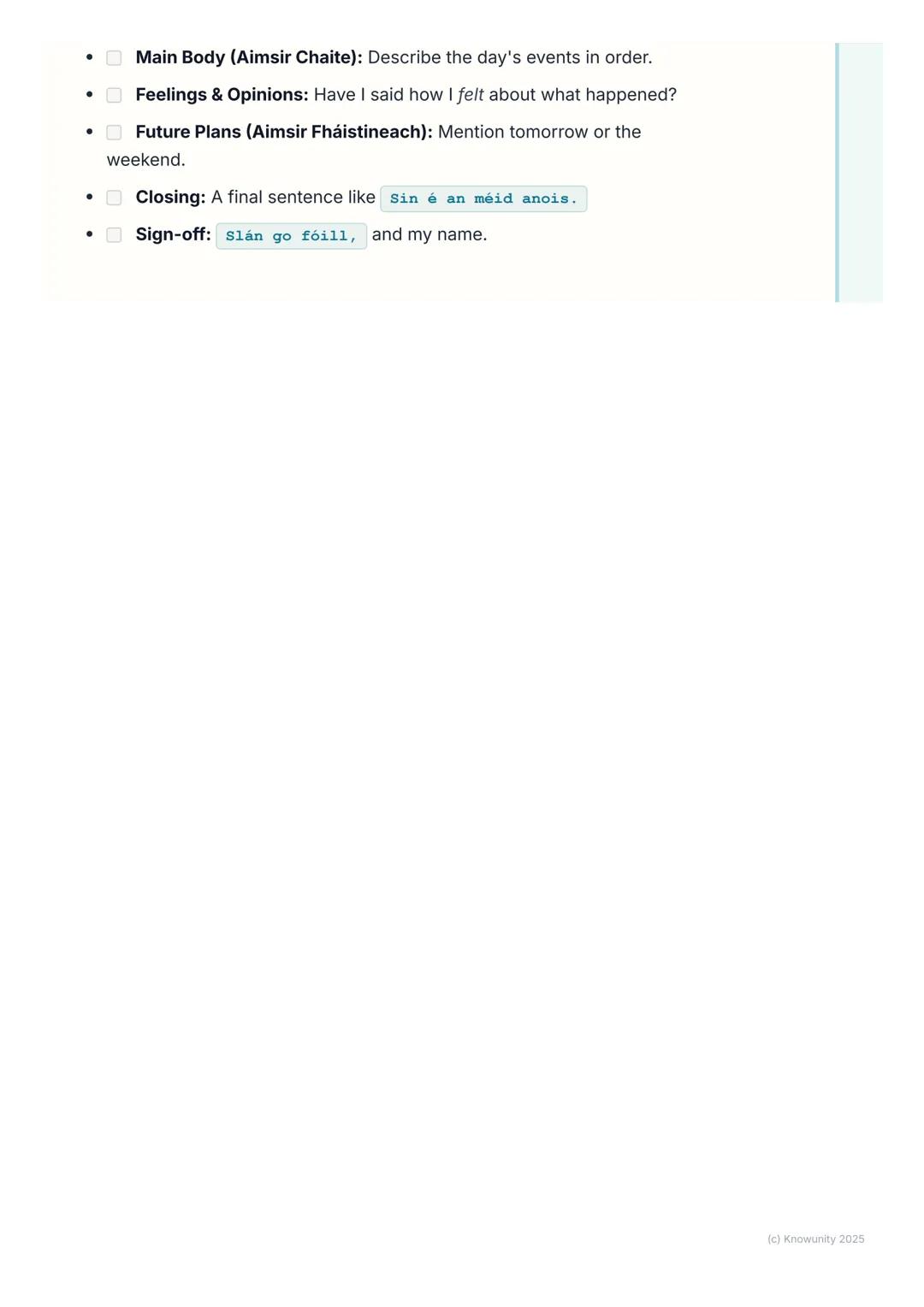
Achamos que você nunca perguntaria...
O que é o assistente de IA da Knowunity?
Nosso companheiro de IA foi criado especificamente para atender às necessidades dos estudantes. Com base nos milhões de conteúdos que temos na plataforma, podemos oferecer respostas realmente relevantes e significativas. Mas não se trata apenas de respostas, o companheiro também está aqui para guiar você pelos desafios diários de aprendizado, com planos de estudo personalizados, quizzes ou conteúdos no chat e 100% de personalização com base nas suas habilidades e desenvolvimentos.
Onde posso baixar o app da Knowunity?
Pode descarregar a aplicação na Google Play Store e na Apple App Store.
Como posso receber meu pagamento? Quanto posso ganhar?
Sim, tem acesso gratuito ao conteúdo da aplicação e ao nosso companheiro de IA. Para desbloquear determinadas funcionalidades da aplicação, pode adquirir o Knowunity Pro.
Conteúdos mais populares de Irish
9IrishIrish oral questions and answers
Questions and answers for the leaving cert oral
5th Year4264
IrishIrish oral questions
Outline of oral questions
5th Year2055
IrishIrish poetry 2027
Iníon + Dínit an Bhróin
5th Year1133
IrishIníon- le hÁine Durkin
Aine Durkin’s poem, Iníon: Themes & summary
5th Year850
IrishLC HL notes- Iníon (poem)
Includes poem in English and Irish, theme, key words & phrases
5th Year2284
IrishMo Ghrá-sa (Idir Lúibíní)
Notes on mo ghrá-sa
5th Year380
IrishGaeilge Grammar Office
All the basics you need to know on Irish grammar.
6th Year1063
IrishAn Gaeilge Aiste
Irish Language essay
6th Year1320
IrishMé Féin & Mo Chlann (Myself & My Family)
Students will learn vocabulary to describe themselves, their family members, and daily routines. This helps in personal introductions and discussions.
TY291
Conteúdos mais populares
9IrishIrish oral questions and answers
Questions and answers for the leaving cert oral
5th Year4264
 English
Key Quotes : Sive
Key Quotes and explanations: Sive
6th Year2842
IrishIrish oral questions
Outline of oral questions
5th Year2055
IrishIníon- le hÁine Durkin
Aine Durkin’s poem, Iníon: Themes & summary
5th Year850
IrishIrish poetry 2027
Iníon + Dínit an Bhróin
5th Year1133
IrishLC HL notes- Iníon (poem)
Includes poem in English and Irish, theme, key words & phrases
5th Year2284
EnglishCultural Context : Shawshank Redemption : Sive : Small Things Like These
Comparative Study : Cultural Context : Shawshank Redemption, Sive and Small Things Like These
6th Year1430
IrishMo Ghrá-sa (Idir Lúibíní)
Notes on mo ghrá-sa
5th Year380
IrishAn Gaeilge Aiste
Irish Language essay
6th Year1320
Não encontrou o que procurava? Explore outras matérias.
Avaliações dos nossos usuários. Eles gostaram de tudo — e você também vai gostar.
4.6/5App Store
4.7/5Google Play
O app é muito fácil de usar e bem projetado. Encontrei tudo o que estava procurando até agora e consegui aprender muito com as apresentações! Definitivamente vou usar o app para uma tarefa de classe! E, claro, também ajuda muito como inspiração.
Stefan Susuário de iOS
Este app é realmente ótimo. Tem muitos materiais de estudo e ajuda [...]. Minha matéria problemática é o francês, por exemplo, e o app tem tantas opções de ajuda. Graças a este app, eu melhorei meu francês. Eu recomendaria para qualquer pessoa.
Samantha Klichusuária de Android
Uau, estou realmente impressionado. Eu experimentei o app porque vi muitos anúncios e fiquei absolutamente maravilhado. Este app é A AJUDA que você quer para a escola e, acima de tudo, oferece muitas coisas, como treinos e resumos, que têm sido MUITO úteis para mim pessoalmente.
Annausuária de iOS
Irish6 visualizações·Atualizado Jun 5, 2026·6 páginasDialann: Ag Scríobh faoin gCéadfaí laethúil
Learning to write diary entries (dialann) in Irish is essential for your written paper - and it's actually quite straightforward once you know the format! This is your chance to show off your ability to talk about daily life, express... Mostrar mais
1
of 6Cadastre-se para ver o conteúdo. É grátis!
- Acesso a todos os documentos
- Melhore suas notas
- Junte-se a milhões de estudantes
What is a Dialann?
Think of diary entries as your personal chat with yourself about the day - but in Irish! They're dead common in exams, so getting the hang of them is crucial for your marks.
The whole point isn't just listing what you did (that's boring). You need to be reflective and share your feelings about events. It's like having a proper conversation with your diary about what mattered to you.
Key things to remember: You'll mainly use the Aimsir Chaite (past tense) for events that happened, but you can switch to present tense for current feelings and future tense for tomorrow's plans. Keep it personal and informal - you're writing to yourself, so be honest!
Pro tip: Always include how you felt about events, not just what happened. This is where you'll pick up extra marks!
2
of 6Cadastre-se para ver o conteúdo. É grátis!
- Acesso a todos os documentos
- Melhore suas notas
- Junte-se a milhões de estudantes
Essential Structure You Must Follow
Every diary entry needs the exact same layout - miss any part and you'll lose marks straight away!
The opening starts with the date in Irish (top right corner) like "Dé Luain, an 20ú Meán Fómhair", then your greeting "A Chara Dialainn," on the left underneath.
Your introduction should grab attention immediately. Don't dive straight into events - set the scene first! Try something like "Ní chreidfeá an méid a tharla inniu!" (You wouldn't believe what happened today!)
The main body is where you shine. Use 2-3 paragraphs describing your day in order with linking words like ar dtús, ansin, tar éis sin. Most importantly, master your Aimsir Chaite verbs: chuaigh mé, chonaic mé, bhuail mé le.
Critical point: For every event you mention, add how it made you feel. "Bhí áthas an domhain orm nuair a..." shows much better Irish than just listing facts!
3
of 6Cadastre-se para ver o conteúdo. É grátis!
- Acesso a todos os documentos
- Melhore suas notas
- Junte-se a milhões de estudantes
Nailing Your Conclusion and Examples
Wrap up your diary entry by summarising your feelings about the day and looking ahead. Use the Aimsir Fháistineach here: "Amárach, beidh mé ag..." or "Táim ag tnúth go mór leis an deireadh seachtaine."
Always end with a proper sign-off like "Sin é an méid anois" followed by "Slán go fóill," and your name. Simple but essential!
Looking at the examples, notice how the good day entry flows naturally from events to feelings. The football match example doesn't just say "we won" - it captures the electric atmosphere, the nervousness, and that pure joy of scoring the winning goal.
The stressful day example works brilliantly too because it's honest about feelings. Failed maths exam, dropped dinner, everyone laughing - we've all been there! The key is showing how these events affected the writer emotionally.
4
of 6Cadastre-se para ver o conteúdo. É grátis!
- Acesso a todos os documentos
- Melhore suas notas
- Junte-se a milhões de estudantes
Common Mistakes and Winning Phrases
Avoid these exam disasters: forgetting your date or "A Chara Dialainn," mixing up your tenses, not signing your name, or writing boring lists like "D'éirigh mé. D'ith mé. Chuaigh mé." Add detail and emotion instead!
Essential feeling phrases you need to memorise: "Bhí áthas an domhain orm" (I was over the moon), "Bhí díomá orm" (I was disappointed), "Bhí mé spíonta" (I was tired out). These will instantly improve your writing.
Time and mood phrases like "Bhí sé go hiontach" (It was brilliant) or "A leithéid de thubaiste!" (What a disaster!) add personality to your entries. Don't just tell what happened - show how you felt about it.
The examiner wants to see you can express complex emotions, not just describe events. Think of it as telling your best mate about your day rather than writing a boring report.
Game changer: Every event needs an emotional reaction. This single tip will boost your marks significantly!
5
of 6Cadastre-se para ver o conteúdo. É grátis!
- Acesso a todos os documentos
- Melhore suas notas
- Junte-se a milhões de estudantes
Your Final Exam Checklist
Before you hand in any diary entry, run through this essential checklist to guarantee you haven't missed anything crucial.
Format basics: Date in Irish (top right), "A Chara Dialainn," (left side), engaging opening sentence that sets the mood for your entire entry.
Content structure: Main body using Aimsir Chaite, clear feelings and opinions expressed throughout, future plans mentioned using Aimsir Fháistineach.
Proper ending: Closing sentence like "Sin é an méid anois," sign-off "Slán go fóill," and your name. Dead simple but absolutely essential.
Remember, diary entries are about showing you can use Irish naturally to express real thoughts and feelings. The more genuine and detailed your emotions, the better your marks will be. You've got this!
Final reminder: Practice writing about both good and bad days - exams love testing your range of emotional vocabulary!
6
of 6Cadastre-se para ver o conteúdo. É grátis!
- Acesso a todos os documentos
- Melhore suas notas
- Junte-se a milhões de estudantes
Achamos que você nunca perguntaria...
O que é o assistente de IA da Knowunity?
Nosso companheiro de IA foi criado especificamente para atender às necessidades dos estudantes. Com base nos milhões de conteúdos que temos na plataforma, podemos oferecer respostas realmente relevantes e significativas. Mas não se trata apenas de respostas, o companheiro também está aqui para guiar você pelos desafios diários de aprendizado, com planos de estudo personalizados, quizzes ou conteúdos no chat e 100% de personalização com base nas suas habilidades e desenvolvimentos.
Onde posso baixar o app da Knowunity?
Pode descarregar a aplicação na Google Play Store e na Apple App Store.
Como posso receber meu pagamento? Quanto posso ganhar?
Sim, tem acesso gratuito ao conteúdo da aplicação e ao nosso companheiro de IA. Para desbloquear determinadas funcionalidades da aplicação, pode adquirir o Knowunity Pro.
Conteúdos mais populares de Irish
9IrishIrish oral questions and answers
Questions and answers for the leaving cert oral
5th Year4264
IrishIrish oral questions
Outline of oral questions
5th Year2055
IrishIrish poetry 2027
Iníon + Dínit an Bhróin
5th Year1133
IrishIníon- le hÁine Durkin
Aine Durkin’s poem, Iníon: Themes & summary
5th Year850
IrishLC HL notes- Iníon (poem)
Includes poem in English and Irish, theme, key words & phrases
5th Year2284
IrishMo Ghrá-sa (Idir Lúibíní)
Notes on mo ghrá-sa
5th Year380
IrishGaeilge Grammar Office
All the basics you need to know on Irish grammar.
6th Year1063
IrishAn Gaeilge Aiste
Irish Language essay
6th Year1320
IrishMé Féin & Mo Chlann (Myself & My Family)
Students will learn vocabulary to describe themselves, their family members, and daily routines. This helps in personal introductions and discussions.
TY291
Conteúdos mais populares
9IrishIrish oral questions and answers
Questions and answers for the leaving cert oral
5th Year4264
EnglishKey Quotes : Sive
Key Quotes and explanations: Sive
6th Year2842
IrishIrish oral questions
Outline of oral questions
5th Year2055
IrishIníon- le hÁine Durkin
Aine Durkin’s poem, Iníon: Themes & summary
5th Year850
IrishIrish poetry 2027
Iníon + Dínit an Bhróin
5th Year1133
IrishLC HL notes- Iníon (poem)
Includes poem in English and Irish, theme, key words & phrases
5th Year2284
EnglishCultural Context : Shawshank Redemption : Sive : Small Things Like These
Comparative Study : Cultural Context : Shawshank Redemption, Sive and Small Things Like These
6th Year1430
IrishMo Ghrá-sa (Idir Lúibíní)
Notes on mo ghrá-sa
5th Year380
IrishAn Gaeilge Aiste
Irish Language essay
6th Year1320
Não encontrou o que procurava? Explore outras matérias.
Avaliações dos nossos usuários. Eles gostaram de tudo — e você também vai gostar.
4.6/5App Store
4.7/5Google Play
O app é muito fácil de usar e bem projetado. Encontrei tudo o que estava procurando até agora e consegui aprender muito com as apresentações! Definitivamente vou usar o app para uma tarefa de classe! E, claro, também ajuda muito como inspiração.
Stefan Susuário de iOS
Este app é realmente ótimo. Tem muitos materiais de estudo e ajuda [...]. Minha matéria problemática é o francês, por exemplo, e o app tem tantas opções de ajuda. Graças a este app, eu melhorei meu francês. Eu recomendaria para qualquer pessoa.
Samantha Klichusuária de Android
Uau, estou realmente impressionado. Eu experimentei o app porque vi muitos anúncios e fiquei absolutamente maravilhado. Este app é A AJUDA que você quer para a escola e, acima de tudo, oferece muitas coisas, como treinos e resumos, que têm sido MUITO úteis para mim pessoalmente.
Annausuária de iOS