
Learning Irish verb conjugations might seem daunting, but it's actually...
 Irish3 visualizações·Atualizado Jun 4, 2026·6 páginas
Irish Verb Conjugations Explained: First and Second Types
1 / 6
1
of 6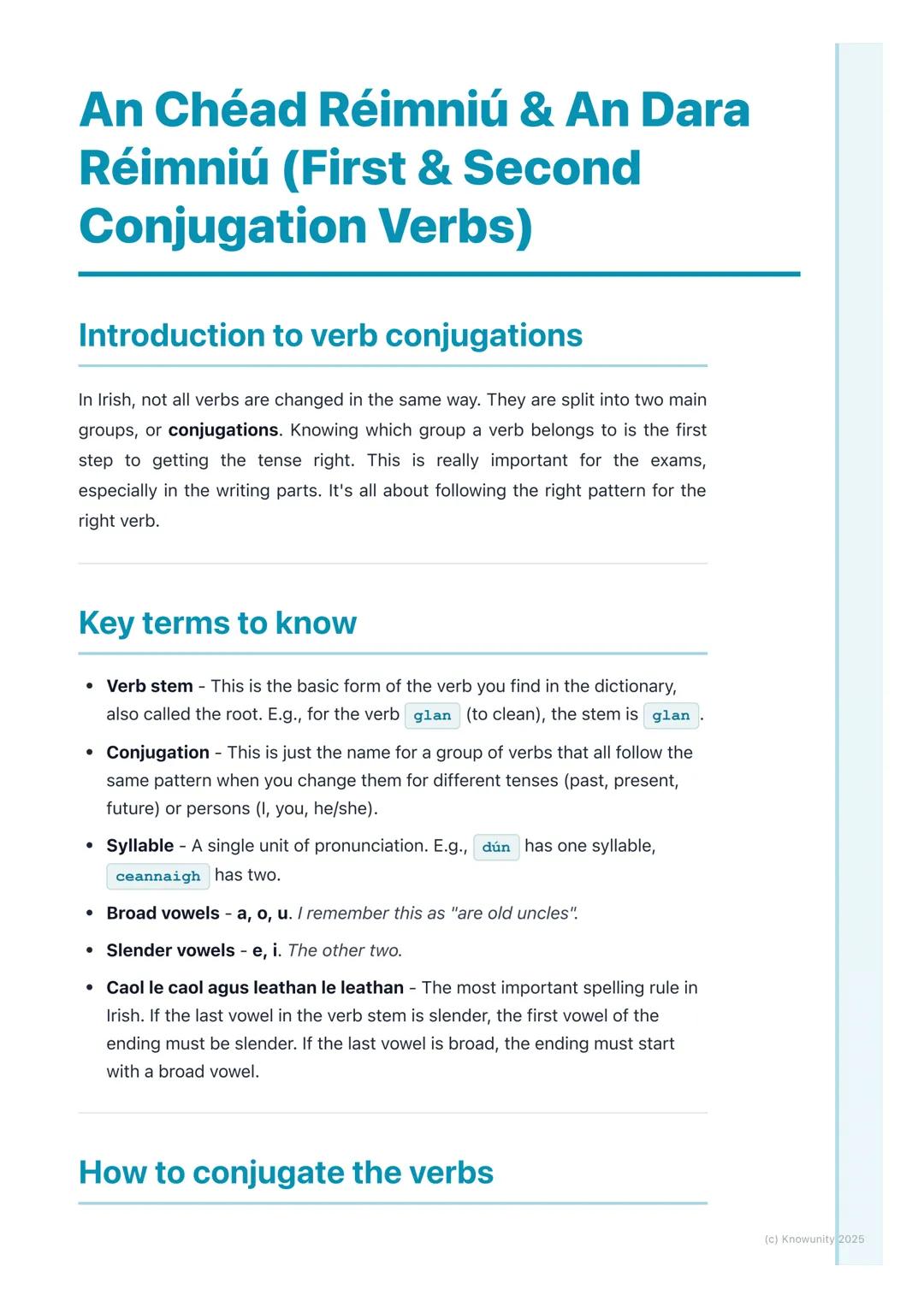
Understanding Irish Verb Conjugations
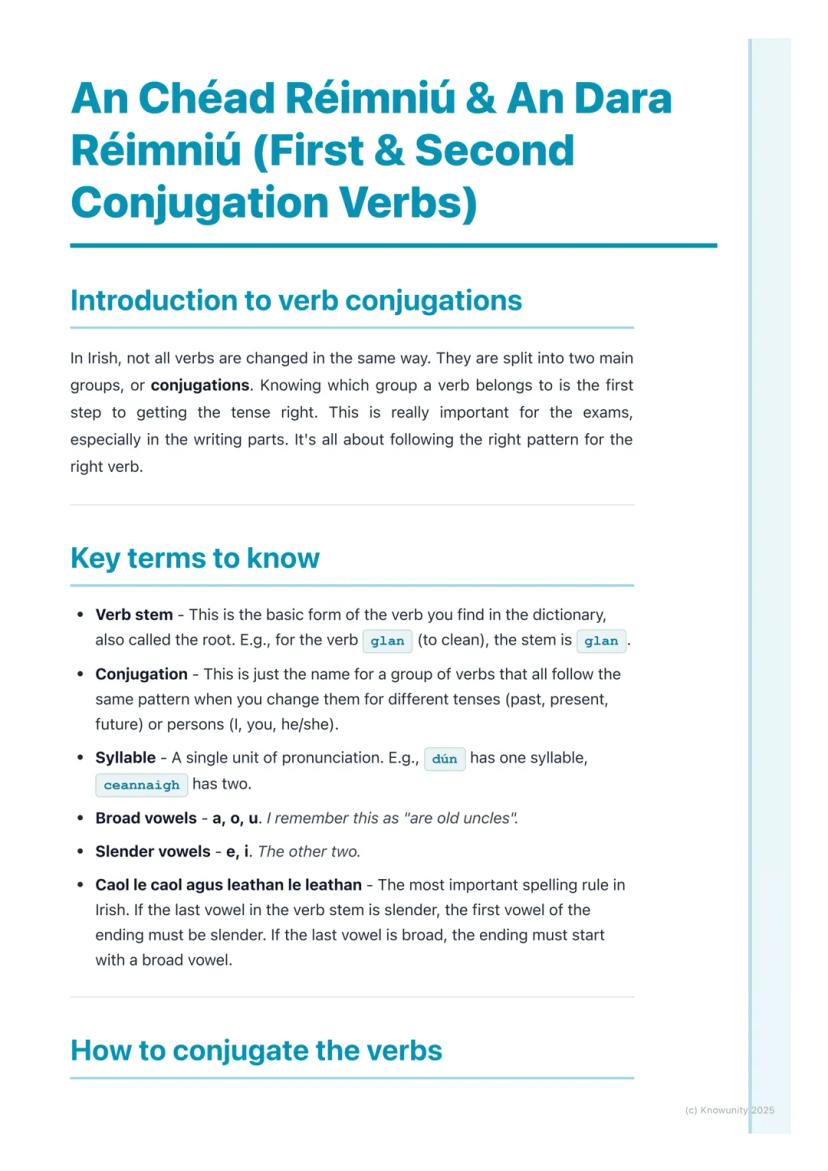
Getting your head around Irish verb conjugations is absolutely crucial for your exams, especially in the writing sections. The good news? Once you crack the system, it becomes much easier than you think.
Irish verbs are split into two main groups called conjugations. Think of these as different teams that follow their own playbook. The verb stem is just the basic dictionary form of the verb - like glan (to clean) or dún (to close).
Here's a game-changer: caol le caol agus leathan le leathan is the most important spelling rule you'll ever learn in Irish. If the last vowel in your verb stem is slender (e, i), your ending must start with a slender vowel. If it's broad (a, o, u), your ending must start with a broad vowel.
Quick tip: Remember broad vowels as "are old uncles" - a, o, u. The slender vowels are just e and i!
2
of 6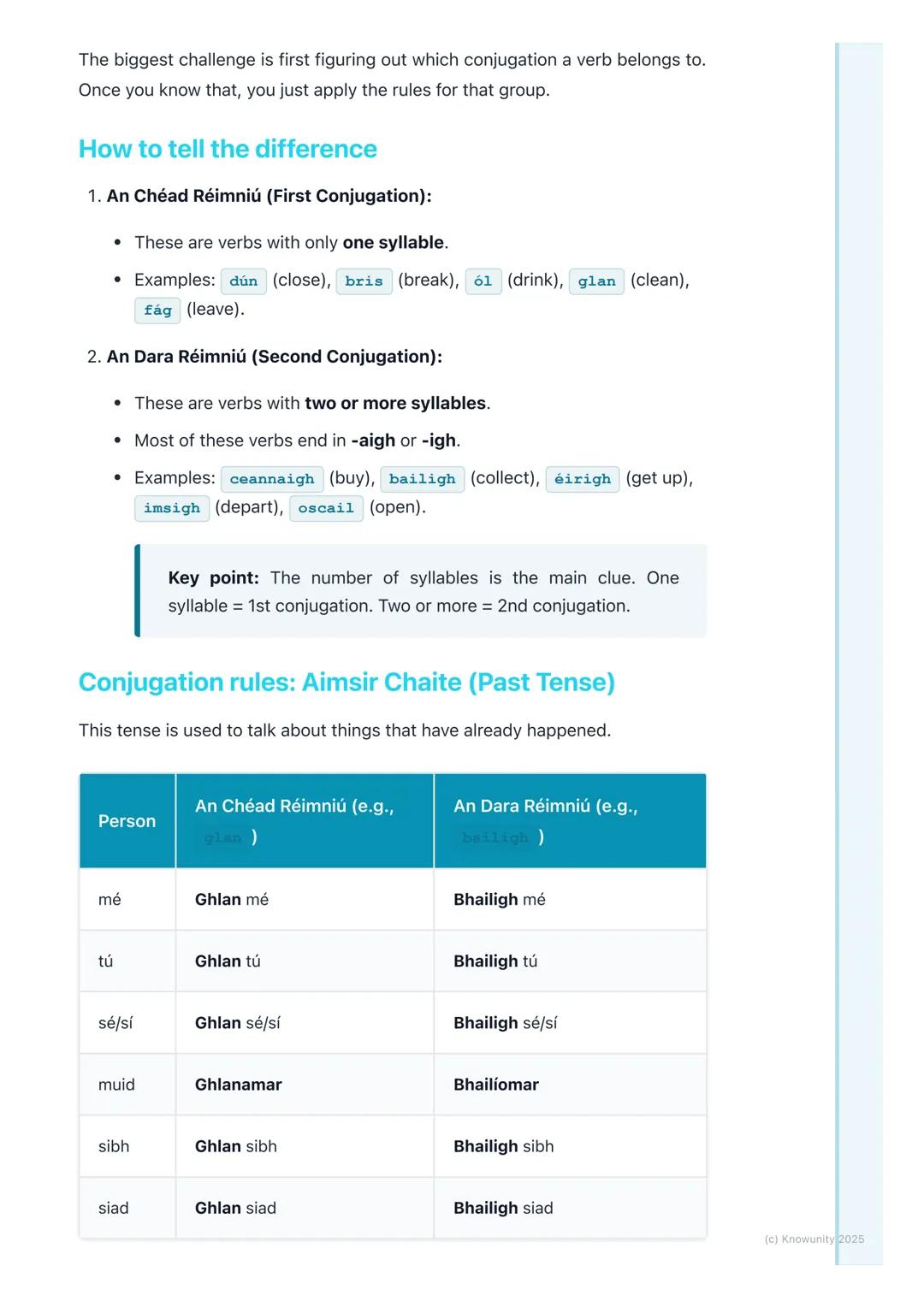
Telling the Conjugations Apart
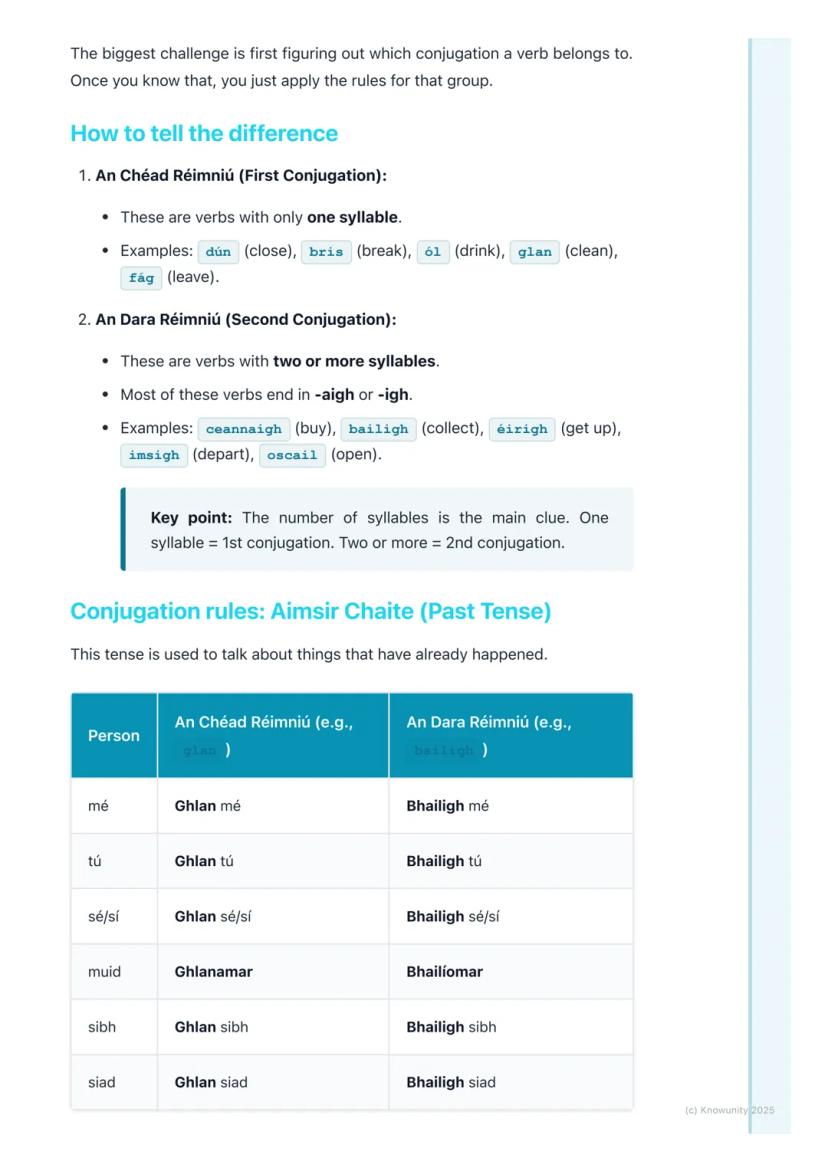
The secret to mastering first conjugation and second conjugation verbs is surprisingly simple - just count the syllables! It's honestly that straightforward.
An Chéad Réimniú (First Conjugation) includes all verbs with just one syllable. Think of verbs like dún (close), bris (break), ól (drink), and glan (clean). These are your short, snappy verbs.
An Dara Réimniú (Second Conjugation) covers verbs with two or more syllables. Most of these end in -aigh or -igh, like ceannaigh (buy), bailigh (collect), éirigh (get up), and oscail (open).
Remember: One syllable = first conjugation, two or more = second conjugation. Count those syllables and you're halfway there!
3
of 6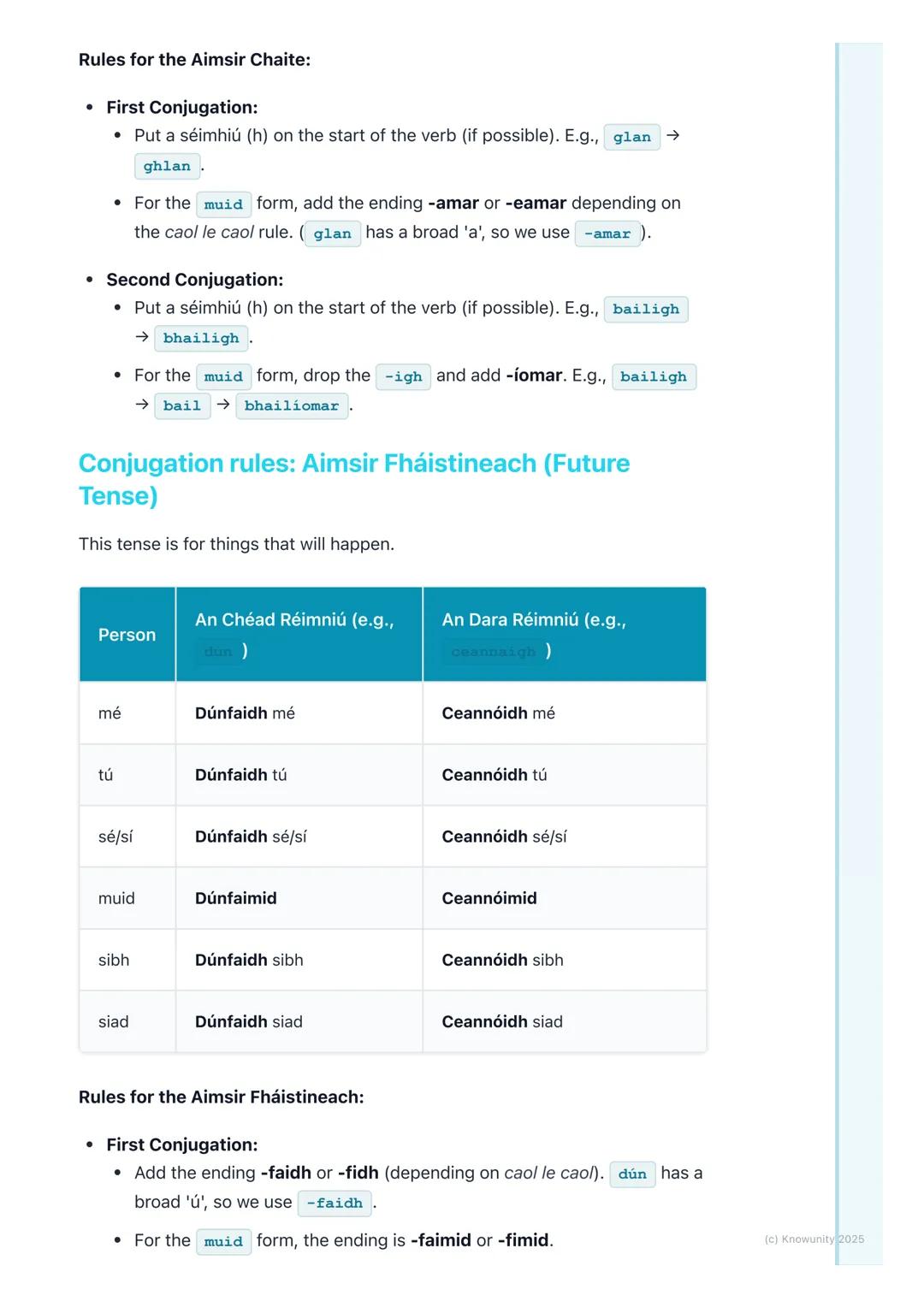
Past Tense (Aimsir Chaite)
The past tense is your go-to for describing things that have already happened, and the patterns are actually quite predictable once you get the hang of them.
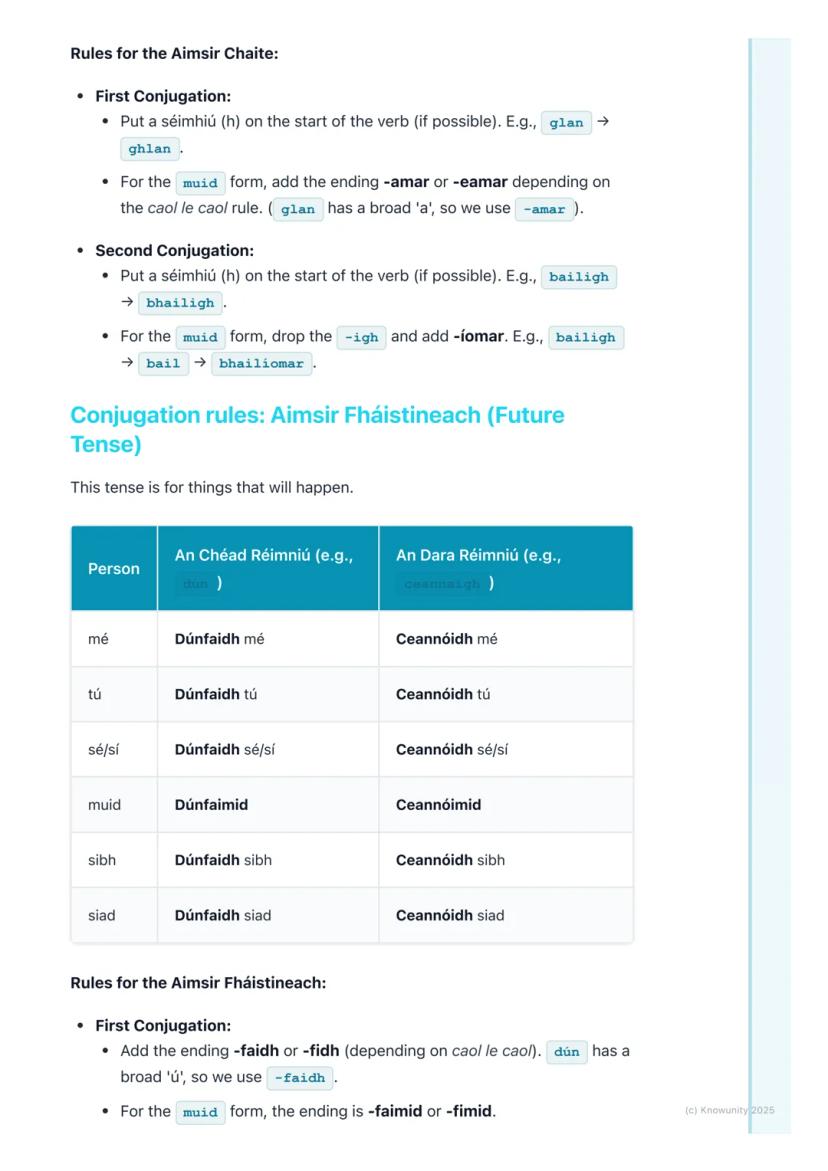
For first conjugation verbs, you add a séimhiú (that's the 'h' after the first letter) to the start. So glan becomes ghlan. For the muid form, you tack on -amar or -eamar depending on that golden rule - ghlanamar in this case.
Second conjugation verbs also get the séimhiú treatment - bailigh becomes bhailigh. But here's where it gets interesting: for the muid form, you drop the -igh and add -íomar. So bailigh becomes bhailíomar.
Watch out: Verbs starting with vowels, l, n, r, or f can't take a séimhiú. Instead, you might need to add d' before them, like d'ól mé.
4
of 6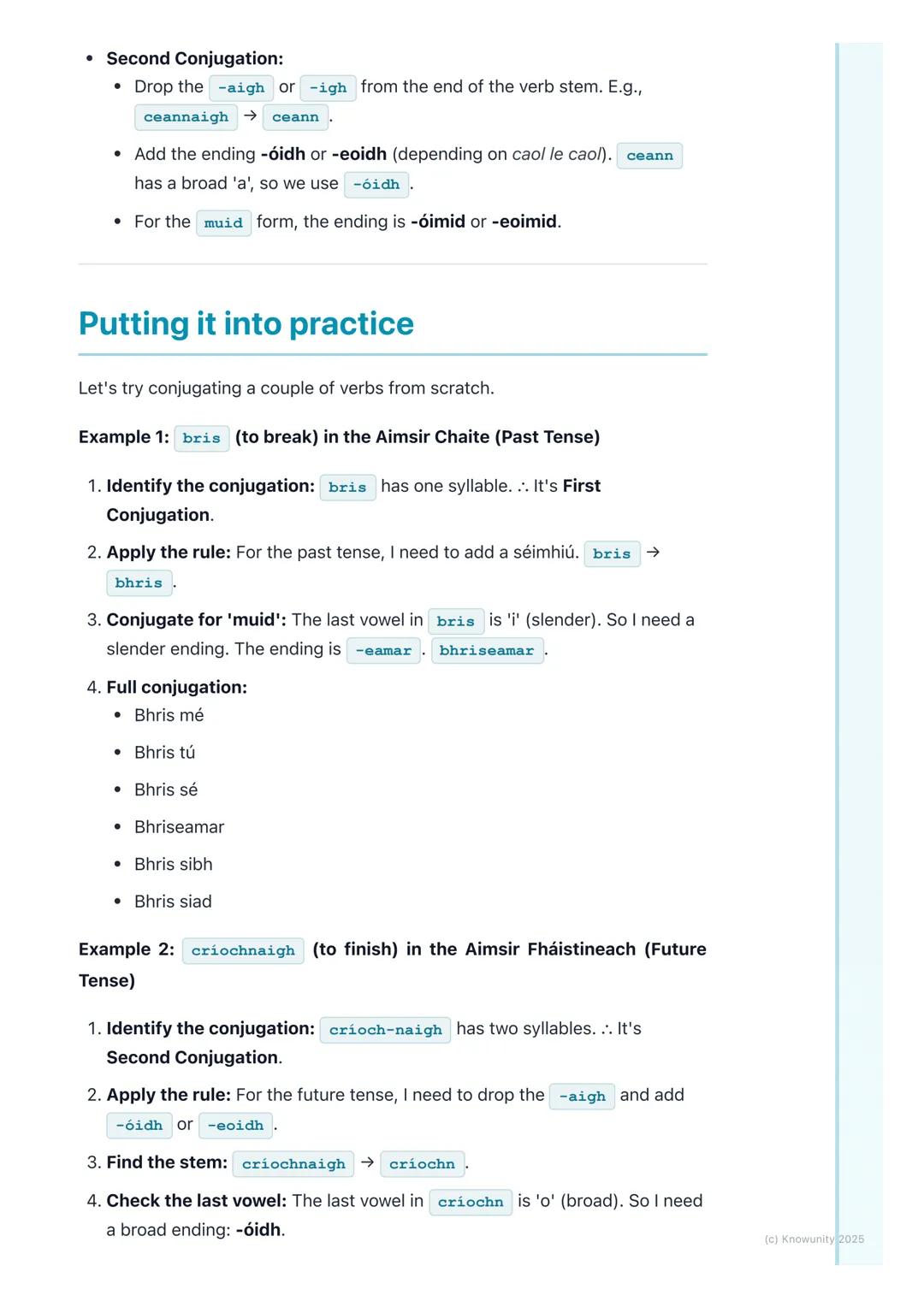
Future Tense (Aimsir Fháistineach)
The future tense is brilliant for talking about what's going to happen, and it follows some really clear patterns that'll make your life easier.
First conjugation verbs get -faidh or -fidh added to the end, following our caol le caol rule. So dún becomes dúnfaidh. For the muid form, use -faimid or -fimid - giving you dúnfaimid.
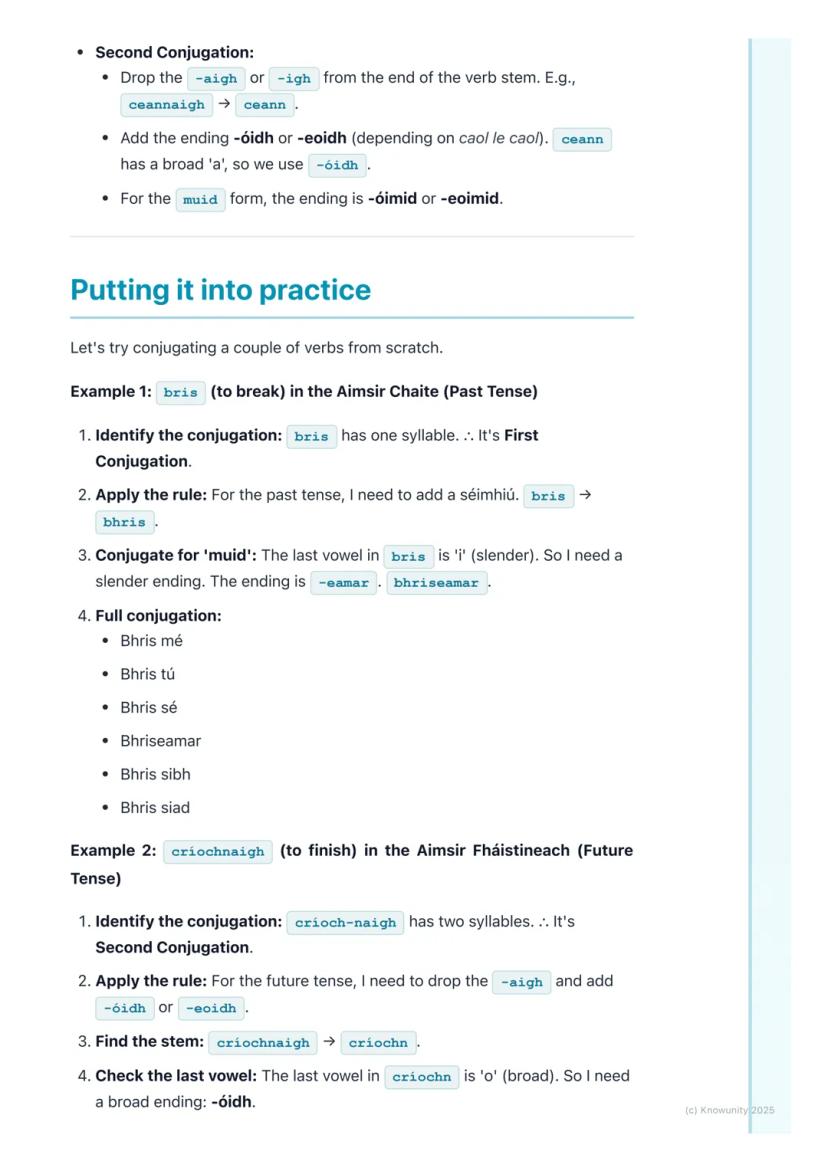
Second conjugation verbs need a bit more work. First, drop that -aigh or -igh from the end - ceannaigh becomes ceann. Then add -óidh or -eoidh depending on whether the last vowel is broad or slender. Since ceann ends with broad 'a', we get ceannóidh.
Critical mistake to avoid: Never write ceannaighfidh! You must drop the -aigh first, then add the future ending.
5
of 6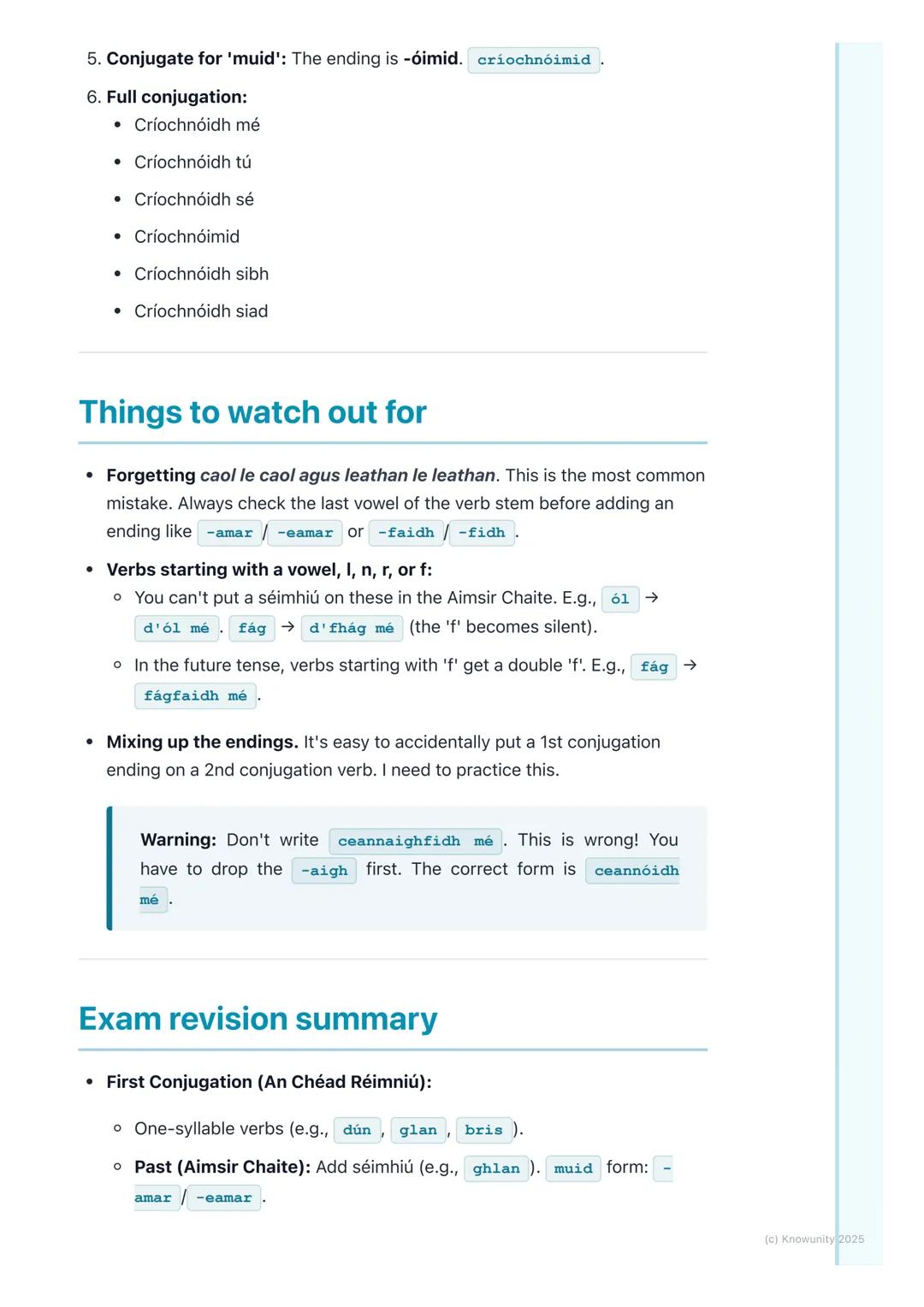
Working Through Examples
Let's put this into practice with some real examples that'll show you exactly how this works in action.
Take bris (to break) in the past tense. It's one syllable, so it's first conjugation. Add the séimhiú to get bhris, and for muid, the 'i' is slender so we need -eamar: bhriseamar. Simple as that!
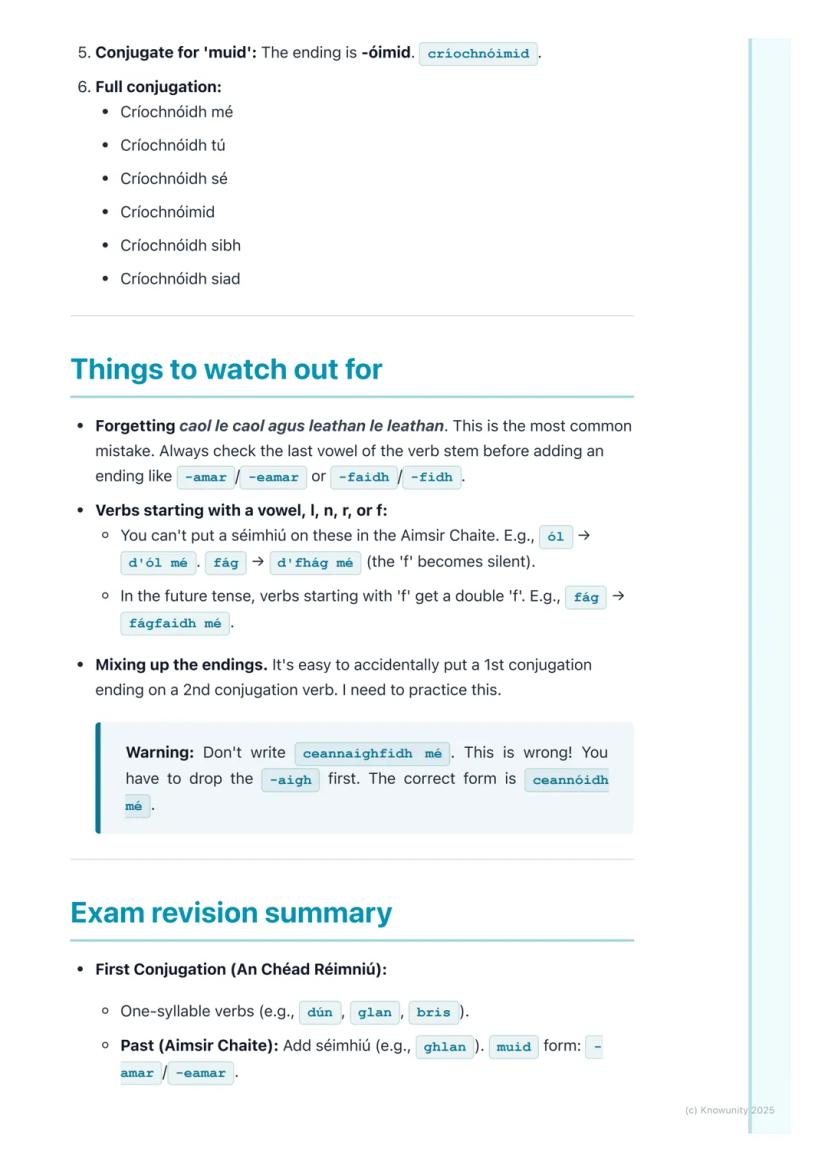
Now try críochnaigh (to finish) in the future tense. Two syllables means second conjugation. Drop the -aigh to get críochn, then since the 'o' is broad, add -óidh: críochnóidh. The muid form becomes críochnóimid.
The key is following the steps methodically - identify the conjugation, apply the right rule, check your vowels, and you're sorted. Practice with different verbs and you'll spot the patterns quickly.
Pro tip: Always identify which conjugation you're dealing with before you start changing anything. This one step will save you from most mistakes!
6
of 6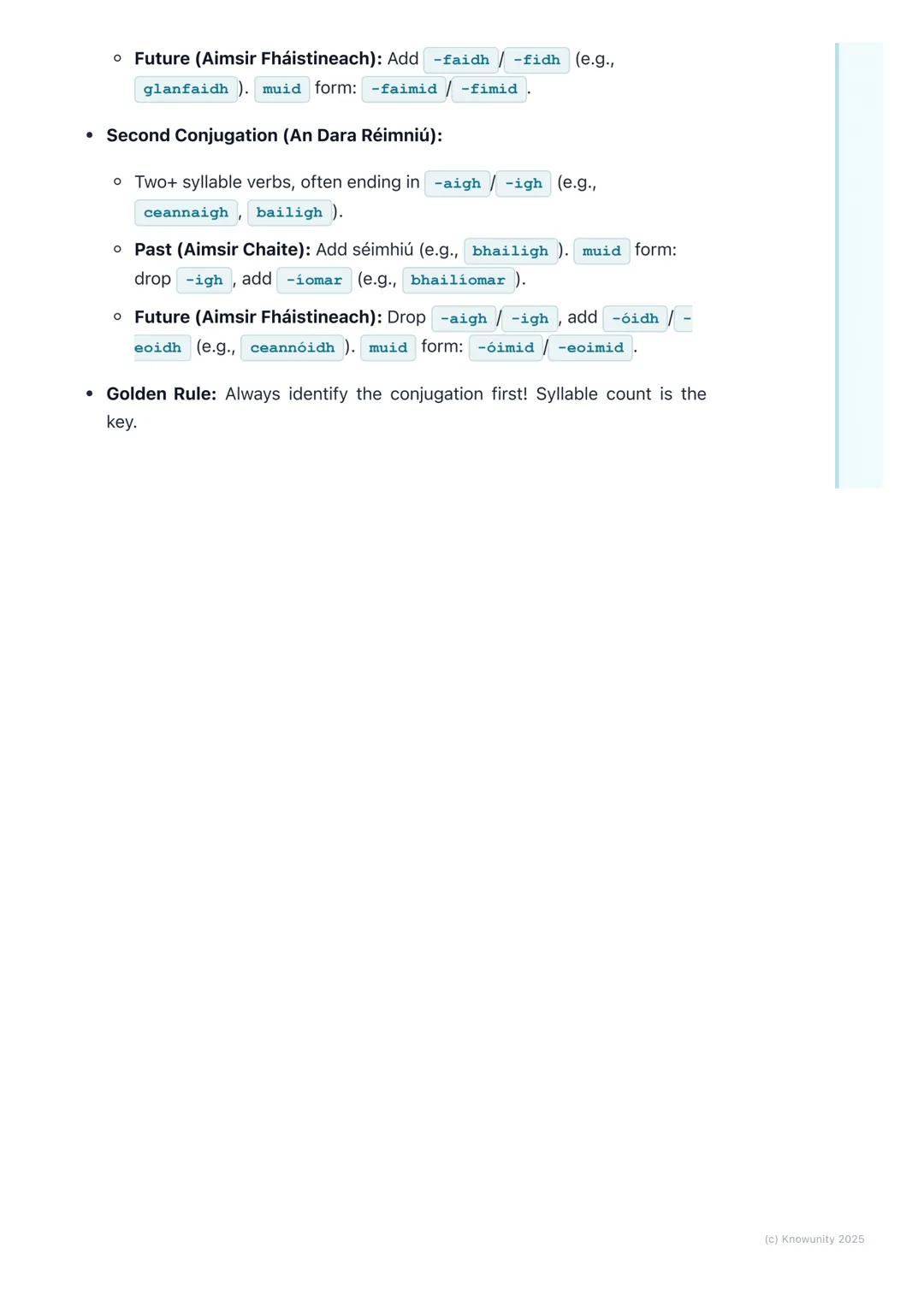
Exam Success Summary
Here's everything you need to remember for your exams, broken down into bite-sized chunks that'll stick in your memory.
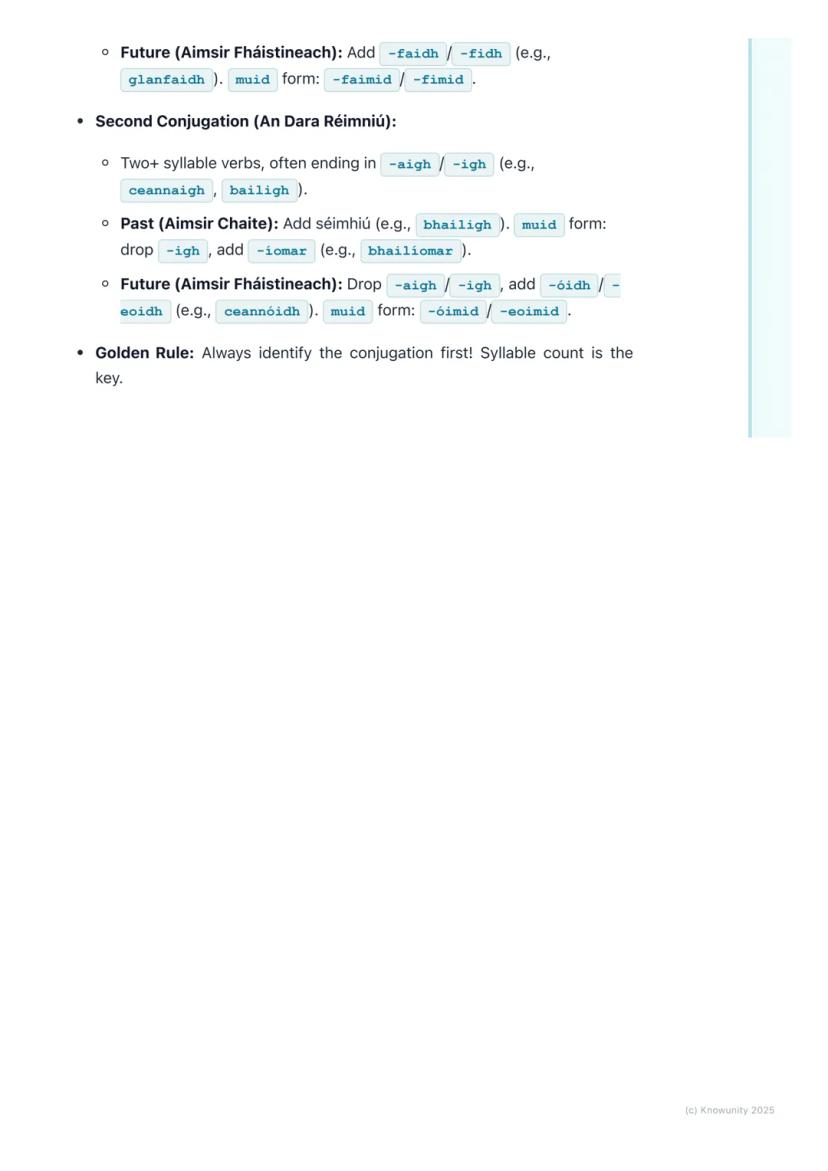
First conjugation verbs have one syllable (like dún, glan, bris). In the past tense, add séimhiú and use -amar/-eamar for muid. In the future, add -faidh/-fidh and -faimid/-fimid for muid.
Second conjugation verbs have two or more syllables, often ending in -aigh/-igh (like ceannaigh, bailigh). Past tense gets séimhiú, with muid dropping -igh and adding -íomar. Future tense drops -aigh/-igh and adds -óidh/-eoidh, with muid getting -óimid/-eoimid.
Remember: count syllables first, follow the pattern for that conjugation, and always check your caol le caol rule. You've absolutely got this!
Final reminder: The syllable count is your compass - it'll always point you in the right direction for which conjugation to use.
Achamos que você nunca perguntaria...
O que é o assistente de IA da Knowunity?
Nosso companheiro de IA foi criado especificamente para atender às necessidades dos estudantes. Com base nos milhões de conteúdos que temos na plataforma, podemos oferecer respostas realmente relevantes e significativas. Mas não se trata apenas de respostas, o companheiro também está aqui para guiar você pelos desafios diários de aprendizado, com planos de estudo personalizados, quizzes ou conteúdos no chat e 100% de personalização com base nas suas habilidades e desenvolvimentos.
Onde posso baixar o app da Knowunity?
Pode descarregar a aplicação na Google Play Store e na Apple App Store.
Como posso receber meu pagamento? Quanto posso ganhar?
Sim, tem acesso gratuito ao conteúdo da aplicação e ao nosso companheiro de IA. Para desbloquear determinadas funcionalidades da aplicação, pode adquirir o Knowunity Pro.
Conteúdos mais populares de Irish
9IrishIrish oral questions and answers
Questions and answers for the leaving cert oral
5th Year4264
IrishIrish oral questions
Outline of oral questions
5th Year2055
IrishIrish poetry 2027
Iníon + Dínit an Bhróin
5th Year1133
IrishIníon- le hÁine Durkin
Aine Durkin’s poem, Iníon: Themes & summary
5th Year850
IrishLC HL notes- Iníon (poem)
Includes poem in English and Irish, theme, key words & phrases
5th Year2284
IrishMo Ghrá-sa (Idir Lúibíní)
Notes on mo ghrá-sa
5th Year380
IrishGaeilge Grammar Office
All the basics you need to know on Irish grammar.
6th Year1063
IrishAn Gaeilge Aiste
Irish Language essay
6th Year1320
IrishMé Féin & Mo Chlann (Myself & My Family)
Students will learn vocabulary to describe themselves, their family members, and daily routines. This helps in personal introductions and discussions.
TY291
Conteúdos mais populares
9IrishIrish oral questions and answers
Questions and answers for the leaving cert oral
5th Year4264
 English
Key Quotes : Sive
Key Quotes and explanations: Sive
6th Year2842
IrishIrish oral questions
Outline of oral questions
5th Year2055
IrishIníon- le hÁine Durkin
Aine Durkin’s poem, Iníon: Themes & summary
5th Year850
IrishIrish poetry 2027
Iníon + Dínit an Bhróin
5th Year1133
IrishLC HL notes- Iníon (poem)
Includes poem in English and Irish, theme, key words & phrases
5th Year2284
EnglishCultural Context : Shawshank Redemption : Sive : Small Things Like These
Comparative Study : Cultural Context : Shawshank Redemption, Sive and Small Things Like These
6th Year1430
IrishMo Ghrá-sa (Idir Lúibíní)
Notes on mo ghrá-sa
5th Year380
IrishAn Gaeilge Aiste
Irish Language essay
6th Year1320
Não encontrou o que procurava? Explore outras matérias.
Avaliações dos nossos usuários. Eles gostaram de tudo — e você também vai gostar.
4.6/5App Store
4.7/5Google Play
O app é muito fácil de usar e bem projetado. Encontrei tudo o que estava procurando até agora e consegui aprender muito com as apresentações! Definitivamente vou usar o app para uma tarefa de classe! E, claro, também ajuda muito como inspiração.
Stefan Susuário de iOS
Este app é realmente ótimo. Tem muitos materiais de estudo e ajuda [...]. Minha matéria problemática é o francês, por exemplo, e o app tem tantas opções de ajuda. Graças a este app, eu melhorei meu francês. Eu recomendaria para qualquer pessoa.
Samantha Klichusuária de Android
Uau, estou realmente impressionado. Eu experimentei o app porque vi muitos anúncios e fiquei absolutamente maravilhado. Este app é A AJUDA que você quer para a escola e, acima de tudo, oferece muitas coisas, como treinos e resumos, que têm sido MUITO úteis para mim pessoalmente.
Annausuária de iOS
Irish3 visualizações·Atualizado Jun 4, 2026·6 páginasIrish Verb Conjugations Explained: First and Second Types
Learning Irish verb conjugations might seem daunting, but it's actually quite straightforward once you know the patterns. All Irish verbs fall into two main groups based on how many syllables they have, and each group follows its own set of...
1
of 6
Cadastre-se para ver o conteúdo. É grátis!
- Acesso a todos os documentos
- Melhore suas notas
- Junte-se a milhões de estudantes
Understanding Irish Verb Conjugations
Getting your head around Irish verb conjugations is absolutely crucial for your exams, especially in the writing sections. The good news? Once you crack the system, it becomes much easier than you think.
Irish verbs are split into two main groups called conjugations. Think of these as different teams that follow their own playbook. The verb stem is just the basic dictionary form of the verb - like glan (to clean) or dún (to close).
Here's a game-changer: caol le caol agus leathan le leathan is the most important spelling rule you'll ever learn in Irish. If the last vowel in your verb stem is slender (e, i), your ending must start with a slender vowel. If it's broad (a, o, u), your ending must start with a broad vowel.
Quick tip: Remember broad vowels as "are old uncles" - a, o, u. The slender vowels are just e and i!
2
of 6Cadastre-se para ver o conteúdo. É grátis!
- Acesso a todos os documentos
- Melhore suas notas
- Junte-se a milhões de estudantes
Telling the Conjugations Apart
The secret to mastering first conjugation and second conjugation verbs is surprisingly simple - just count the syllables! It's honestly that straightforward.
An Chéad Réimniú (First Conjugation) includes all verbs with just one syllable. Think of verbs like dún (close), bris (break), ól (drink), and glan (clean). These are your short, snappy verbs.
An Dara Réimniú (Second Conjugation) covers verbs with two or more syllables. Most of these end in -aigh or -igh, like ceannaigh (buy), bailigh (collect), éirigh (get up), and oscail (open).
Remember: One syllable = first conjugation, two or more = second conjugation. Count those syllables and you're halfway there!
3
of 6Cadastre-se para ver o conteúdo. É grátis!
- Acesso a todos os documentos
- Melhore suas notas
- Junte-se a milhões de estudantes
Past Tense (Aimsir Chaite)
The past tense is your go-to for describing things that have already happened, and the patterns are actually quite predictable once you get the hang of them.
For first conjugation verbs, you add a séimhiú (that's the 'h' after the first letter) to the start. So glan becomes ghlan. For the muid form, you tack on -amar or -eamar depending on that golden rule - ghlanamar in this case.
Second conjugation verbs also get the séimhiú treatment - bailigh becomes bhailigh. But here's where it gets interesting: for the muid form, you drop the -igh and add -íomar. So bailigh becomes bhailíomar.
Watch out: Verbs starting with vowels, l, n, r, or f can't take a séimhiú. Instead, you might need to add d' before them, like d'ól mé.
4
of 6Cadastre-se para ver o conteúdo. É grátis!
- Acesso a todos os documentos
- Melhore suas notas
- Junte-se a milhões de estudantes
Future Tense (Aimsir Fháistineach)
The future tense is brilliant for talking about what's going to happen, and it follows some really clear patterns that'll make your life easier.
First conjugation verbs get -faidh or -fidh added to the end, following our caol le caol rule. So dún becomes dúnfaidh. For the muid form, use -faimid or -fimid - giving you dúnfaimid.
Second conjugation verbs need a bit more work. First, drop that -aigh or -igh from the end - ceannaigh becomes ceann. Then add -óidh or -eoidh depending on whether the last vowel is broad or slender. Since ceann ends with broad 'a', we get ceannóidh.
Critical mistake to avoid: Never write ceannaighfidh! You must drop the -aigh first, then add the future ending.
5
of 6Cadastre-se para ver o conteúdo. É grátis!
- Acesso a todos os documentos
- Melhore suas notas
- Junte-se a milhões de estudantes
Working Through Examples
Let's put this into practice with some real examples that'll show you exactly how this works in action.
Take bris (to break) in the past tense. It's one syllable, so it's first conjugation. Add the séimhiú to get bhris, and for muid, the 'i' is slender so we need -eamar: bhriseamar. Simple as that!
Now try críochnaigh (to finish) in the future tense. Two syllables means second conjugation. Drop the -aigh to get críochn, then since the 'o' is broad, add -óidh: críochnóidh. The muid form becomes críochnóimid.
The key is following the steps methodically - identify the conjugation, apply the right rule, check your vowels, and you're sorted. Practice with different verbs and you'll spot the patterns quickly.
Pro tip: Always identify which conjugation you're dealing with before you start changing anything. This one step will save you from most mistakes!
6
of 6Cadastre-se para ver o conteúdo. É grátis!
- Acesso a todos os documentos
- Melhore suas notas
- Junte-se a milhões de estudantes
Exam Success Summary
Here's everything you need to remember for your exams, broken down into bite-sized chunks that'll stick in your memory.
First conjugation verbs have one syllable (like dún, glan, bris). In the past tense, add séimhiú and use -amar/-eamar for muid. In the future, add -faidh/-fidh and -faimid/-fimid for muid.
Second conjugation verbs have two or more syllables, often ending in -aigh/-igh (like ceannaigh, bailigh). Past tense gets séimhiú, with muid dropping -igh and adding -íomar. Future tense drops -aigh/-igh and adds -óidh/-eoidh, with muid getting -óimid/-eoimid.
Remember: count syllables first, follow the pattern for that conjugation, and always check your caol le caol rule. You've absolutely got this!
Final reminder: The syllable count is your compass - it'll always point you in the right direction for which conjugation to use.
Achamos que você nunca perguntaria...
O que é o assistente de IA da Knowunity?
Nosso companheiro de IA foi criado especificamente para atender às necessidades dos estudantes. Com base nos milhões de conteúdos que temos na plataforma, podemos oferecer respostas realmente relevantes e significativas. Mas não se trata apenas de respostas, o companheiro também está aqui para guiar você pelos desafios diários de aprendizado, com planos de estudo personalizados, quizzes ou conteúdos no chat e 100% de personalização com base nas suas habilidades e desenvolvimentos.
Onde posso baixar o app da Knowunity?
Pode descarregar a aplicação na Google Play Store e na Apple App Store.
Como posso receber meu pagamento? Quanto posso ganhar?
Sim, tem acesso gratuito ao conteúdo da aplicação e ao nosso companheiro de IA. Para desbloquear determinadas funcionalidades da aplicação, pode adquirir o Knowunity Pro.
Conteúdos mais populares de Irish
9IrishIrish oral questions and answers
Questions and answers for the leaving cert oral
5th Year4264
IrishIrish oral questions
Outline of oral questions
5th Year2055
IrishIrish poetry 2027
Iníon + Dínit an Bhróin
5th Year1133
IrishIníon- le hÁine Durkin
Aine Durkin’s poem, Iníon: Themes & summary
5th Year850
IrishLC HL notes- Iníon (poem)
Includes poem in English and Irish, theme, key words & phrases
5th Year2284
IrishMo Ghrá-sa (Idir Lúibíní)
Notes on mo ghrá-sa
5th Year380
IrishGaeilge Grammar Office
All the basics you need to know on Irish grammar.
6th Year1063
IrishAn Gaeilge Aiste
Irish Language essay
6th Year1320
IrishMé Féin & Mo Chlann (Myself & My Family)
Students will learn vocabulary to describe themselves, their family members, and daily routines. This helps in personal introductions and discussions.
TY291
Conteúdos mais populares
9IrishIrish oral questions and answers
Questions and answers for the leaving cert oral
5th Year4264
EnglishKey Quotes : Sive
Key Quotes and explanations: Sive
6th Year2842
IrishIrish oral questions
Outline of oral questions
5th Year2055
IrishIníon- le hÁine Durkin
Aine Durkin’s poem, Iníon: Themes & summary
5th Year850
IrishIrish poetry 2027
Iníon + Dínit an Bhróin
5th Year1133
IrishLC HL notes- Iníon (poem)
Includes poem in English and Irish, theme, key words & phrases
5th Year2284
EnglishCultural Context : Shawshank Redemption : Sive : Small Things Like These
Comparative Study : Cultural Context : Shawshank Redemption, Sive and Small Things Like These
6th Year1430
IrishMo Ghrá-sa (Idir Lúibíní)
Notes on mo ghrá-sa
5th Year380
IrishAn Gaeilge Aiste
Irish Language essay
6th Year1320
Não encontrou o que procurava? Explore outras matérias.
Avaliações dos nossos usuários. Eles gostaram de tudo — e você também vai gostar.
4.6/5App Store
4.7/5Google Play
O app é muito fácil de usar e bem projetado. Encontrei tudo o que estava procurando até agora e consegui aprender muito com as apresentações! Definitivamente vou usar o app para uma tarefa de classe! E, claro, também ajuda muito como inspiração.
Stefan Susuário de iOS
Este app é realmente ótimo. Tem muitos materiais de estudo e ajuda [...]. Minha matéria problemática é o francês, por exemplo, e o app tem tantas opções de ajuda. Graças a este app, eu melhorei meu francês. Eu recomendaria para qualquer pessoa.
Samantha Klichusuária de Android
Uau, estou realmente impressionado. Eu experimentei o app porque vi muitos anúncios e fiquei absolutamente maravilhado. Este app é A AJUDA que você quer para a escola e, acima de tudo, oferece muitas coisas, como treinos e resumos, que têm sido MUITO úteis para mim pessoalmente.
Annausuária de iOS