
Learning the German verb 'haben' (to have) is absolutely essential...
 German4 visualizações·Atualizado Jun 7, 2026·4 páginas
Mastering the German Verb 'haben' (to have)
1 / 4
1
of 4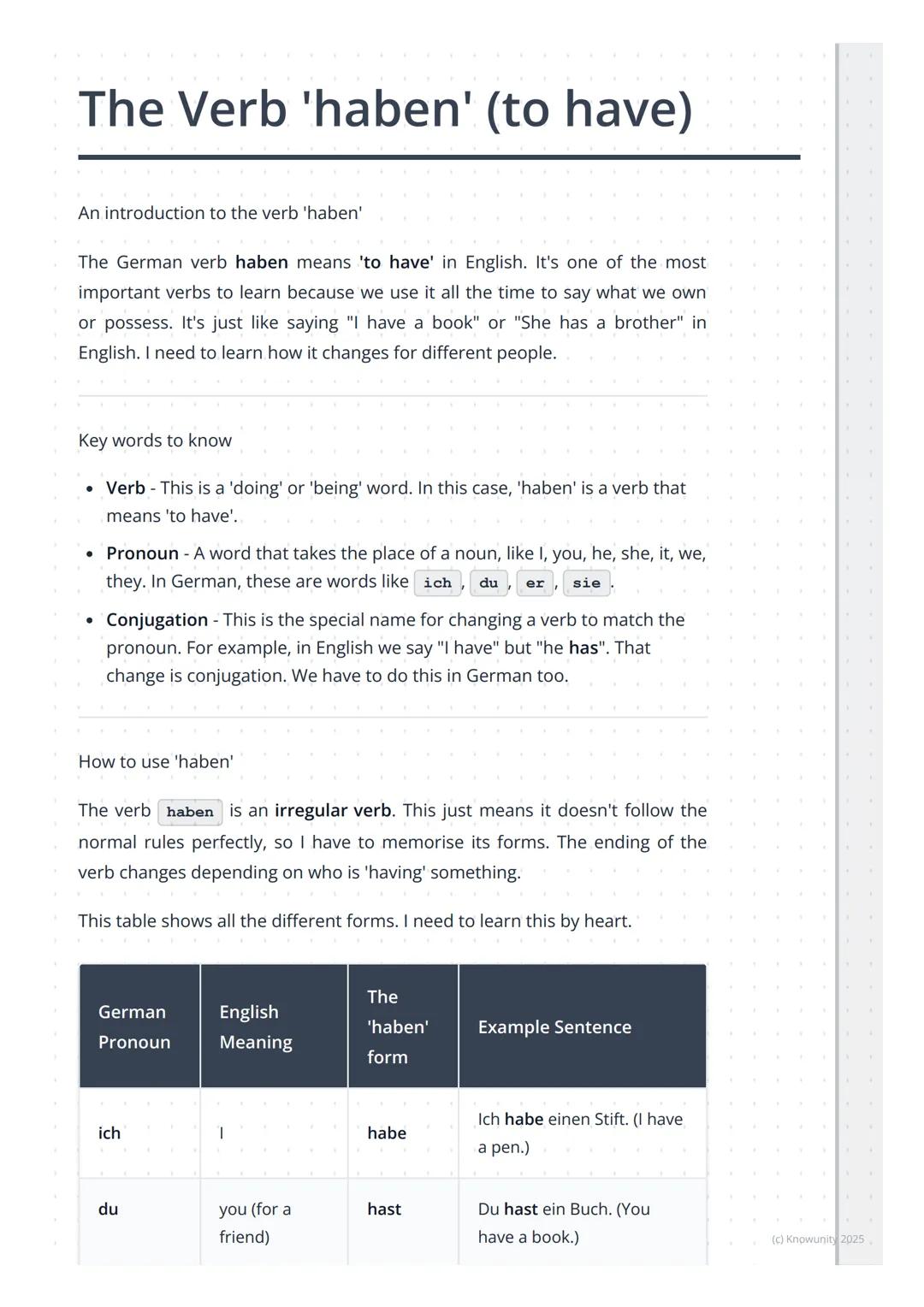
What is 'haben' and why does it matter?
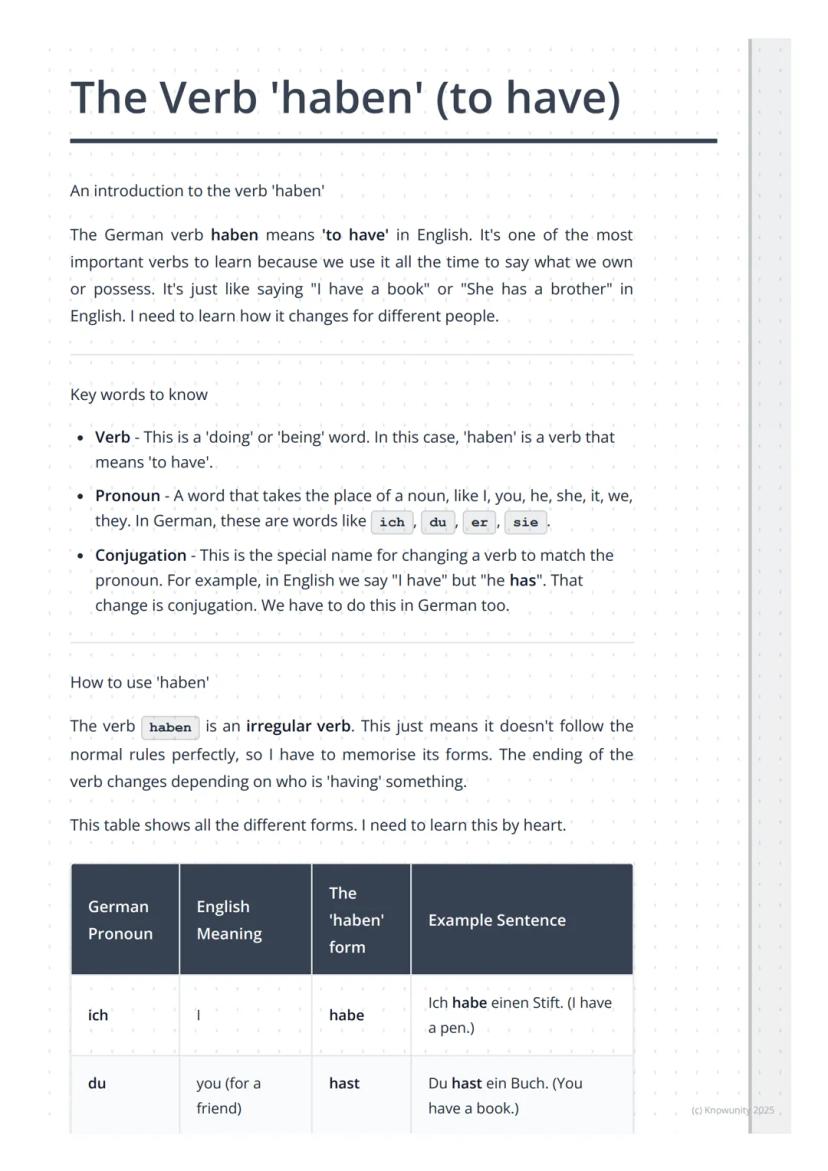
The German verb haben means 'to have' in English, and you'll use it loads to talk about what you own or possess. Think "I have a phone" or "My mate has a new bike" - that's haben in action!
Here's the thing though - haben is an irregular verb. This means it doesn't follow the normal patterns, so you can't just guess the endings. You've got to memorise how it changes for different people.
The key terms you need to know are conjugation (when verbs change to match different people) and pronouns (words like I, you, he, she). In German, these are ich, du, er, sie, and so on.
Quick Tip: Don't worry if this feels tricky at first - even native German speakers had to learn these patterns when they were young!
2
of 4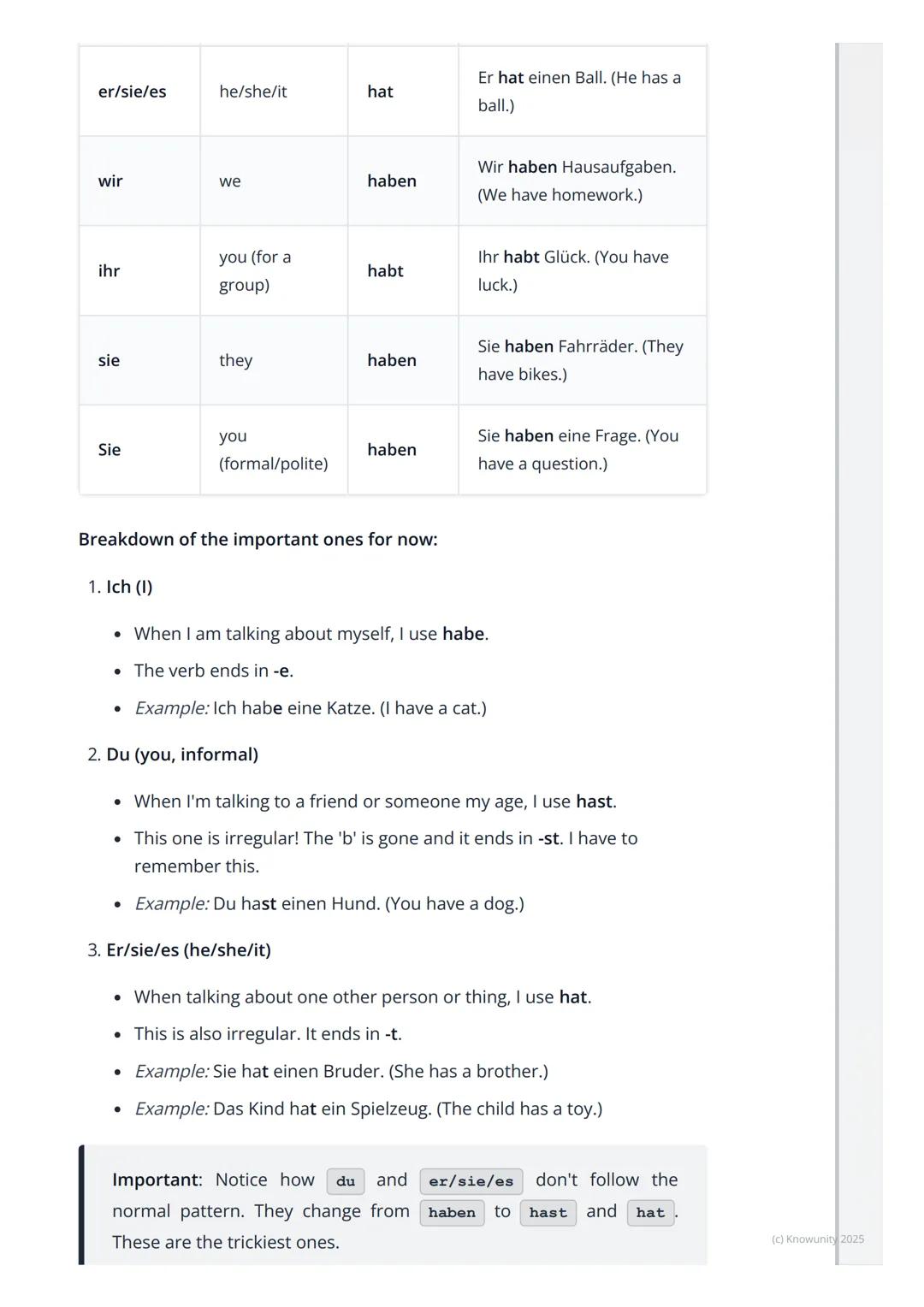
The haben forms you absolutely must know
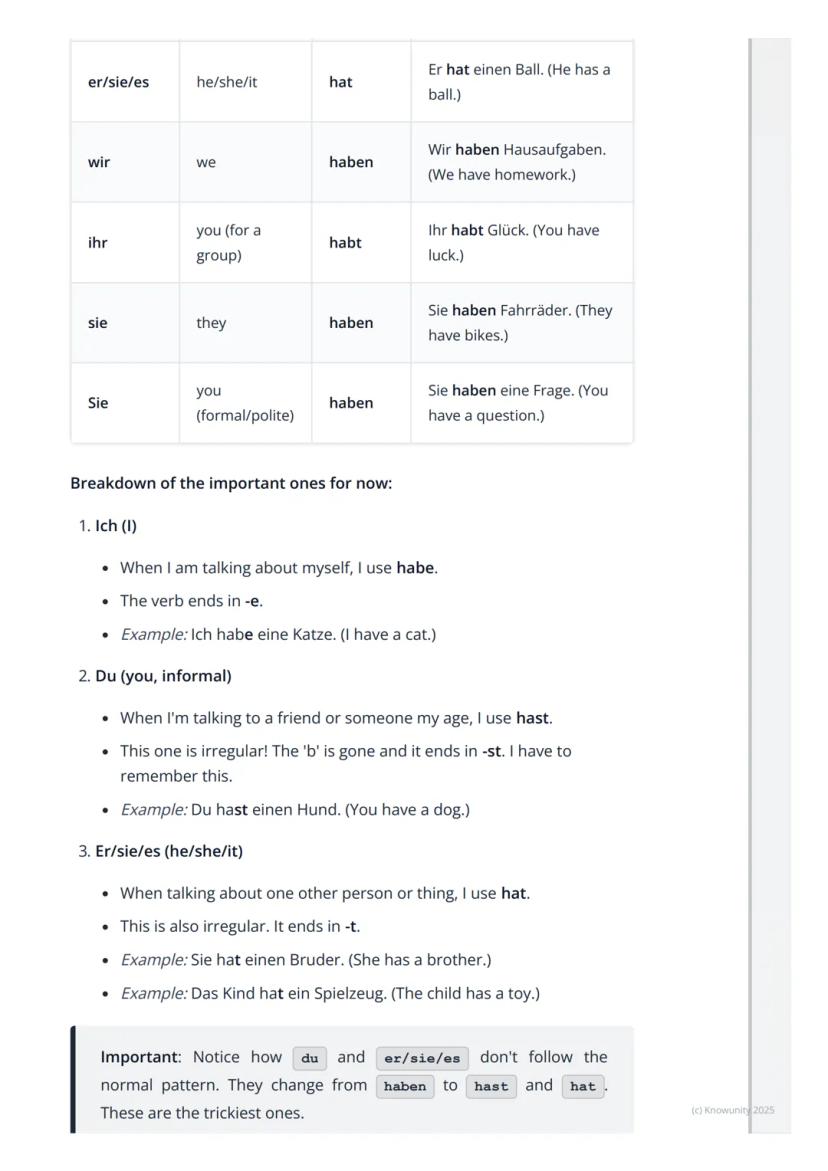
The three most important forms are the irregular ones that break the rules. Let's focus on these first: ich habe (I have), du hast (you have), and er/sie/es hat .
Notice how 'du hast' loses the 'b' completely - it's not 'du habst'! And 'hat' is super short compared to the original 'haben'. These two are the trickiest because they're so different.
The easier ones to remember are wir haben (we have) and sie haben (they have) because they stay the same as the original verb. There's also ihr habt (you all have), which just adds a 't' on the end.
Memory Trick: Think "Du HAST to remember this one!" for the du form - it's the most common mistake students make.
3
of 4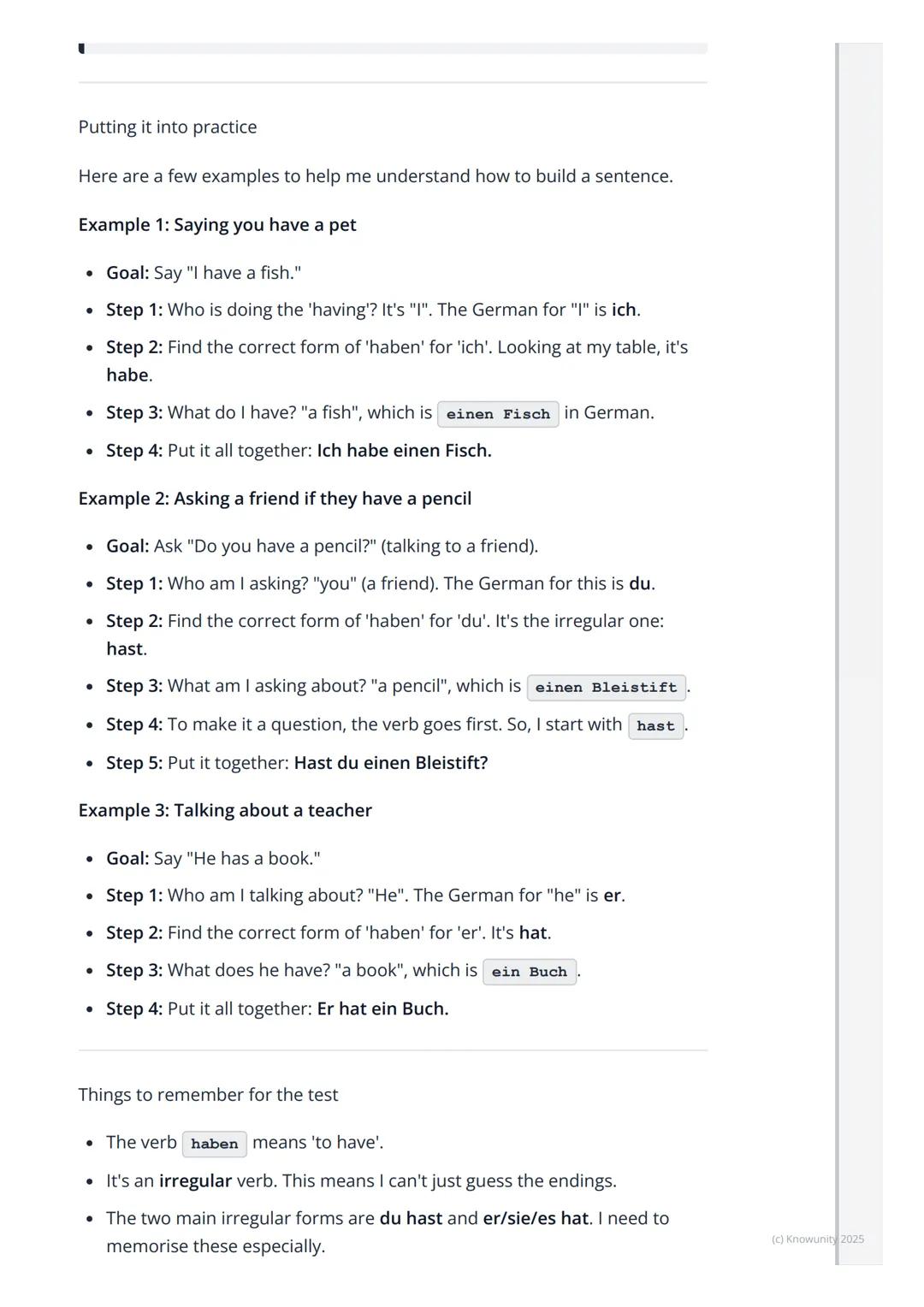
Building sentences with haben
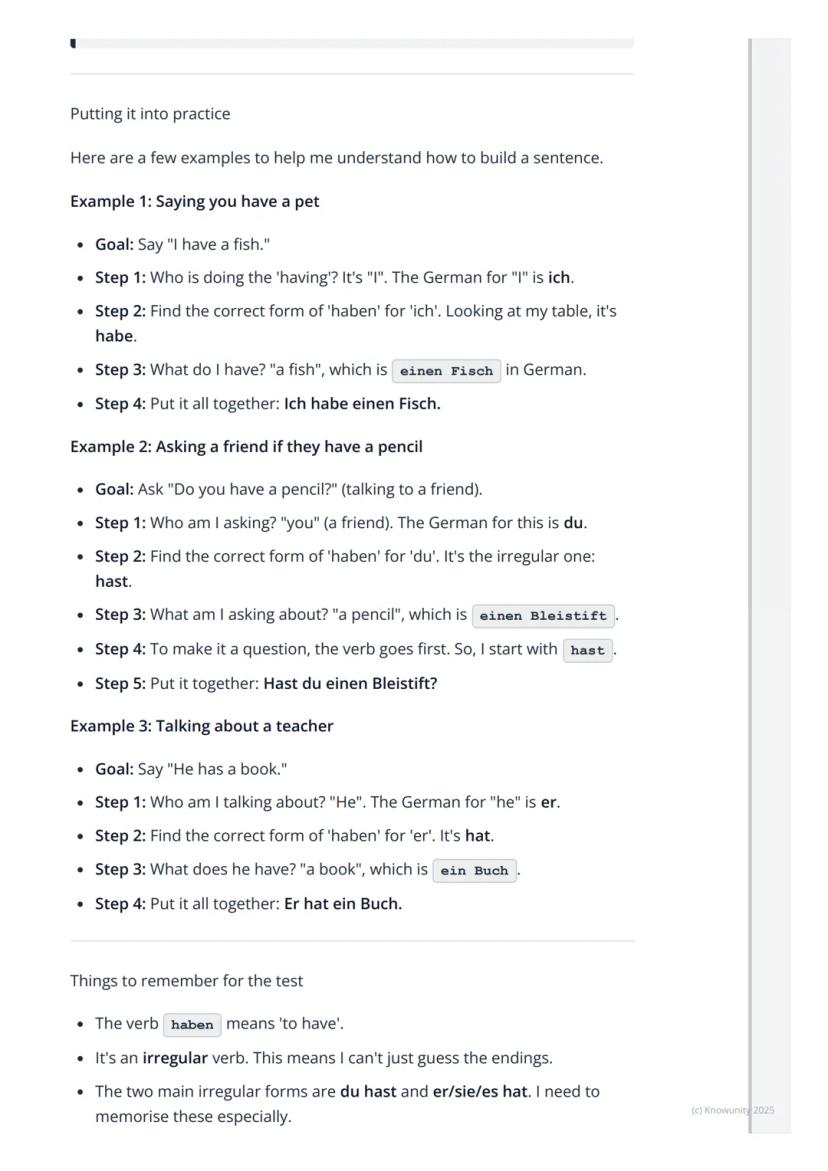
Let's put this into practice with real examples you might actually use! When saying "I have a cat", start with ich (I), then habe (have), then eine Katze (a cat). Simple as that: "Ich habe eine Katze."
For questions, flip the order around. Instead of "Du hast einen Stift" (You have a pen), ask "Hast du einen Stift?" (Do you have a pen?). The verb jumps to the front in German questions.
When talking about someone else, like "She has a brother", use sie hat einen Bruder. Remember, it's 'hat' not 'hast' because you're talking about her, not to her directly.
Pro Tip: Practice by describing what people in your class have - "Emma hat ein neues Handy" or "Wir haben Mathe heute."
4
of 4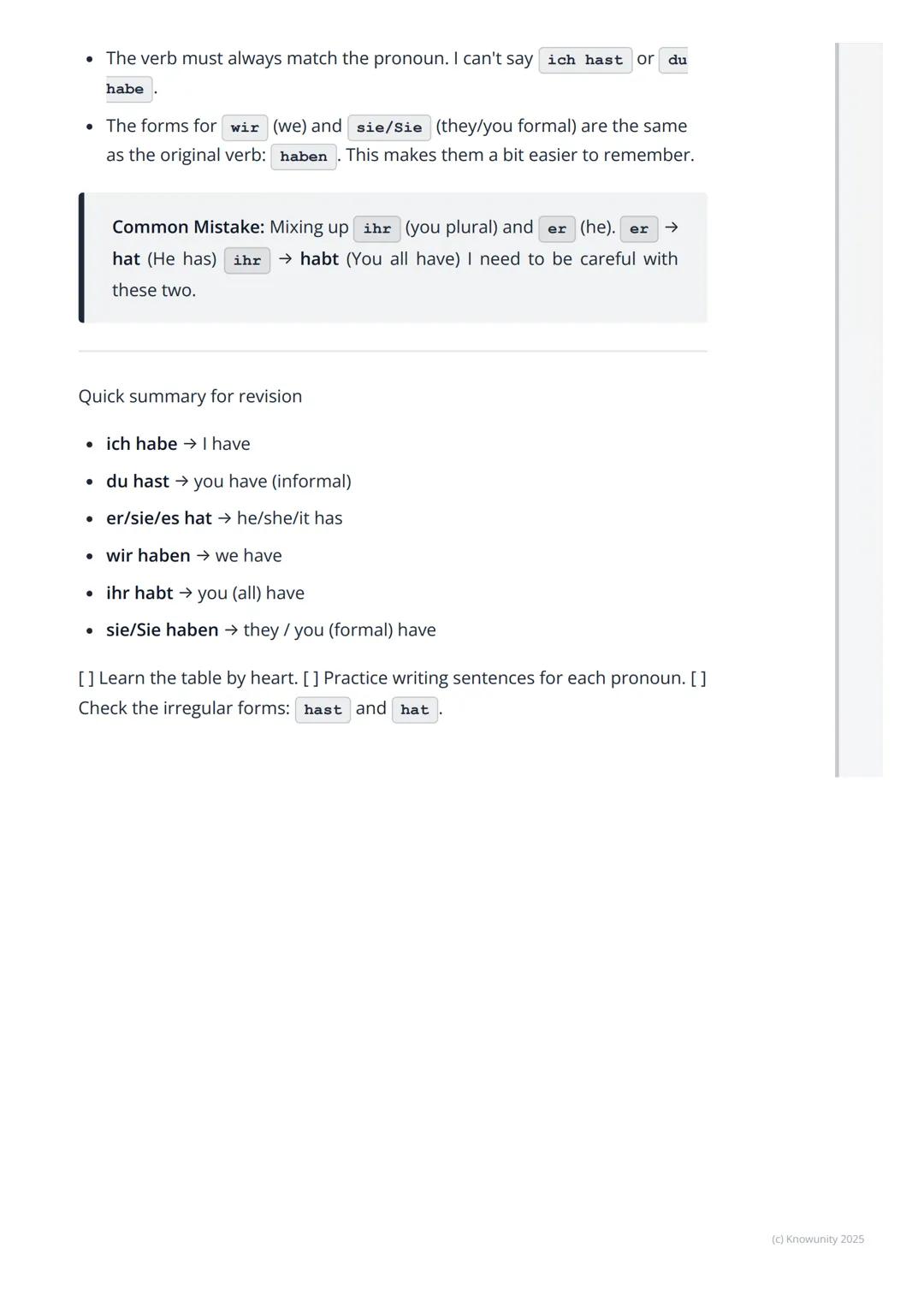
Avoiding the most common mistakes
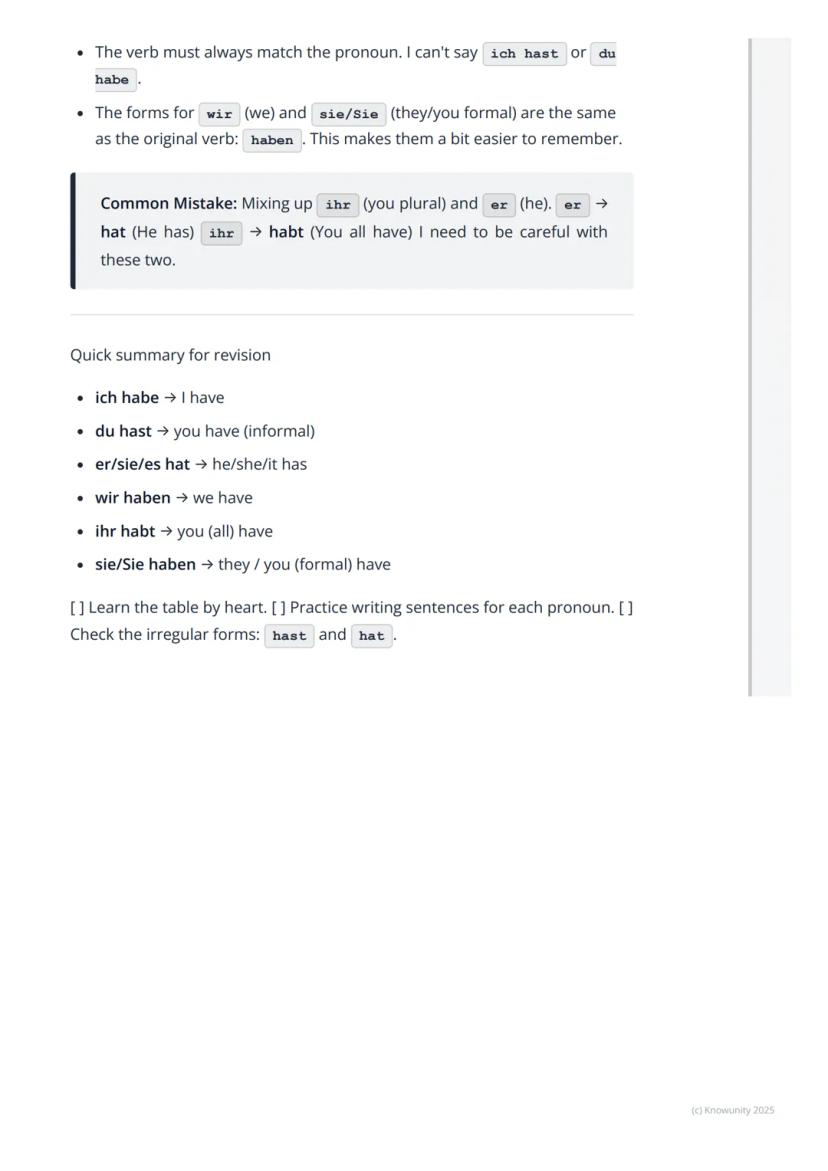
The biggest mistake is mixing up du hast and er hat. Remember: if you're talking TO someone (like your mate), use 'hast'. If you're talking ABOUT someone (like your teacher), use 'hat'.
Don't confuse ihr habt (you all have) with er hat (he has) either. 'Ihr' is when you're talking to a whole group of friends, whilst 'er' is just one person you're talking about.
Here's your quick revision list: ich habe, du hast, er/sie/es hat, wir haben, ihr habt, sie haben. The irregular ones (hast and hat) are your priority - get these rock solid first!
Test Prep: Make flashcards with just the tricky forms and quiz yourself daily until they're automatic.
Achamos que você nunca perguntaria...
O que é o assistente de IA da Knowunity?
Nosso companheiro de IA foi criado especificamente para atender às necessidades dos estudantes. Com base nos milhões de conteúdos que temos na plataforma, podemos oferecer respostas realmente relevantes e significativas. Mas não se trata apenas de respostas, o companheiro também está aqui para guiar você pelos desafios diários de aprendizado, com planos de estudo personalizados, quizzes ou conteúdos no chat e 100% de personalização com base nas suas habilidades e desenvolvimentos.
Onde posso baixar o app da Knowunity?
Pode descarregar a aplicação na Google Play Store e na Apple App Store.
Como posso receber meu pagamento? Quanto posso ganhar?
Sim, tem acesso gratuito ao conteúdo da aplicação e ao nosso companheiro de IA. Para desbloquear determinadas funcionalidades da aplicação, pode adquirir o Knowunity Pro.
Conteúdos mais populares de German
2Conteúdos mais populares
9 Irish
IrishIrish oral questions and answers
Questions and answers for the leaving cert oral
5th Year4264
 English
Key Quotes : Sive
Key Quotes and explanations: Sive
6th Year2842
IrishIrish oral questions
Outline of oral questions
5th Year2055
IrishIníon- le hÁine Durkin
Aine Durkin’s poem, Iníon: Themes & summary
5th Year890
IrishIrish poetry 2027
Iníon + Dínit an Bhróin
5th Year1153
IrishLC HL notes- Iníon (poem)
Includes poem in English and Irish, theme, key words & phrases
5th Year2304
EnglishCultural Context : Shawshank Redemption : Sive : Small Things Like These
Comparative Study : Cultural Context : Shawshank Redemption, Sive and Small Things Like These
6th Year1430
IrishMo Ghrá-sa (Idir Lúibíní)
Notes on mo ghrá-sa
5th Year380
IrishAn Gaeilge Aiste
Irish Language essay
6th Year1320
Não encontrou o que procurava? Explore outras matérias.
Avaliações dos nossos usuários. Eles gostaram de tudo — e você também vai gostar.
4.6/5App Store
4.7/5Google Play
O app é muito fácil de usar e bem projetado. Encontrei tudo o que estava procurando até agora e consegui aprender muito com as apresentações! Definitivamente vou usar o app para uma tarefa de classe! E, claro, também ajuda muito como inspiração.
Stefan Susuário de iOS
Este app é realmente ótimo. Tem muitos materiais de estudo e ajuda [...]. Minha matéria problemática é o francês, por exemplo, e o app tem tantas opções de ajuda. Graças a este app, eu melhorei meu francês. Eu recomendaria para qualquer pessoa.
Samantha Klichusuária de Android
Uau, estou realmente impressionado. Eu experimentei o app porque vi muitos anúncios e fiquei absolutamente maravilhado. Este app é A AJUDA que você quer para a escola e, acima de tudo, oferece muitas coisas, como treinos e resumos, que têm sido MUITO úteis para mim pessoalmente.
Annausuária de iOS
German4 visualizações·Atualizado Jun 7, 2026·4 páginasMastering the German Verb 'haben' (to have)
Learning the German verb 'haben' (to have) is absolutely essential - you'll use it constantly! Just like in English where we say "I have" but "she has", German verbs change their endings depending on who's doing the action.
1
of 4
Cadastre-se para ver o conteúdo. É grátis!
- Acesso a todos os documentos
- Melhore suas notas
- Junte-se a milhões de estudantes
What is 'haben' and why does it matter?
The German verb haben means 'to have' in English, and you'll use it loads to talk about what you own or possess. Think "I have a phone" or "My mate has a new bike" - that's haben in action!
Here's the thing though - haben is an irregular verb. This means it doesn't follow the normal patterns, so you can't just guess the endings. You've got to memorise how it changes for different people.
The key terms you need to know are conjugation (when verbs change to match different people) and pronouns (words like I, you, he, she). In German, these are ich, du, er, sie, and so on.
Quick Tip: Don't worry if this feels tricky at first - even native German speakers had to learn these patterns when they were young!
2
of 4Cadastre-se para ver o conteúdo. É grátis!
- Acesso a todos os documentos
- Melhore suas notas
- Junte-se a milhões de estudantes
The haben forms you absolutely must know
The three most important forms are the irregular ones that break the rules. Let's focus on these first: ich habe (I have), du hast (you have), and er/sie/es hat .
Notice how 'du hast' loses the 'b' completely - it's not 'du habst'! And 'hat' is super short compared to the original 'haben'. These two are the trickiest because they're so different.
The easier ones to remember are wir haben (we have) and sie haben (they have) because they stay the same as the original verb. There's also ihr habt (you all have), which just adds a 't' on the end.
Memory Trick: Think "Du HAST to remember this one!" for the du form - it's the most common mistake students make.
3
of 4Cadastre-se para ver o conteúdo. É grátis!
- Acesso a todos os documentos
- Melhore suas notas
- Junte-se a milhões de estudantes
Building sentences with haben
Let's put this into practice with real examples you might actually use! When saying "I have a cat", start with ich (I), then habe (have), then eine Katze (a cat). Simple as that: "Ich habe eine Katze."
For questions, flip the order around. Instead of "Du hast einen Stift" (You have a pen), ask "Hast du einen Stift?" (Do you have a pen?). The verb jumps to the front in German questions.
When talking about someone else, like "She has a brother", use sie hat einen Bruder. Remember, it's 'hat' not 'hast' because you're talking about her, not to her directly.
Pro Tip: Practice by describing what people in your class have - "Emma hat ein neues Handy" or "Wir haben Mathe heute."
4
of 4Cadastre-se para ver o conteúdo. É grátis!
- Acesso a todos os documentos
- Melhore suas notas
- Junte-se a milhões de estudantes
Avoiding the most common mistakes
The biggest mistake is mixing up du hast and er hat. Remember: if you're talking TO someone (like your mate), use 'hast'. If you're talking ABOUT someone (like your teacher), use 'hat'.
Don't confuse ihr habt (you all have) with er hat (he has) either. 'Ihr' is when you're talking to a whole group of friends, whilst 'er' is just one person you're talking about.
Here's your quick revision list: ich habe, du hast, er/sie/es hat, wir haben, ihr habt, sie haben. The irregular ones (hast and hat) are your priority - get these rock solid first!
Test Prep: Make flashcards with just the tricky forms and quiz yourself daily until they're automatic.
Achamos que você nunca perguntaria...
O que é o assistente de IA da Knowunity?
Nosso companheiro de IA foi criado especificamente para atender às necessidades dos estudantes. Com base nos milhões de conteúdos que temos na plataforma, podemos oferecer respostas realmente relevantes e significativas. Mas não se trata apenas de respostas, o companheiro também está aqui para guiar você pelos desafios diários de aprendizado, com planos de estudo personalizados, quizzes ou conteúdos no chat e 100% de personalização com base nas suas habilidades e desenvolvimentos.
Onde posso baixar o app da Knowunity?
Pode descarregar a aplicação na Google Play Store e na Apple App Store.
Como posso receber meu pagamento? Quanto posso ganhar?
Sim, tem acesso gratuito ao conteúdo da aplicação e ao nosso companheiro de IA. Para desbloquear determinadas funcionalidades da aplicação, pode adquirir o Knowunity Pro.
Conteúdos mais populares de German
2Conteúdos mais populares
9IrishIrish oral questions and answers
Questions and answers for the leaving cert oral
5th Year4264
EnglishKey Quotes : Sive
Key Quotes and explanations: Sive
6th Year2842
IrishIrish oral questions
Outline of oral questions
5th Year2055
IrishIníon- le hÁine Durkin
Aine Durkin’s poem, Iníon: Themes & summary
5th Year890
IrishIrish poetry 2027
Iníon + Dínit an Bhróin
5th Year1153
IrishLC HL notes- Iníon (poem)
Includes poem in English and Irish, theme, key words & phrases
5th Year2304
EnglishCultural Context : Shawshank Redemption : Sive : Small Things Like These
Comparative Study : Cultural Context : Shawshank Redemption, Sive and Small Things Like These
6th Year1430
IrishMo Ghrá-sa (Idir Lúibíní)
Notes on mo ghrá-sa
5th Year380
IrishAn Gaeilge Aiste
Irish Language essay
6th Year1320
Não encontrou o que procurava? Explore outras matérias.
Avaliações dos nossos usuários. Eles gostaram de tudo — e você também vai gostar.
4.6/5App Store
4.7/5Google Play
O app é muito fácil de usar e bem projetado. Encontrei tudo o que estava procurando até agora e consegui aprender muito com as apresentações! Definitivamente vou usar o app para uma tarefa de classe! E, claro, também ajuda muito como inspiração.
Stefan Susuário de iOS
Este app é realmente ótimo. Tem muitos materiais de estudo e ajuda [...]. Minha matéria problemática é o francês, por exemplo, e o app tem tantas opções de ajuda. Graças a este app, eu melhorei meu francês. Eu recomendaria para qualquer pessoa.
Samantha Klichusuária de Android
Uau, estou realmente impressionado. Eu experimentei o app porque vi muitos anúncios e fiquei absolutamente maravilhado. Este app é A AJUDA que você quer para a escola e, acima de tudo, oferece muitas coisas, como treinos e resumos, que têm sido MUITO úteis para mim pessoalmente.
Annausuária de iOS