
Ever wondered how to describe your daily routine in French?... Mostrar mais
 French1 visualizações·Atualizado May 8, 2026·6 páginas
Ma journée typique : Une routine quotidienne illustrée
1 / 6
1
of 6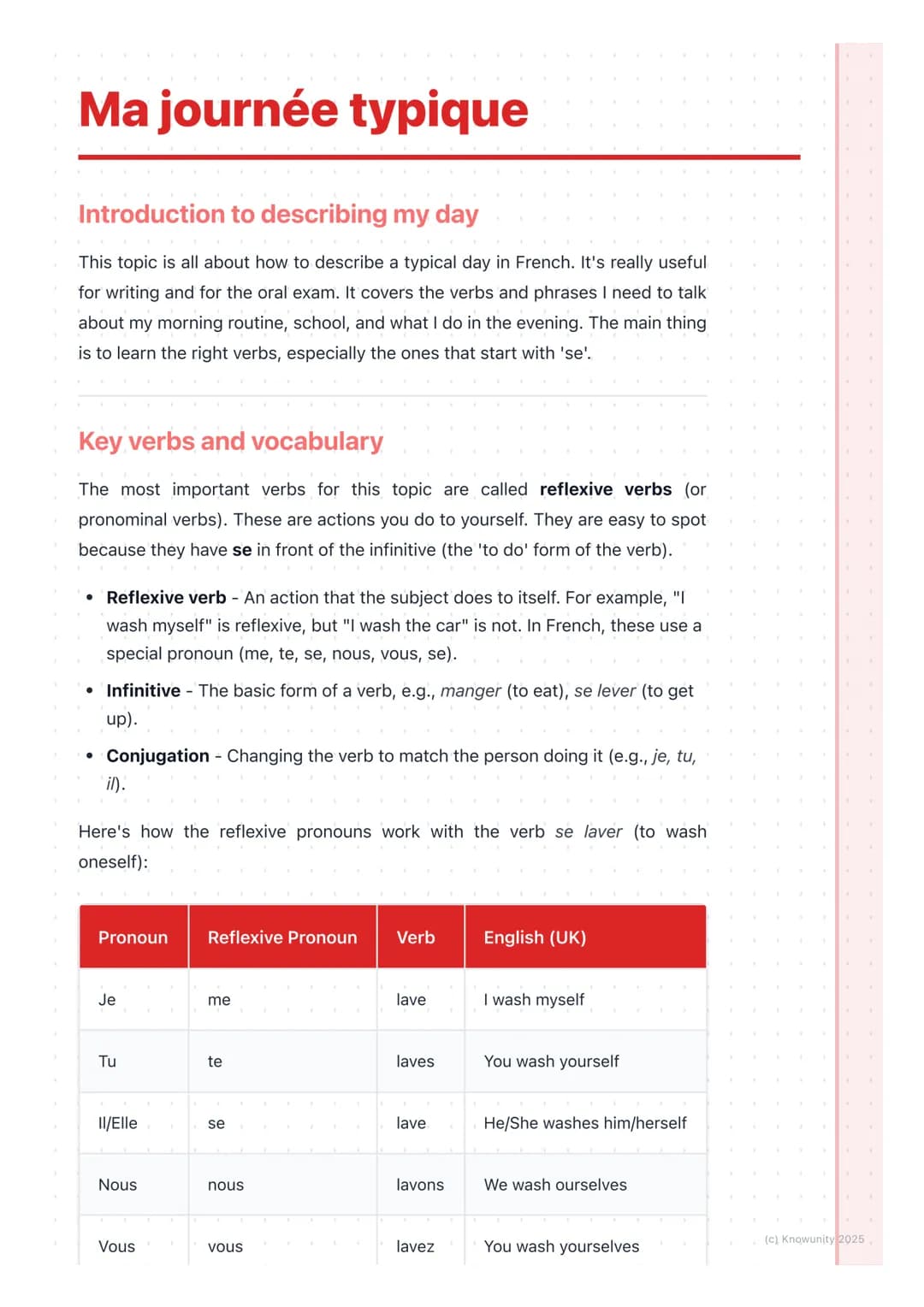
Getting Started with Daily Routines
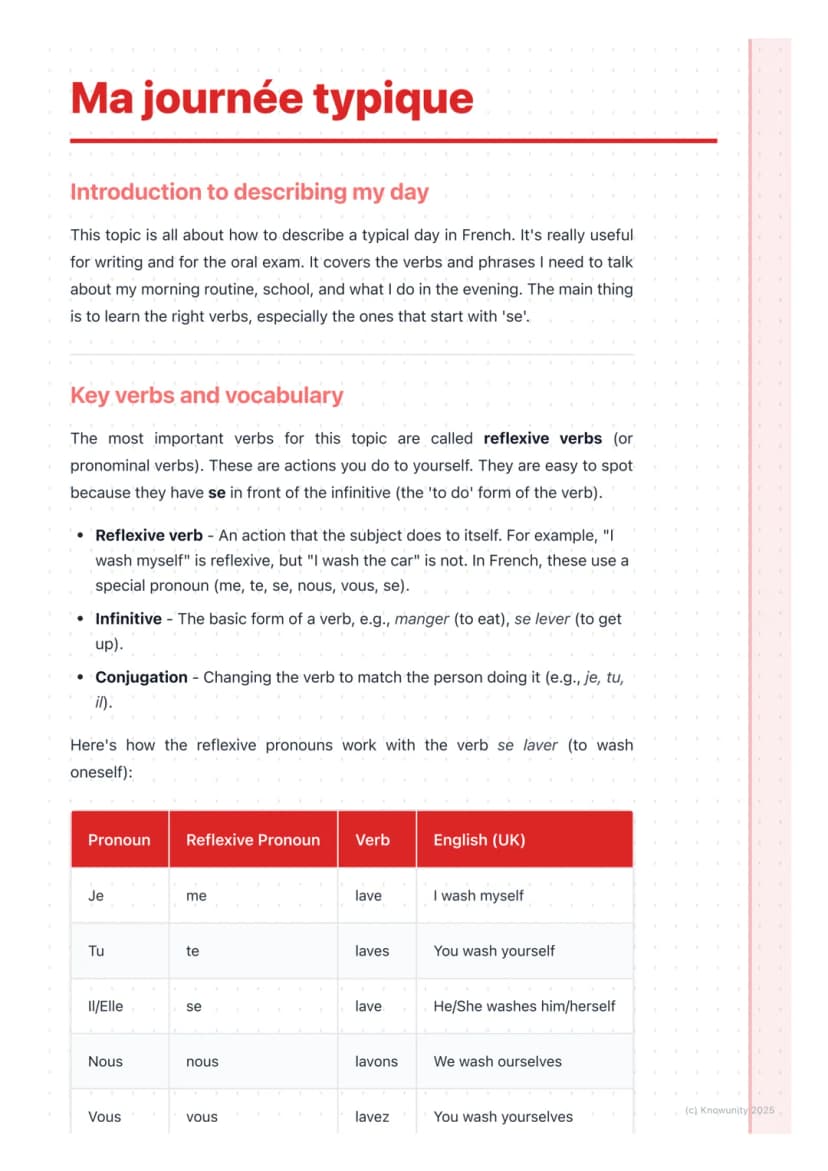
Learning to describe your day in French is actually dead useful - you'll use it loads in your exams and it's proper practical for real conversations. The key is mastering reflexive verbs, which are actions you do to yourself like washing or getting dressed.
Reflexive verbs are easy to spot because they have 'se' in front of them when you see them in the dictionary. Think of "se laver" (to wash oneself) - the 'se' tells you it's something you do to yourself, not to someone else.
The magic happens with reflexive pronouns - these little words (me, te, se) go right before the verb. So "I wash myself" becomes "je me lave". Dead simple once you get the hang of it!
Top Tip: For verbs starting with a vowel, 'me' becomes 'm' - so it's "je m'habille" (I get dressed), not "je me habille".
2
of 6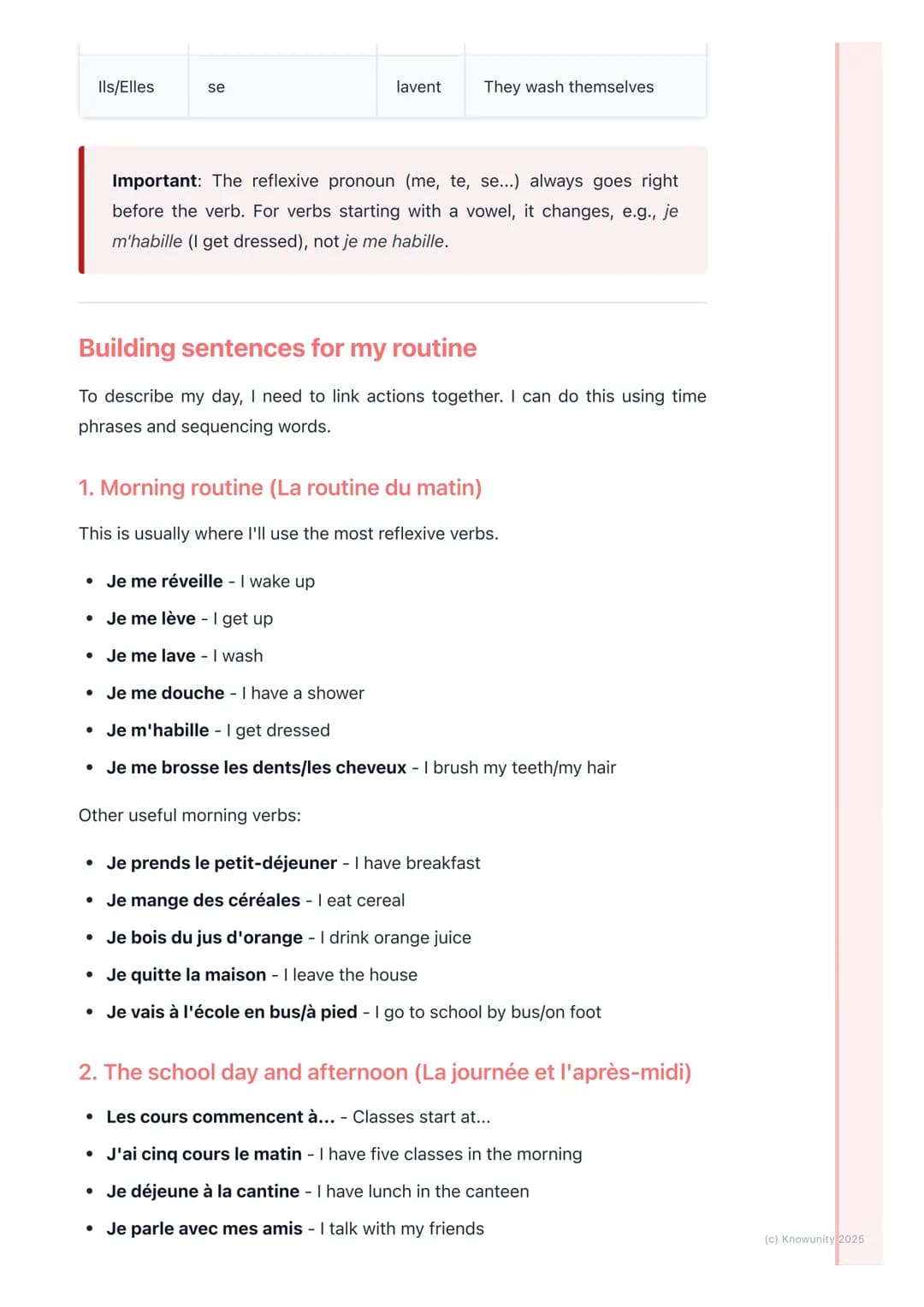
Morning Routine Vocabulary
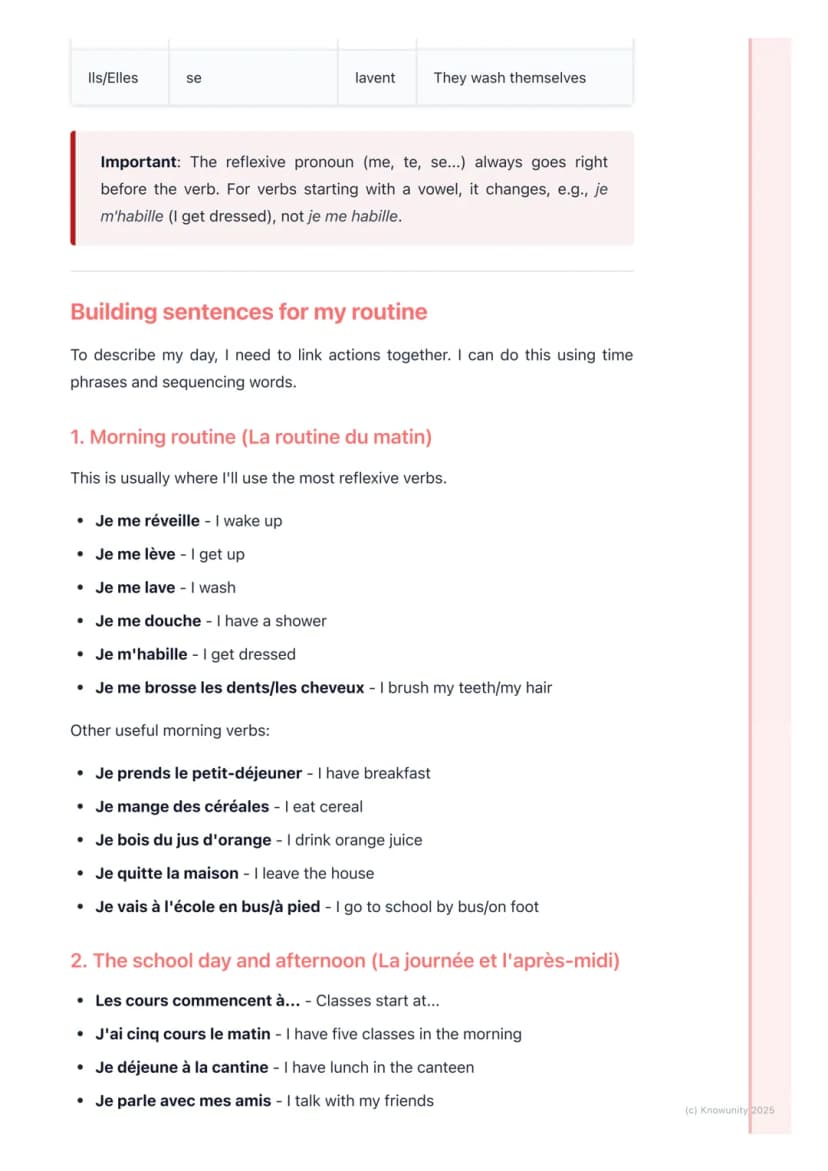
Your morning routine is where you'll use loads of reflexive verbs, so let's nail these first. Start with the basics: je me réveille (I wake up), je me lève (I get up), and je me douche (I have a shower).
Getting dressed and ready involves je m'habille (I get dressed) and je me brosse les dents (I brush my teeth). Don't forget breakfast vocabulary too - je prends le petit-déjeuner covers having breakfast in general.
For getting to school, you'll want je quitte la maison (I leave the house) and je vais à l'école (I go to school). Add "en bus" for by bus or "à pied" if you walk.
Remember: The reflexive pronoun always sits right before the verb - never forget that little 'me'!
3
of 6
School Day and Evening Activities
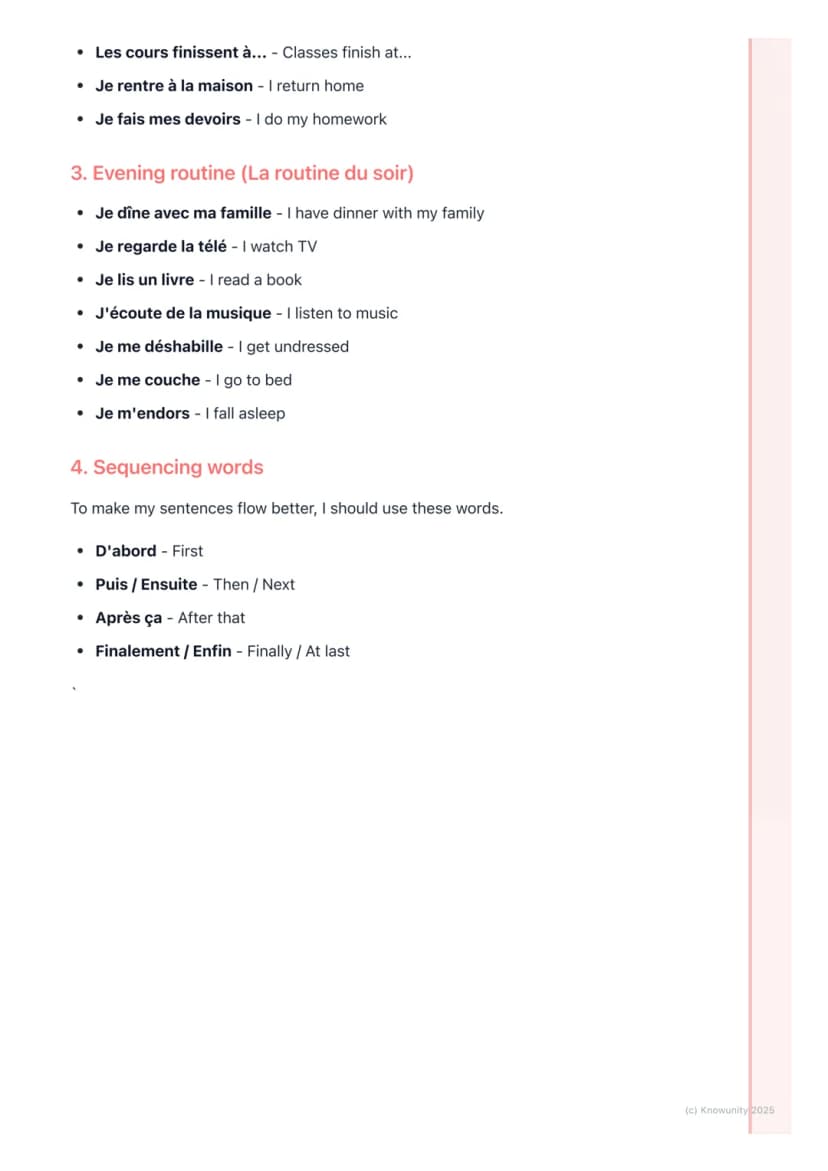
The school day gives you loads of chances to use regular verbs alongside your reflexives. Les cours commencent à... (classes start at...) and les cours finissent à... (classes finish at...) are brilliant for showing off your time-telling skills.
For afternoon activities, try je fais mes devoirs (I do my homework) - though you might want to add "c'est ennuyeux!" (it's boring!) to make it more interesting. Je déjeune à la cantine (I have lunch in the canteen) shows you know school vocabulary too.
Evening routines bring back those reflexive verbs: je me déshabille (I get undressed), je me couche (I go to bed), and je m'endors (I fall asleep). Mix these with regular verbs like je regarde la télé (I watch TV) for variety.
Quick Check: Don't mix up "se coucher" (getting into bed) with "dormir" (being asleep) - they're different actions!
4
of 6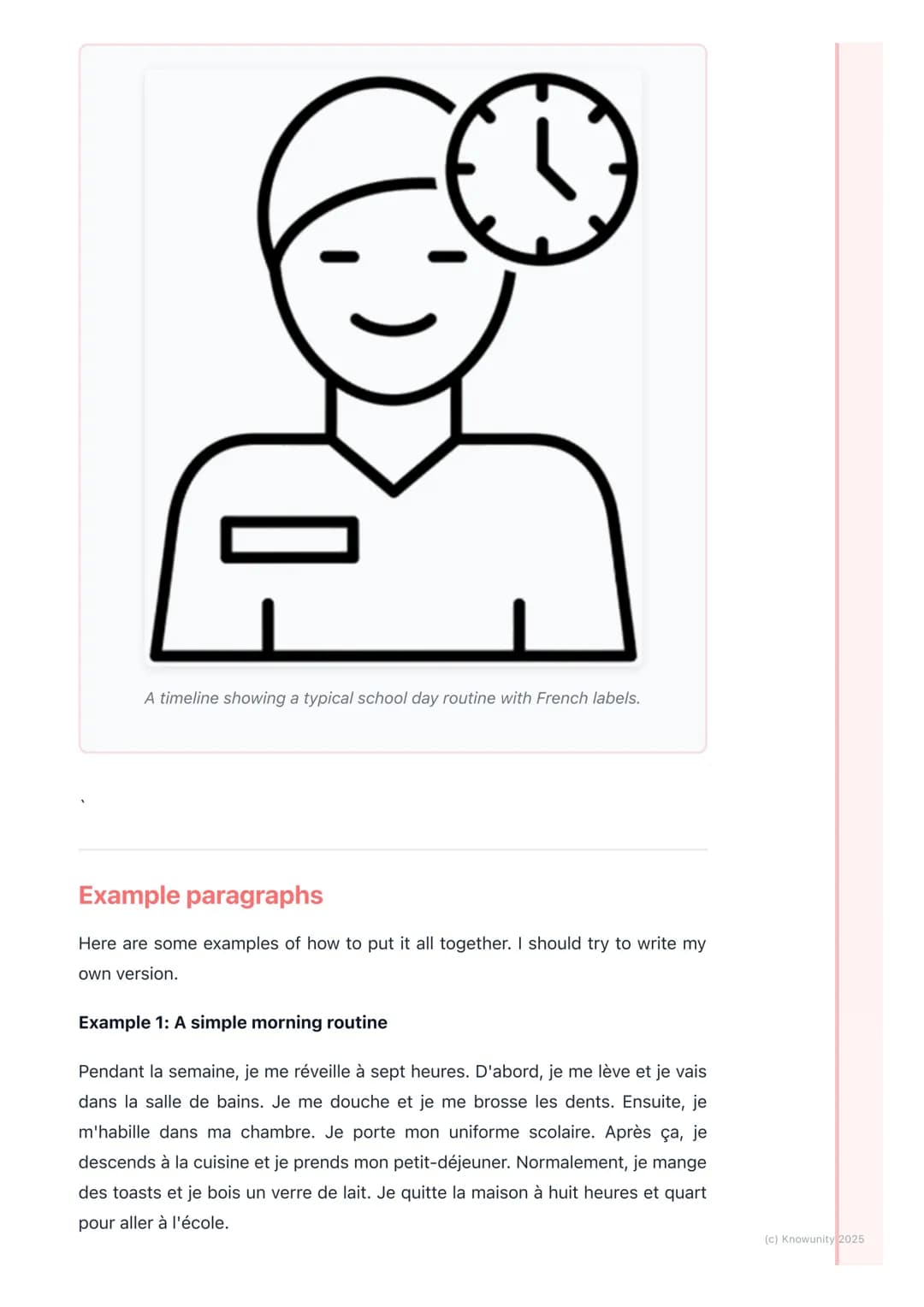
Linking It All Together
Sequencing words are your secret weapon for making your French sound natural and flowing. Start with "d'abord" (first), then use "puis" or "ensuite" , and finish with "finalement" (finally).
Time expressions make everything sound more authentic. Use "à" for exact times (à sept heures) and "vers" for approximate times (vers huit heures). This adds proper detail to your descriptions.
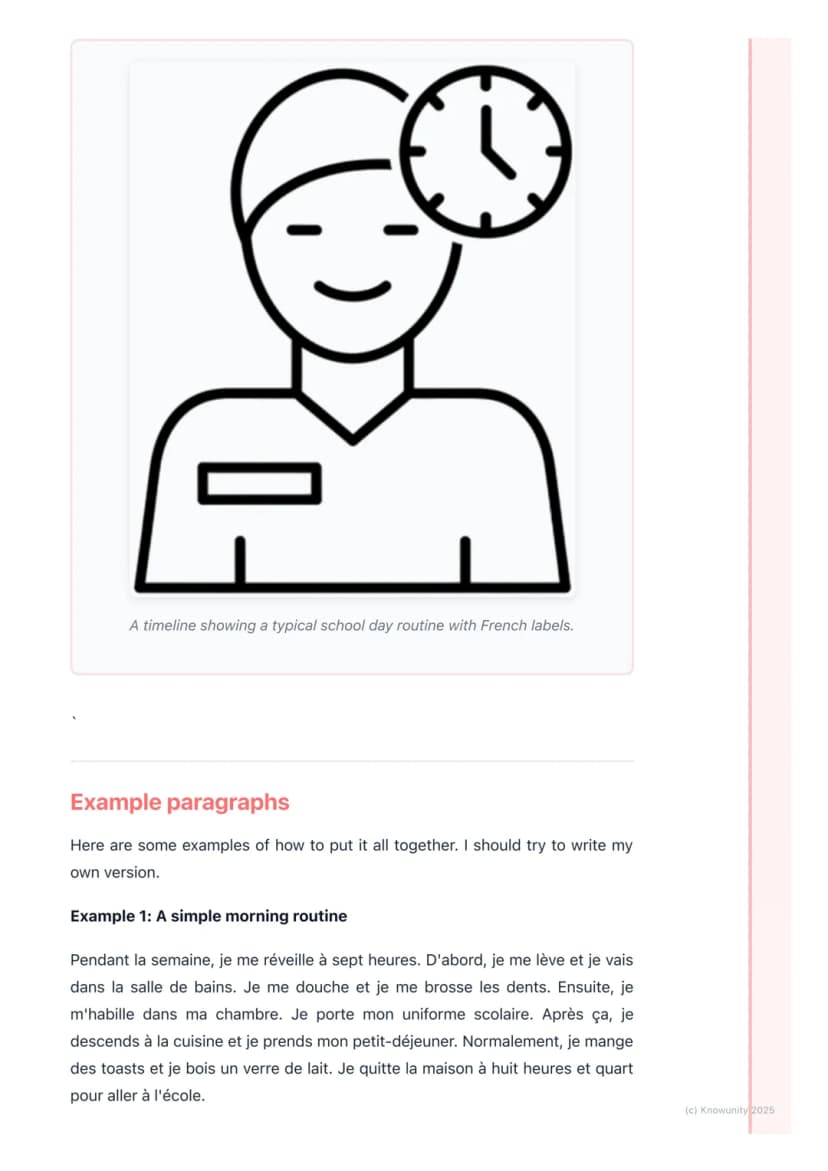
Here's a cracking example: "D'abord, je me réveille à sept heures. Ensuite, je me douche et je m'habille. Finalement, je prends mon petit-déjeuner." See how it flows nicely?
Pro Tip: When using two verbs together, only conjugate the first one - "Je vais me coucher" (I'm going to go to bed), not "Je vais me couche"!
5
of 6
Putting It Into Practice
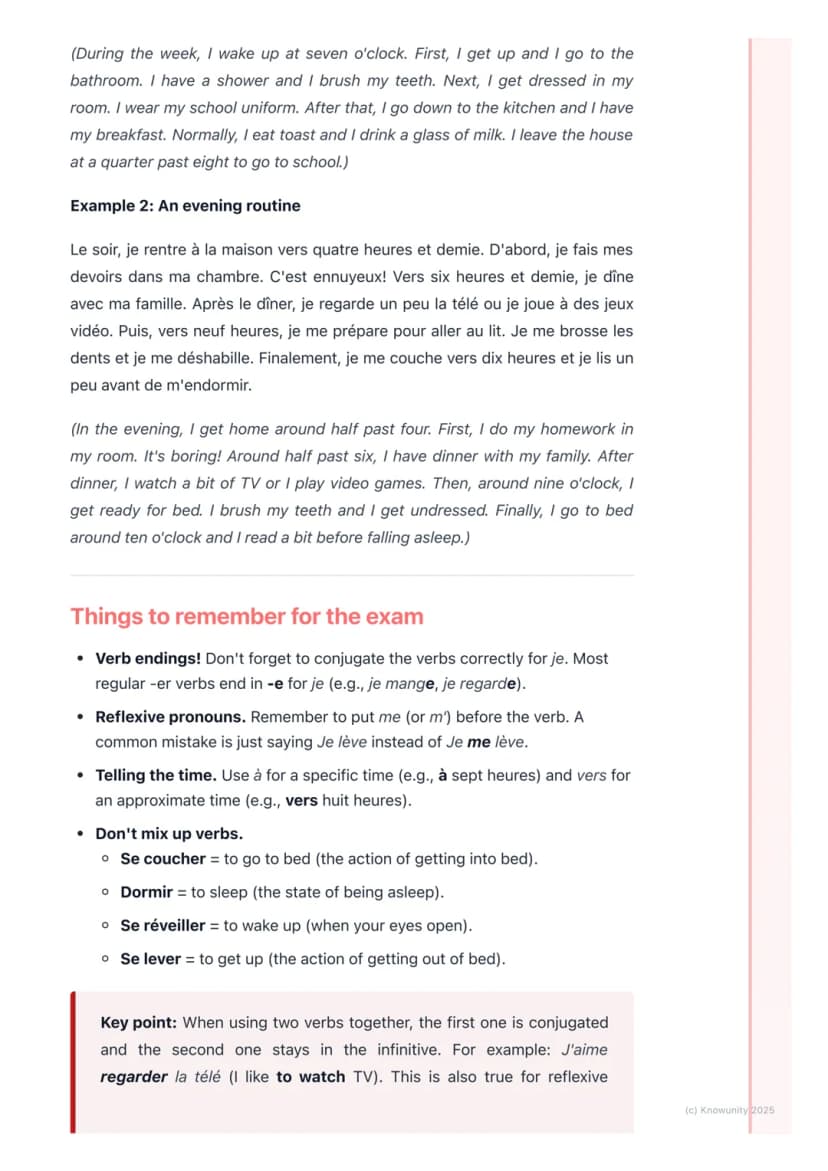
Now you can build proper paragraphs about your day. Start simple - pick your most important morning activities and link them with sequencing words. Something like: "Je me réveille à sept heures. D'abord, je me lève et je vais dans la salle de bains."
Don't forget to add personality to your writing! Say what you normally eat (je mange des toasts) or mention your school uniform (je porte mon uniforme scolaire). These details make your French more interesting and realistic.
For evening routines, try mixing activities: "Le soir, je fais mes devoirs - c'est ennuyeux! Puis je regarde la télé avec ma famille." This shows you can handle different types of verbs and opinions.
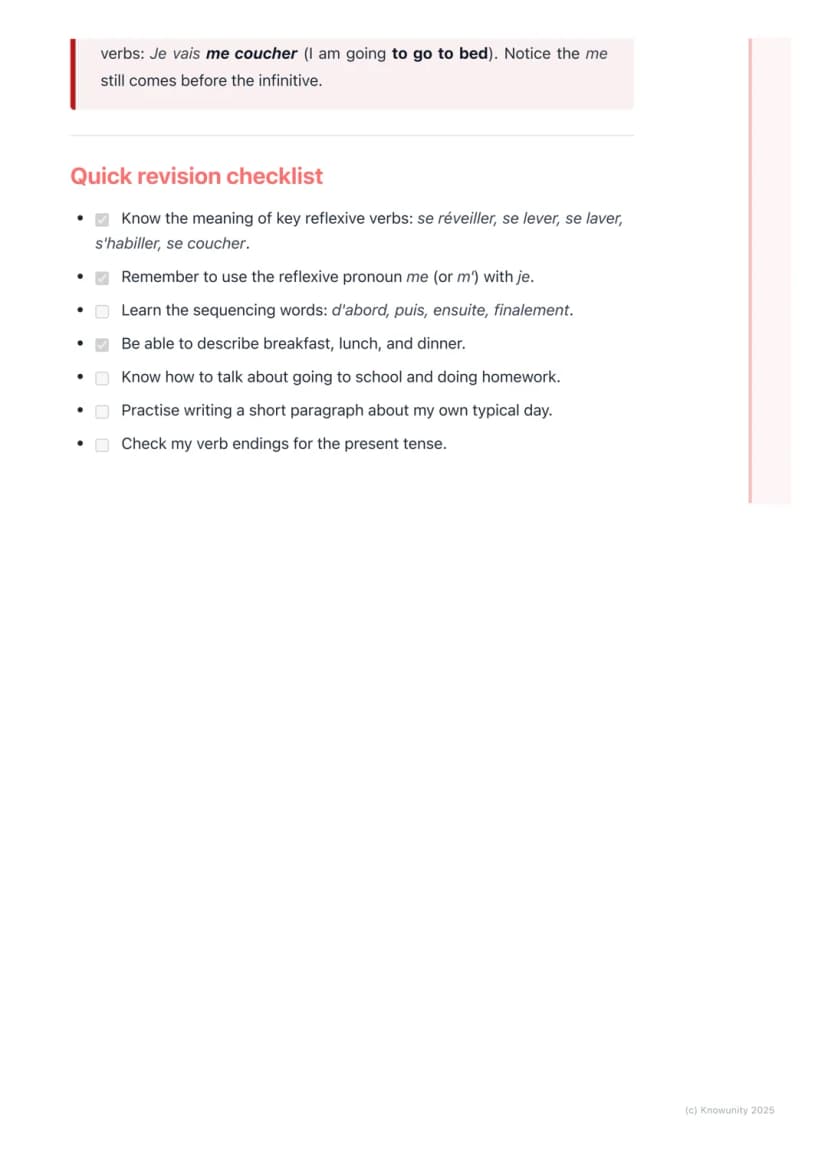
Exam Gold: Always check your verb endings - most regular -er verbs with 'je' end in -e, and don't forget those reflexive pronouns!
6
of 6
Quick Revision Essentials
You're nearly sorted! Make sure you can rattle off the main reflexive verbs: se réveiller, se lever, se laver, s'habiller, se coucher. Remember, they all need that reflexive pronoun 'me' with 'je'.
Sequencing words are dead important for flowing sentences - d'abord, puis, ensuite, finalement. These make you sound like you really know what you're doing. Practice linking at least three activities together smoothly.
Finally, nail your time expressions and don't mix up similar verbs. Se réveiller is opening your eyes, se lever is getting out of bed - they're different actions! Get these right and you'll smash your exams.
Final Check: Write a short paragraph about your own day, check all your verb endings, and make sure every reflexive verb has its pronoun. You've got this!
Achamos que você nunca perguntaria...
O que é o assistente de IA da Knowunity?
Nosso companheiro de IA foi criado especificamente para atender às necessidades dos estudantes. Com base nos milhões de conteúdos que temos na plataforma, podemos oferecer respostas realmente relevantes e significativas. Mas não se trata apenas de respostas, o companheiro também está aqui para guiar você pelos desafios diários de aprendizado, com planos de estudo personalizados, quizzes ou conteúdos no chat e 100% de personalização com base nas suas habilidades e desenvolvimentos.
Onde posso baixar o app da Knowunity?
Pode descarregar a aplicação na Google Play Store e na Apple App Store.
Como posso receber meu pagamento? Quanto posso ganhar?
Sim, tem acesso gratuito ao conteúdo da aplicação e ao nosso companheiro de IA. Para desbloquear determinadas funcionalidades da aplicação, pode adquirir o Knowunity Pro.
Conteúdos mais populares de French
1Conteúdos mais populares
9 Irish
IrishIrish oral questions and answers
Questions and answers for the leaving cert oral
5th Year4254
IrishIrish oral questions
Outline of oral questions
5th Year2055
IrishGaeilge Grammar Office
All the basics you need to know on Irish grammar.
3rd Year873
 English
Key Quotes : Sive
Key Quotes and explanations: Sive
6th Year2191
IrishAn Gaeilge Aiste
Irish Language essay
6th Year1250
IrishIrish poetry 2027
Iníon + Dínit an Bhróin
5th Year1133
IrishMé Féin & Mo Chlann (Myself & My Family)
Students will learn vocabulary to describe themselves, their family members, and daily routines. This helps in personal introductions and discussions.
TY291
IrishLC HL notes- Iníon (poem)
Includes poem in English and Irish, theme, key words & phrases
5th Year2284
 Geography
Territory, economic activities in Paris basin
essay
6th Year80
Não encontrou o que procurava? Explore outras matérias.
Avaliações dos nossos usuários. Eles gostaram de tudo — e você também vai gostar.
4.6/5App Store
4.7/5Google Play
O app é muito fácil de usar e bem projetado. Encontrei tudo o que estava procurando até agora e consegui aprender muito com as apresentações! Definitivamente vou usar o app para uma tarefa de classe! E, claro, também ajuda muito como inspiração.
Stefan Susuário de iOS
Este app é realmente ótimo. Tem muitos materiais de estudo e ajuda [...]. Minha matéria problemática é o francês, por exemplo, e o app tem tantas opções de ajuda. Graças a este app, eu melhorei meu francês. Eu recomendaria para qualquer pessoa.
Samantha Klichusuária de Android
Uau, estou realmente impressionado. Eu experimentei o app porque vi muitos anúncios e fiquei absolutamente maravilhado. Este app é A AJUDA que você quer para a escola e, acima de tudo, oferece muitas coisas, como treinos e resumos, que têm sido MUITO úteis para mim pessoalmente.
Annausuária de iOS
French1 visualizações·Atualizado May 8, 2026·6 páginasMa journée typique : Une routine quotidienne illustrée
Ever wondered how to describe your daily routine in French? This topic covers all the essential vocabulary and grammar you need to talk about your typical day, from waking up to going to bed. It's brilliant for both writing tasks... Mostrar mais
1
of 6Cadastre-se para ver o conteúdo. É grátis!
- Acesso a todos os documentos
- Melhore suas notas
- Junte-se a milhões de estudantes
Getting Started with Daily Routines
Learning to describe your day in French is actually dead useful - you'll use it loads in your exams and it's proper practical for real conversations. The key is mastering reflexive verbs, which are actions you do to yourself like washing or getting dressed.
Reflexive verbs are easy to spot because they have 'se' in front of them when you see them in the dictionary. Think of "se laver" (to wash oneself) - the 'se' tells you it's something you do to yourself, not to someone else.
The magic happens with reflexive pronouns - these little words (me, te, se) go right before the verb. So "I wash myself" becomes "je me lave". Dead simple once you get the hang of it!
Top Tip: For verbs starting with a vowel, 'me' becomes 'm' - so it's "je m'habille" (I get dressed), not "je me habille".
2
of 6Cadastre-se para ver o conteúdo. É grátis!
- Acesso a todos os documentos
- Melhore suas notas
- Junte-se a milhões de estudantes
Morning Routine Vocabulary
Your morning routine is where you'll use loads of reflexive verbs, so let's nail these first. Start with the basics: je me réveille (I wake up), je me lève (I get up), and je me douche (I have a shower).
Getting dressed and ready involves je m'habille (I get dressed) and je me brosse les dents (I brush my teeth). Don't forget breakfast vocabulary too - je prends le petit-déjeuner covers having breakfast in general.
For getting to school, you'll want je quitte la maison (I leave the house) and je vais à l'école (I go to school). Add "en bus" for by bus or "à pied" if you walk.
Remember: The reflexive pronoun always sits right before the verb - never forget that little 'me'!
3
of 6Cadastre-se para ver o conteúdo. É grátis!
- Acesso a todos os documentos
- Melhore suas notas
- Junte-se a milhões de estudantes
School Day and Evening Activities
The school day gives you loads of chances to use regular verbs alongside your reflexives. Les cours commencent à... (classes start at...) and les cours finissent à... (classes finish at...) are brilliant for showing off your time-telling skills.
For afternoon activities, try je fais mes devoirs (I do my homework) - though you might want to add "c'est ennuyeux!" (it's boring!) to make it more interesting. Je déjeune à la cantine (I have lunch in the canteen) shows you know school vocabulary too.
Evening routines bring back those reflexive verbs: je me déshabille (I get undressed), je me couche (I go to bed), and je m'endors (I fall asleep). Mix these with regular verbs like je regarde la télé (I watch TV) for variety.
Quick Check: Don't mix up "se coucher" (getting into bed) with "dormir" (being asleep) - they're different actions!
4
of 6Cadastre-se para ver o conteúdo. É grátis!
- Acesso a todos os documentos
- Melhore suas notas
- Junte-se a milhões de estudantes
Linking It All Together
Sequencing words are your secret weapon for making your French sound natural and flowing. Start with "d'abord" (first), then use "puis" or "ensuite" , and finish with "finalement" (finally).
Time expressions make everything sound more authentic. Use "à" for exact times (à sept heures) and "vers" for approximate times (vers huit heures). This adds proper detail to your descriptions.
Here's a cracking example: "D'abord, je me réveille à sept heures. Ensuite, je me douche et je m'habille. Finalement, je prends mon petit-déjeuner." See how it flows nicely?
Pro Tip: When using two verbs together, only conjugate the first one - "Je vais me coucher" (I'm going to go to bed), not "Je vais me couche"!
5
of 6Cadastre-se para ver o conteúdo. É grátis!
- Acesso a todos os documentos
- Melhore suas notas
- Junte-se a milhões de estudantes
Putting It Into Practice
Now you can build proper paragraphs about your day. Start simple - pick your most important morning activities and link them with sequencing words. Something like: "Je me réveille à sept heures. D'abord, je me lève et je vais dans la salle de bains."
Don't forget to add personality to your writing! Say what you normally eat (je mange des toasts) or mention your school uniform (je porte mon uniforme scolaire). These details make your French more interesting and realistic.
For evening routines, try mixing activities: "Le soir, je fais mes devoirs - c'est ennuyeux! Puis je regarde la télé avec ma famille." This shows you can handle different types of verbs and opinions.
Exam Gold: Always check your verb endings - most regular -er verbs with 'je' end in -e, and don't forget those reflexive pronouns!
6
of 6Cadastre-se para ver o conteúdo. É grátis!
- Acesso a todos os documentos
- Melhore suas notas
- Junte-se a milhões de estudantes
Quick Revision Essentials
You're nearly sorted! Make sure you can rattle off the main reflexive verbs: se réveiller, se lever, se laver, s'habiller, se coucher. Remember, they all need that reflexive pronoun 'me' with 'je'.
Sequencing words are dead important for flowing sentences - d'abord, puis, ensuite, finalement. These make you sound like you really know what you're doing. Practice linking at least three activities together smoothly.
Finally, nail your time expressions and don't mix up similar verbs. Se réveiller is opening your eyes, se lever is getting out of bed - they're different actions! Get these right and you'll smash your exams.
Final Check: Write a short paragraph about your own day, check all your verb endings, and make sure every reflexive verb has its pronoun. You've got this!
Achamos que você nunca perguntaria...
O que é o assistente de IA da Knowunity?
Nosso companheiro de IA foi criado especificamente para atender às necessidades dos estudantes. Com base nos milhões de conteúdos que temos na plataforma, podemos oferecer respostas realmente relevantes e significativas. Mas não se trata apenas de respostas, o companheiro também está aqui para guiar você pelos desafios diários de aprendizado, com planos de estudo personalizados, quizzes ou conteúdos no chat e 100% de personalização com base nas suas habilidades e desenvolvimentos.
Onde posso baixar o app da Knowunity?
Pode descarregar a aplicação na Google Play Store e na Apple App Store.
Como posso receber meu pagamento? Quanto posso ganhar?
Sim, tem acesso gratuito ao conteúdo da aplicação e ao nosso companheiro de IA. Para desbloquear determinadas funcionalidades da aplicação, pode adquirir o Knowunity Pro.
Conteúdos mais populares de French
1Conteúdos mais populares
9IrishIrish oral questions and answers
Questions and answers for the leaving cert oral
5th Year4254
IrishIrish oral questions
Outline of oral questions
5th Year2055
IrishGaeilge Grammar Office
All the basics you need to know on Irish grammar.
3rd Year873
EnglishKey Quotes : Sive
Key Quotes and explanations: Sive
6th Year2191
IrishAn Gaeilge Aiste
Irish Language essay
6th Year1250
IrishIrish poetry 2027
Iníon + Dínit an Bhróin
5th Year1133
IrishMé Féin & Mo Chlann (Myself & My Family)
Students will learn vocabulary to describe themselves, their family members, and daily routines. This helps in personal introductions and discussions.
TY291
IrishLC HL notes- Iníon (poem)
Includes poem in English and Irish, theme, key words & phrases
5th Year2284
GeographyTerritory, economic activities in Paris basin
essay
6th Year80
Não encontrou o que procurava? Explore outras matérias.
Avaliações dos nossos usuários. Eles gostaram de tudo — e você também vai gostar.
4.6/5App Store
4.7/5Google Play
O app é muito fácil de usar e bem projetado. Encontrei tudo o que estava procurando até agora e consegui aprender muito com as apresentações! Definitivamente vou usar o app para uma tarefa de classe! E, claro, também ajuda muito como inspiração.
Stefan Susuário de iOS
Este app é realmente ótimo. Tem muitos materiais de estudo e ajuda [...]. Minha matéria problemática é o francês, por exemplo, e o app tem tantas opções de ajuda. Graças a este app, eu melhorei meu francês. Eu recomendaria para qualquer pessoa.
Samantha Klichusuária de Android
Uau, estou realmente impressionado. Eu experimentei o app porque vi muitos anúncios e fiquei absolutamente maravilhado. Este app é A AJUDA que você quer para a escola e, acima de tudo, oferece muitas coisas, como treinos e resumos, que têm sido MUITO úteis para mim pessoalmente.
Annausuária de iOS