
Every business creates two crucial financial documents that tell the...
 Business2 visualizações·Atualizado Jun 11, 2026·7 páginas
Overview of Key Financial Statements: Income Statement and Balance Sheet

1 / 7
1
of 7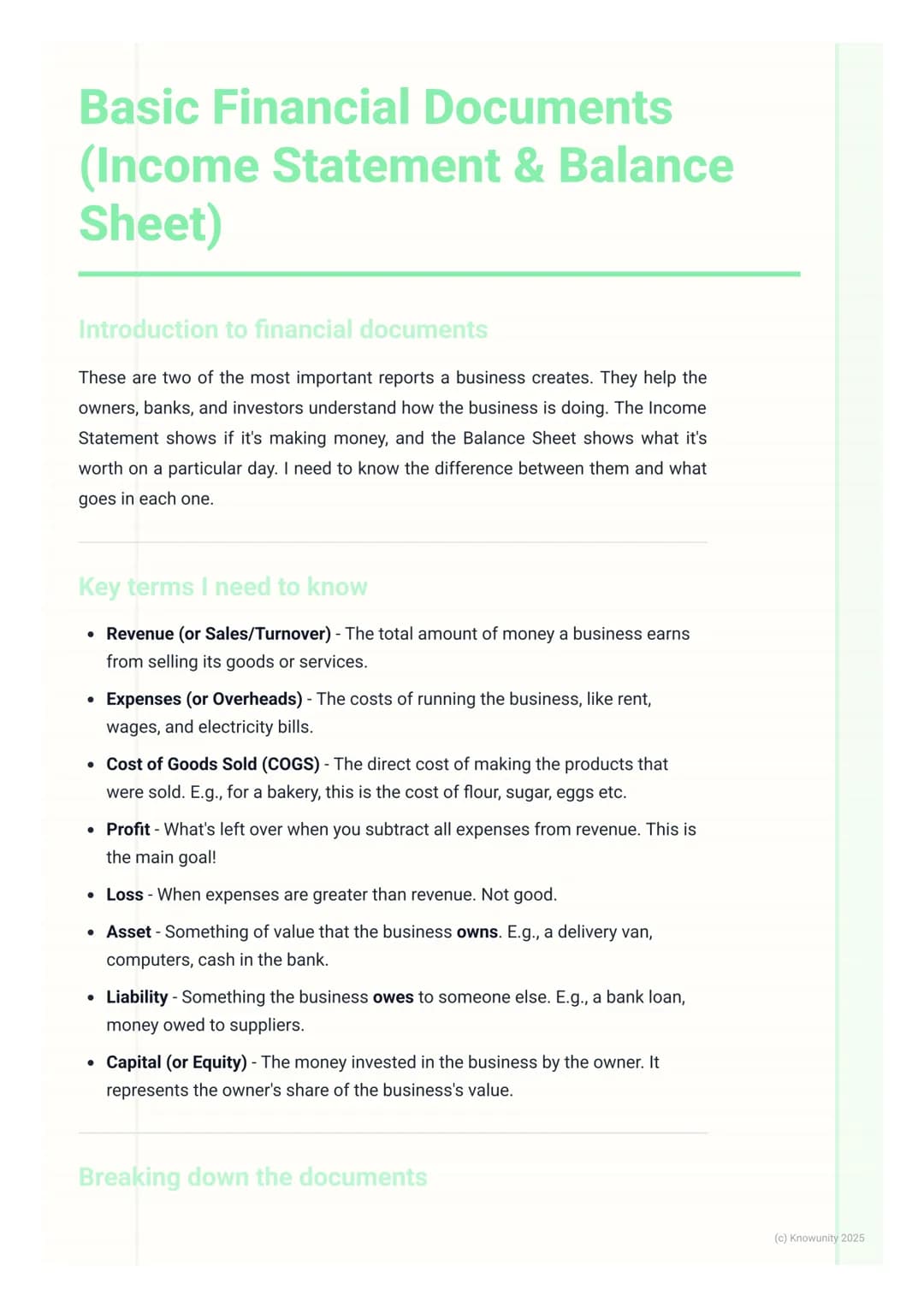
Basic Financial Documents
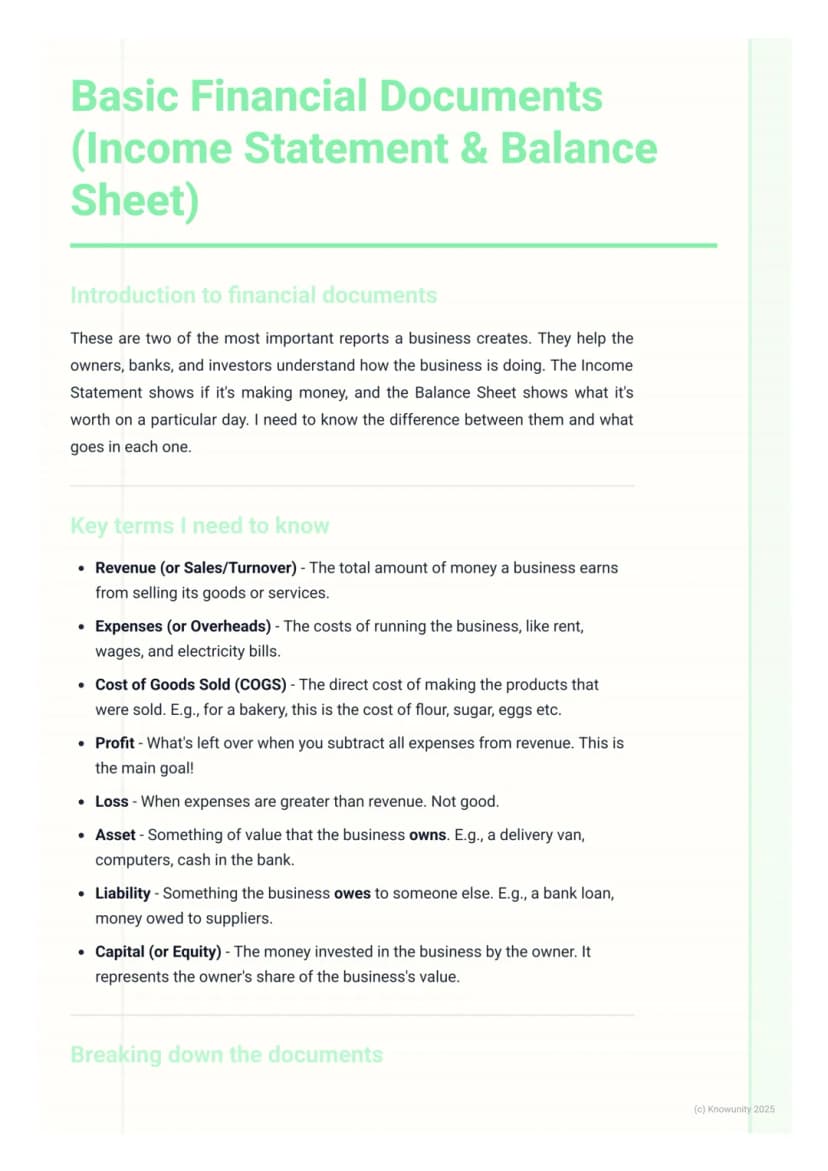
Understanding financial documents is like learning to read a business's health check. These reports help everyone from business owners to banks figure out if a company is worth investing in or lending money to.
Revenue (also called sales or turnover) is simply all the money a business earns from selling stuff. Expenses are all the costs of keeping the business running - things like rent, wages, and electricity bills. When you subtract expenses from revenue, you get profit (the good outcome) or loss (not so good).
On the flip side, assets are valuable things the business owns like delivery vans or cash in the bank. Liabilities are debts the business owes to others, whilst capital represents the owner's stake in the business.
Quick Tip: Think of assets as "what we have" and liabilities as "what we owe" - this makes the concepts much easier to remember!
2
of 7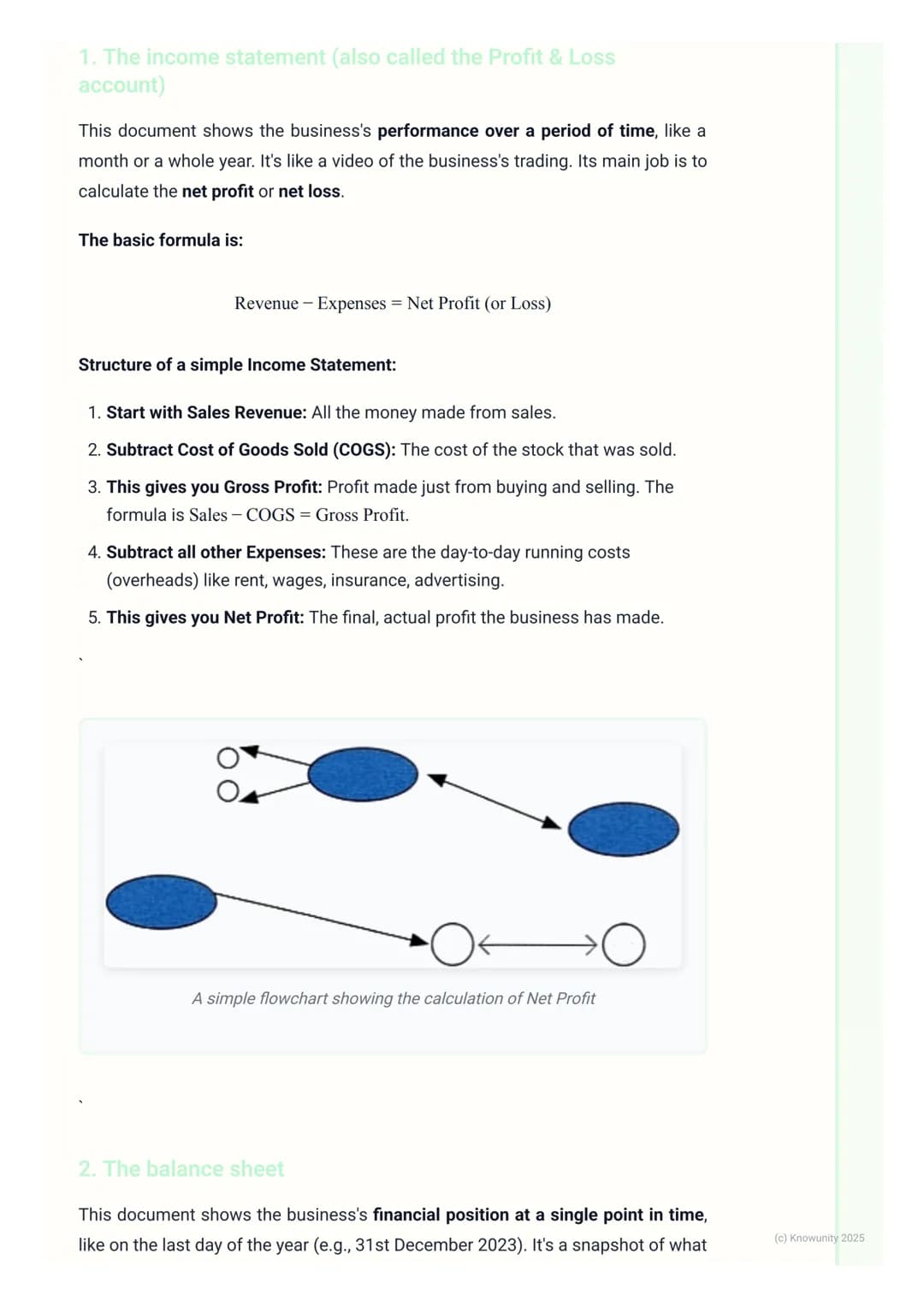
The Income Statement
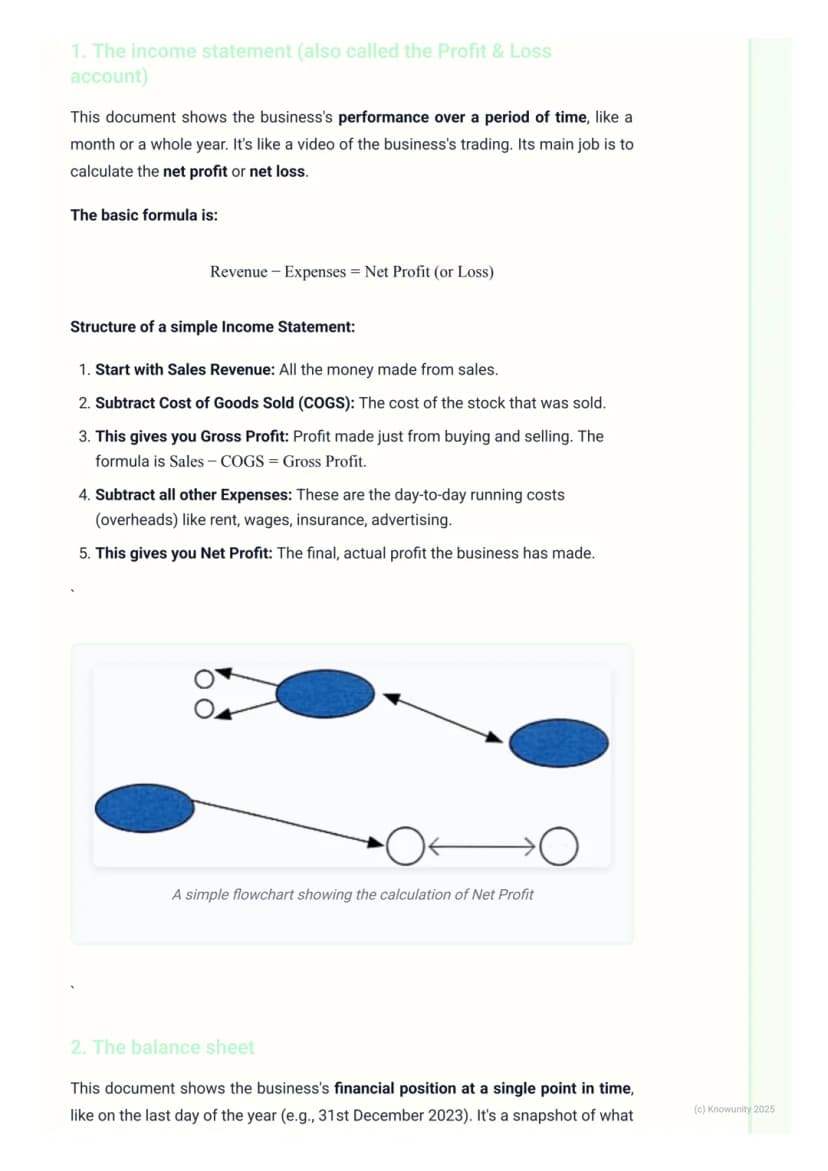
This document works like a business video - it shows performance over a specific time period, whether that's a month or a full year. Its main job is dead simple: calculate whether the business made money or lost it.
The income statement follows a straightforward formula: Revenue minus Expenses equals Net Profit (or Loss). You start with all the sales revenue, subtract the cost of goods sold (COGS), and this gives you gross profit. Then you subtract all other running costs to reach your final net profit.
Here's the flow: Sales → minus COGS → equals Gross Profit → minus other expenses → equals Net Profit. It's basically asking "did we make more than we spent?"
Remember: The income statement is all about performance over time - it's the "how did we do?" document.
3
of 7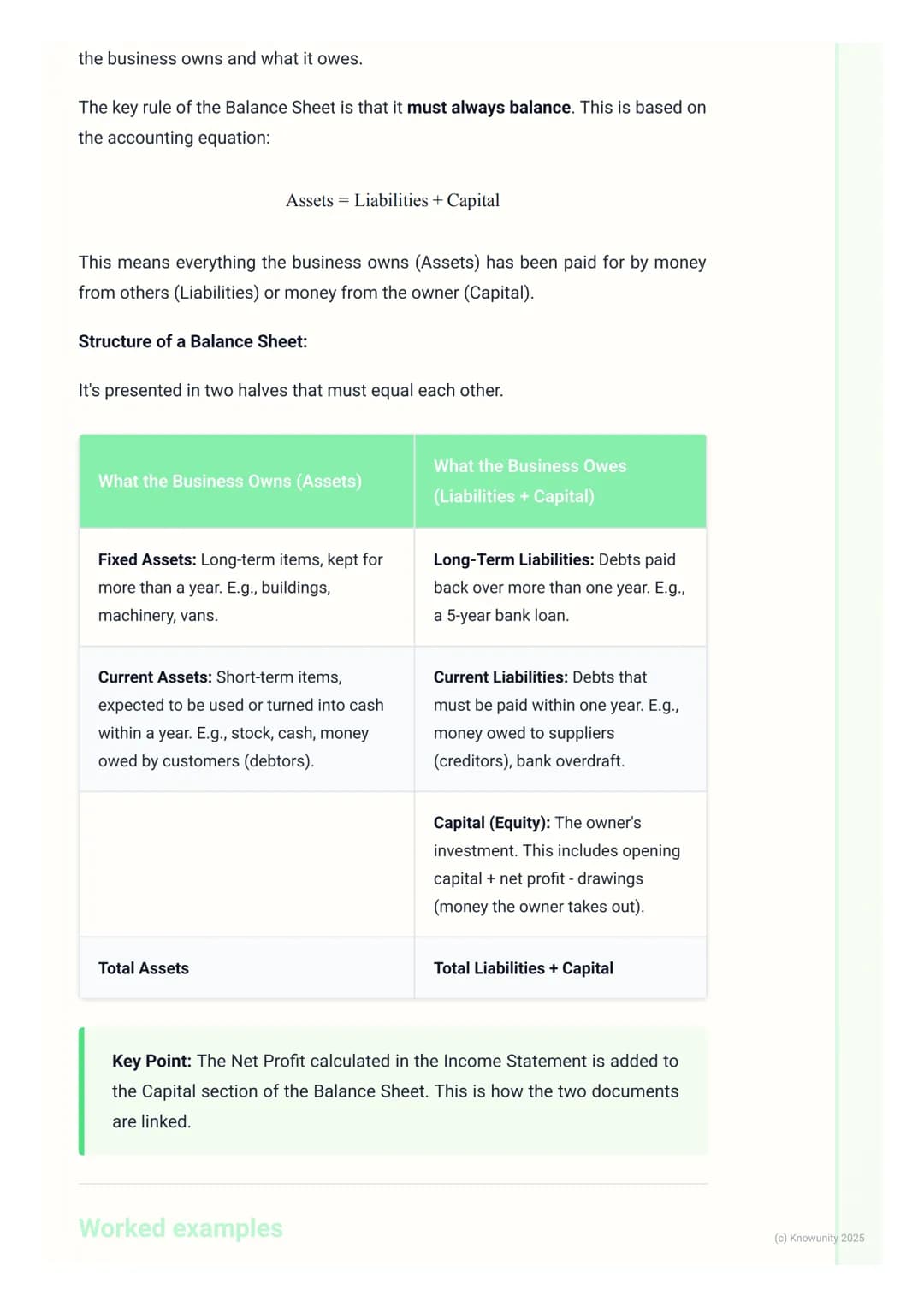
The Balance Sheet
Unlike the income statement's video approach, the balance sheet works like a photograph - it captures the business's financial position at one exact moment in time. Think of it as a snapshot taken on a specific date, like 31st December.
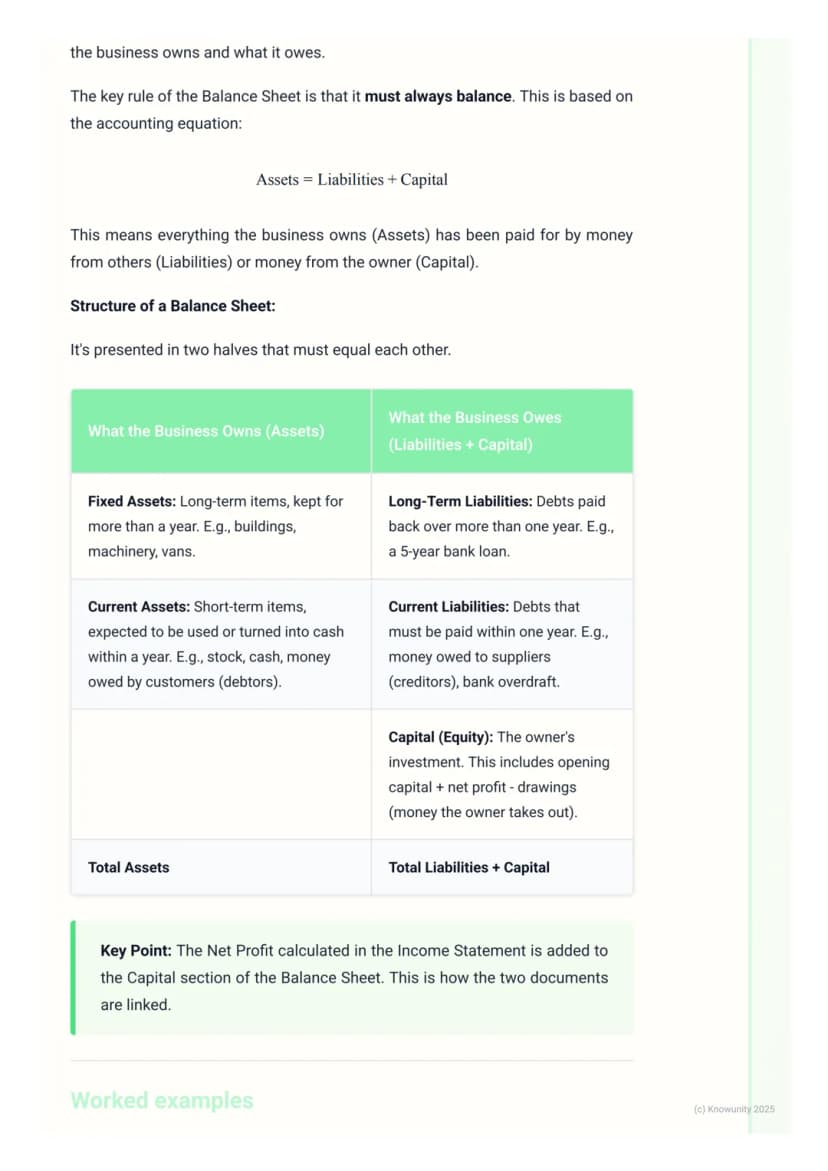
The magic rule of balance sheets is that they must always balance perfectly. This follows the accounting equation: Assets = Liabilities + Capital. Everything the business owns has been paid for either by borrowing money (liabilities) or using the owner's money (capital).
Fixed assets are long-term items kept for over a year (buildings, machinery), whilst current assets are short-term items like stock or cash. Similarly, liabilities split into long-term debts and current debts due within a year.
The clever bit is how the net profit from your income statement gets added to the capital section of your balance sheet - this is how the two documents connect together.
Key Point: If your balance sheet doesn't balance, you've definitely made a calculation error somewhere!
4
of 7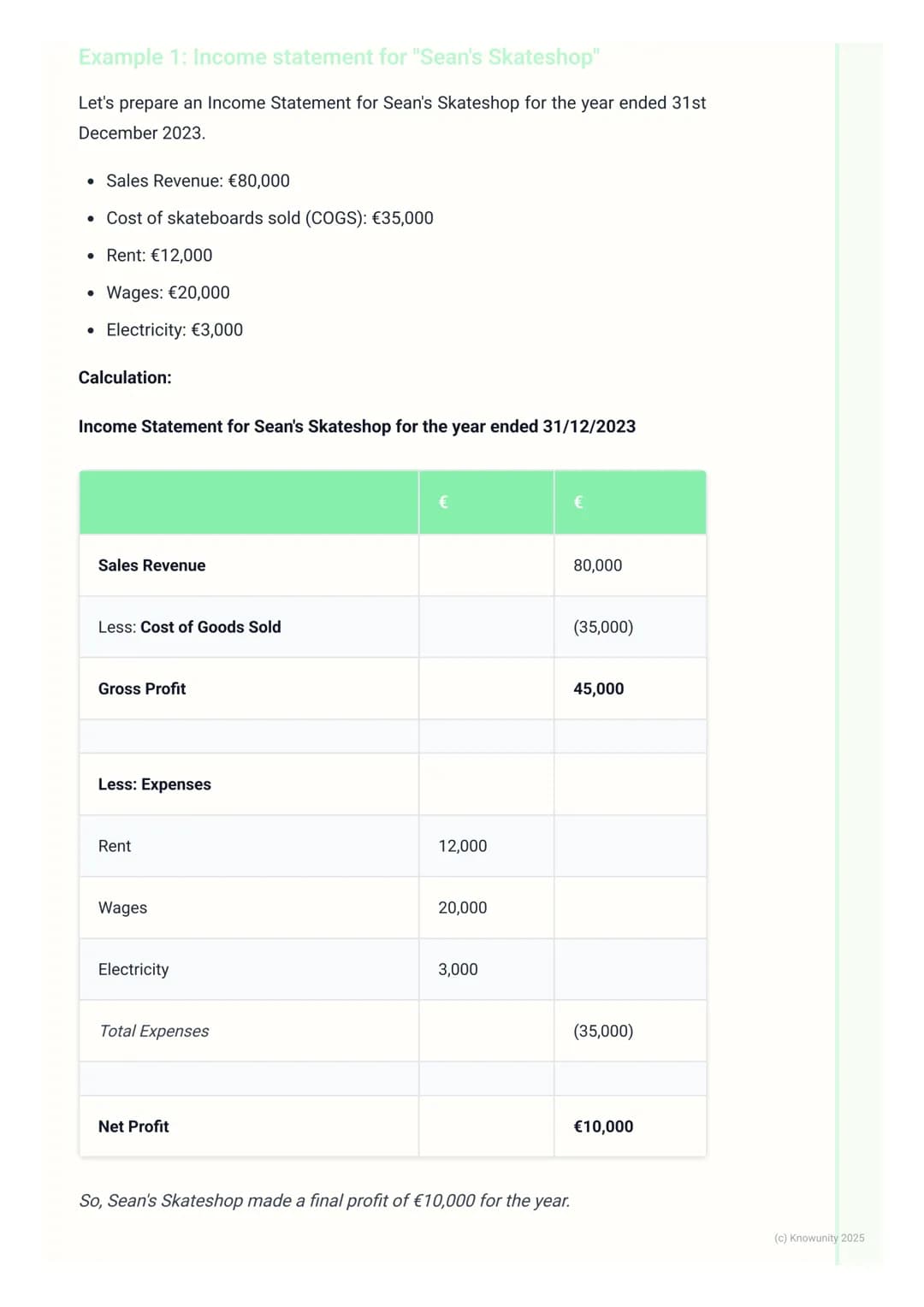
Worked Example - Sean's Skateshop Income Statement
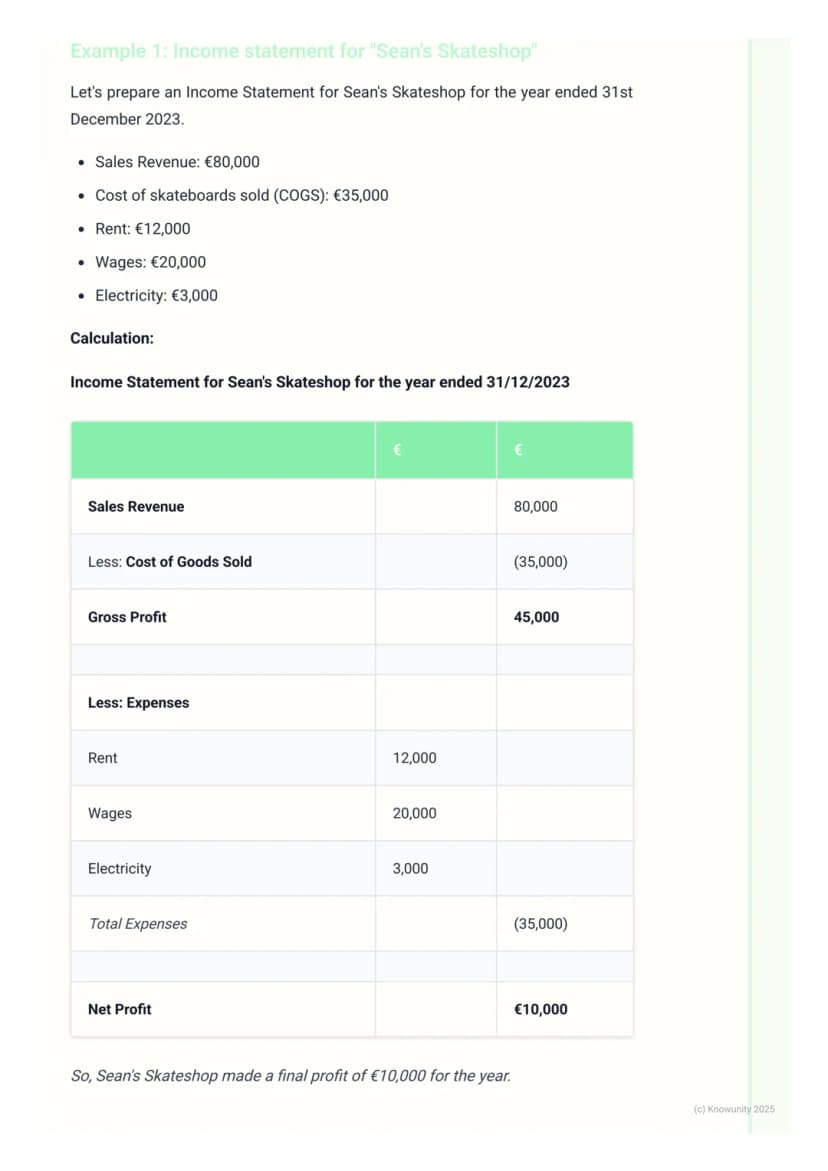
Let's see how this works in practice with Sean's Skateshop for the year ending 31st December 2023. Sean had sales of €80,000, but his skateboards cost him €35,000 to buy (his COGS).
After subtracting the €35,000 COGS from his €80,000 sales, Sean's gross profit was €45,000. Not bad! But he still had running costs: €12,000 rent, €20,000 wages, and €3,000 electricity bills.
When Sean subtracts his total expenses of €35,000 from his gross profit of €45,000, he ends up with a net profit of €10,000. This means after paying for everything, Sean actually made €10,000 for the year.
Pro Tip: Always double-check your arithmetic - small calculation errors can throw off your entire financial statement!
5
of 7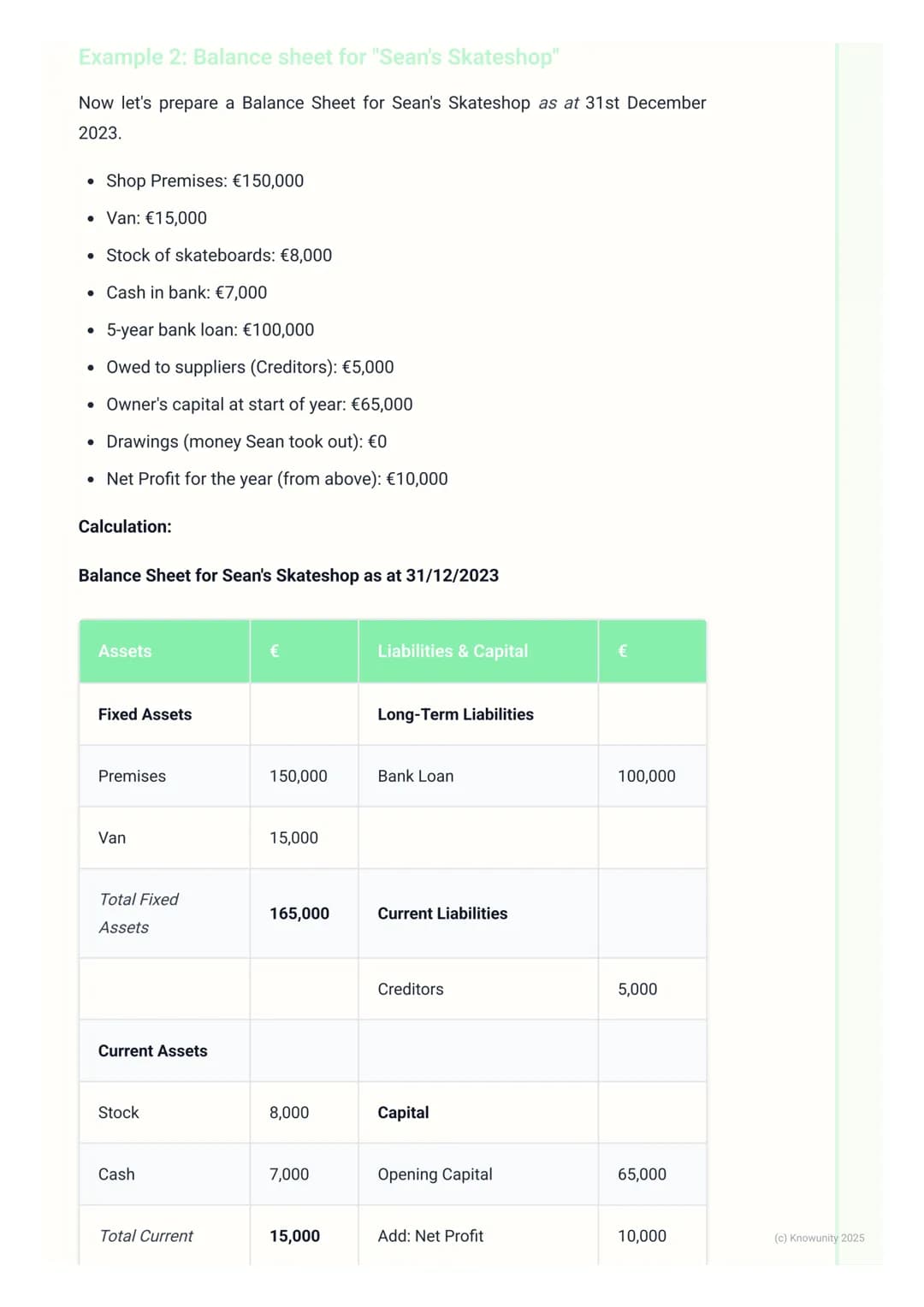
Worked Example - Sean's Skateshop Balance Sheet
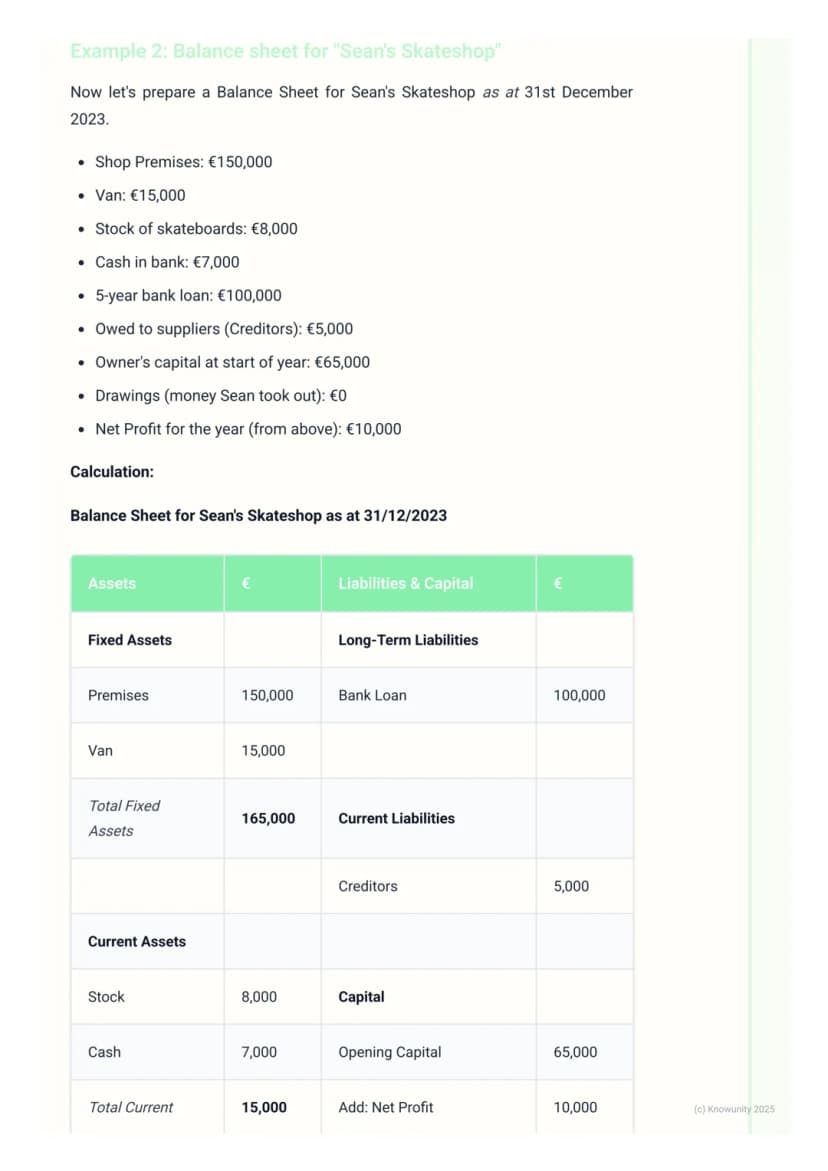
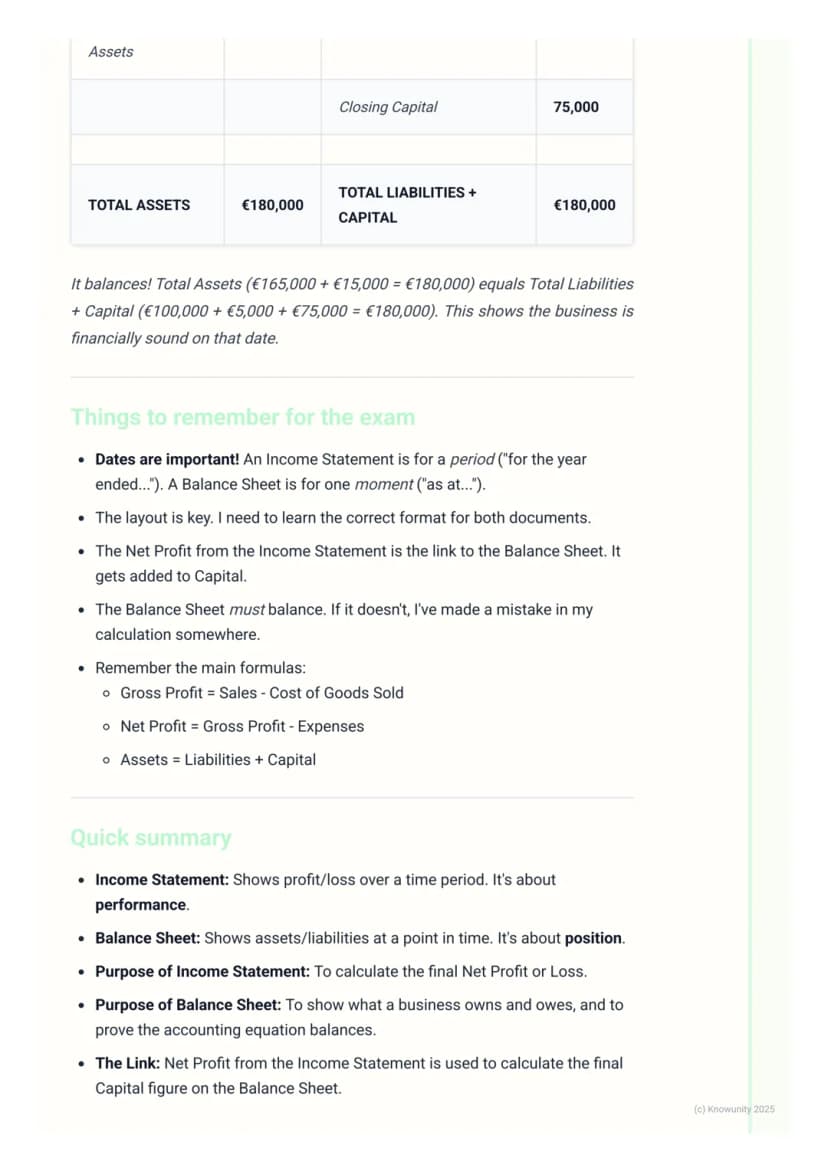
Now let's create Sean's balance sheet as at 31st December 2023. On the assets side, Sean owns shop premises worth €150,000, a van worth €15,000, stock worth €8,000, and has €7,000 cash in the bank.
His liabilities include a €100,000 five-year bank loan and €5,000 owed to suppliers. Sean started the year with €65,000 capital, didn't take any money out (drawings), and made that €10,000 profit we calculated earlier.
Adding the €10,000 net profit to his original €65,000 capital gives Sean €75,000 total capital. When we check the balance: total assets (€180,000) equals total liabilities plus capital (€180,000). Perfect!
Success Check: When your balance sheet balances perfectly, you know you've got all the numbers right!
6
of 7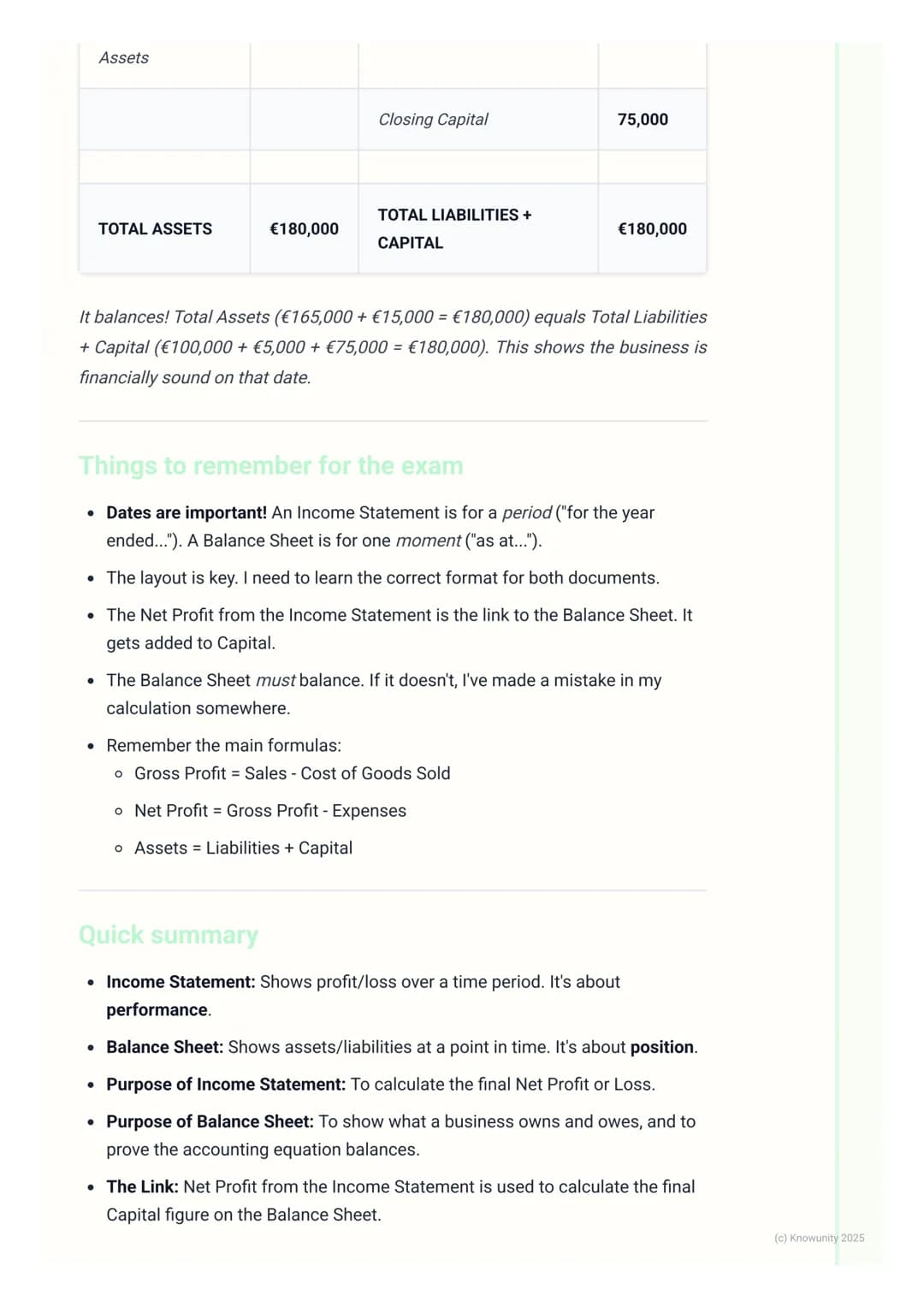
Exam Tips and Key Formulas
Getting the dates right is absolutely crucial for exams. Income statements cover a time period ("for the year ended...") whilst balance sheets capture a single moment ("as at..."). Mix these up and you'll lose marks instantly.
The layout matters just as much as the numbers. Learn the correct format for both documents and practise writing them out properly. Remember that net profit from your income statement must appear in the capital section of your balance sheet - this connection often comes up in exam questions.
Master these essential formulas: Gross Profit = Sales minus Cost of Goods Sold, Net Profit = Gross Profit minus Expenses, and Assets = Liabilities + Capital. If your balance sheet doesn't balance, work backwards through your calculations to find the mistake.
Exam Success: Think of the income statement as showing performance (how did we do?) and the balance sheet as showing position (what do we have?).
7
of 7
Achamos que você nunca perguntaria...
O que é o assistente de IA da Knowunity?
Nosso companheiro de IA foi criado especificamente para atender às necessidades dos estudantes. Com base nos milhões de conteúdos que temos na plataforma, podemos oferecer respostas realmente relevantes e significativas. Mas não se trata apenas de respostas, o companheiro também está aqui para guiar você pelos desafios diários de aprendizado, com planos de estudo personalizados, quizzes ou conteúdos no chat e 100% de personalização com base nas suas habilidades e desenvolvimentos.
Onde posso baixar o app da Knowunity?
Pode descarregar a aplicação na Google Play Store e na Apple App Store.
Como posso receber meu pagamento? Quanto posso ganhar?
Sim, tem acesso gratuito ao conteúdo da aplicação e ao nosso companheiro de IA. Para desbloquear determinadas funcionalidades da aplicação, pode adquirir o Knowunity Pro.
Conteúdos mais populares de Business
3Conteúdos mais populares
9 Irish
IrishIrish oral questions and answers
Questions and answers for the leaving cert oral
5th Year4264
 English
Key Quotes : Sive
Key Quotes and explanations: Sive
6th Year2842
IrishIrish oral questions
Outline of oral questions
5th Year2055
IrishIníon- le hÁine Durkin
Aine Durkin’s poem, Iníon: Themes & summary
5th Year890
IrishIrish poetry 2027
Iníon + Dínit an Bhróin
5th Year1153
IrishLC HL notes- Iníon (poem)
Includes poem in English and Irish, theme, key words & phrases
5th Year2304
EnglishCultural Context : Shawshank Redemption : Sive : Small Things Like These
Comparative Study : Cultural Context : Shawshank Redemption, Sive and Small Things Like These
6th Year1430
IrishMo Ghrá-sa (Idir Lúibíní)
Notes on mo ghrá-sa
5th Year380
IrishAn Gaeilge Aiste
Irish Language essay
6th Year1320
Não encontrou o que procurava? Explore outras matérias.
Avaliações dos nossos usuários. Eles gostaram de tudo — e você também vai gostar.
4.6/5App Store
4.7/5Google Play
O app é muito fácil de usar e bem projetado. Encontrei tudo o que estava procurando até agora e consegui aprender muito com as apresentações! Definitivamente vou usar o app para uma tarefa de classe! E, claro, também ajuda muito como inspiração.
Stefan Susuário de iOS
Este app é realmente ótimo. Tem muitos materiais de estudo e ajuda [...]. Minha matéria problemática é o francês, por exemplo, e o app tem tantas opções de ajuda. Graças a este app, eu melhorei meu francês. Eu recomendaria para qualquer pessoa.
Samantha Klichusuária de Android
Uau, estou realmente impressionado. Eu experimentei o app porque vi muitos anúncios e fiquei absolutamente maravilhado. Este app é A AJUDA que você quer para a escola e, acima de tudo, oferece muitas coisas, como treinos e resumos, que têm sido MUITO úteis para mim pessoalmente.
Annausuária de iOS
Business2 visualizações·Atualizado Jun 11, 2026·7 páginasOverview of Key Financial Statements: Income Statement and Balance Sheet
Every business creates two crucial financial documents that tell the story of how it's performing - think of them as the business's report card and bank statement rolled into one. The Income Statement shows whether a company is actually making...
1
of 7
Cadastre-se para ver o conteúdo. É grátis!
- Acesso a todos os documentos
- Melhore suas notas
- Junte-se a milhões de estudantes
Basic Financial Documents
Understanding financial documents is like learning to read a business's health check. These reports help everyone from business owners to banks figure out if a company is worth investing in or lending money to.
Revenue (also called sales or turnover) is simply all the money a business earns from selling stuff. Expenses are all the costs of keeping the business running - things like rent, wages, and electricity bills. When you subtract expenses from revenue, you get profit (the good outcome) or loss (not so good).
On the flip side, assets are valuable things the business owns like delivery vans or cash in the bank. Liabilities are debts the business owes to others, whilst capital represents the owner's stake in the business.
Quick Tip: Think of assets as "what we have" and liabilities as "what we owe" - this makes the concepts much easier to remember!
2
of 7Cadastre-se para ver o conteúdo. É grátis!
- Acesso a todos os documentos
- Melhore suas notas
- Junte-se a milhões de estudantes
The Income Statement
This document works like a business video - it shows performance over a specific time period, whether that's a month or a full year. Its main job is dead simple: calculate whether the business made money or lost it.
The income statement follows a straightforward formula: Revenue minus Expenses equals Net Profit (or Loss). You start with all the sales revenue, subtract the cost of goods sold (COGS), and this gives you gross profit. Then you subtract all other running costs to reach your final net profit.
Here's the flow: Sales → minus COGS → equals Gross Profit → minus other expenses → equals Net Profit. It's basically asking "did we make more than we spent?"
Remember: The income statement is all about performance over time - it's the "how did we do?" document.
3
of 7Cadastre-se para ver o conteúdo. É grátis!
- Acesso a todos os documentos
- Melhore suas notas
- Junte-se a milhões de estudantes
The Balance Sheet
Unlike the income statement's video approach, the balance sheet works like a photograph - it captures the business's financial position at one exact moment in time. Think of it as a snapshot taken on a specific date, like 31st December.
The magic rule of balance sheets is that they must always balance perfectly. This follows the accounting equation: Assets = Liabilities + Capital. Everything the business owns has been paid for either by borrowing money (liabilities) or using the owner's money (capital).
Fixed assets are long-term items kept for over a year (buildings, machinery), whilst current assets are short-term items like stock or cash. Similarly, liabilities split into long-term debts and current debts due within a year.
The clever bit is how the net profit from your income statement gets added to the capital section of your balance sheet - this is how the two documents connect together.
Key Point: If your balance sheet doesn't balance, you've definitely made a calculation error somewhere!
4
of 7Cadastre-se para ver o conteúdo. É grátis!
- Acesso a todos os documentos
- Melhore suas notas
- Junte-se a milhões de estudantes
Worked Example - Sean's Skateshop Income Statement
Let's see how this works in practice with Sean's Skateshop for the year ending 31st December 2023. Sean had sales of €80,000, but his skateboards cost him €35,000 to buy (his COGS).
After subtracting the €35,000 COGS from his €80,000 sales, Sean's gross profit was €45,000. Not bad! But he still had running costs: €12,000 rent, €20,000 wages, and €3,000 electricity bills.
When Sean subtracts his total expenses of €35,000 from his gross profit of €45,000, he ends up with a net profit of €10,000. This means after paying for everything, Sean actually made €10,000 for the year.
Pro Tip: Always double-check your arithmetic - small calculation errors can throw off your entire financial statement!
5
of 7Cadastre-se para ver o conteúdo. É grátis!
- Acesso a todos os documentos
- Melhore suas notas
- Junte-se a milhões de estudantes
Worked Example - Sean's Skateshop Balance Sheet
Now let's create Sean's balance sheet as at 31st December 2023. On the assets side, Sean owns shop premises worth €150,000, a van worth €15,000, stock worth €8,000, and has €7,000 cash in the bank.
His liabilities include a €100,000 five-year bank loan and €5,000 owed to suppliers. Sean started the year with €65,000 capital, didn't take any money out (drawings), and made that €10,000 profit we calculated earlier.
Adding the €10,000 net profit to his original €65,000 capital gives Sean €75,000 total capital. When we check the balance: total assets (€180,000) equals total liabilities plus capital (€180,000). Perfect!
Success Check: When your balance sheet balances perfectly, you know you've got all the numbers right!
6
of 7Cadastre-se para ver o conteúdo. É grátis!
- Acesso a todos os documentos
- Melhore suas notas
- Junte-se a milhões de estudantes
Exam Tips and Key Formulas
Getting the dates right is absolutely crucial for exams. Income statements cover a time period ("for the year ended...") whilst balance sheets capture a single moment ("as at..."). Mix these up and you'll lose marks instantly.
The layout matters just as much as the numbers. Learn the correct format for both documents and practise writing them out properly. Remember that net profit from your income statement must appear in the capital section of your balance sheet - this connection often comes up in exam questions.
Master these essential formulas: Gross Profit = Sales minus Cost of Goods Sold, Net Profit = Gross Profit minus Expenses, and Assets = Liabilities + Capital. If your balance sheet doesn't balance, work backwards through your calculations to find the mistake.
Exam Success: Think of the income statement as showing performance (how did we do?) and the balance sheet as showing position (what do we have?).
7
of 7Cadastre-se para ver o conteúdo. É grátis!
- Acesso a todos os documentos
- Melhore suas notas
- Junte-se a milhões de estudantes
Achamos que você nunca perguntaria...
O que é o assistente de IA da Knowunity?
Nosso companheiro de IA foi criado especificamente para atender às necessidades dos estudantes. Com base nos milhões de conteúdos que temos na plataforma, podemos oferecer respostas realmente relevantes e significativas. Mas não se trata apenas de respostas, o companheiro também está aqui para guiar você pelos desafios diários de aprendizado, com planos de estudo personalizados, quizzes ou conteúdos no chat e 100% de personalização com base nas suas habilidades e desenvolvimentos.
Onde posso baixar o app da Knowunity?
Pode descarregar a aplicação na Google Play Store e na Apple App Store.
Como posso receber meu pagamento? Quanto posso ganhar?
Sim, tem acesso gratuito ao conteúdo da aplicação e ao nosso companheiro de IA. Para desbloquear determinadas funcionalidades da aplicação, pode adquirir o Knowunity Pro.
Conteúdos mais populares de Business
3Conteúdos mais populares
9IrishIrish oral questions and answers
Questions and answers for the leaving cert oral
5th Year4264
EnglishKey Quotes : Sive
Key Quotes and explanations: Sive
6th Year2842
IrishIrish oral questions
Outline of oral questions
5th Year2055
IrishIníon- le hÁine Durkin
Aine Durkin’s poem, Iníon: Themes & summary
5th Year890
IrishIrish poetry 2027
Iníon + Dínit an Bhróin
5th Year1153
IrishLC HL notes- Iníon (poem)
Includes poem in English and Irish, theme, key words & phrases
5th Year2304
EnglishCultural Context : Shawshank Redemption : Sive : Small Things Like These
Comparative Study : Cultural Context : Shawshank Redemption, Sive and Small Things Like These
6th Year1430
IrishMo Ghrá-sa (Idir Lúibíní)
Notes on mo ghrá-sa
5th Year380
IrishAn Gaeilge Aiste
Irish Language essay
6th Year1320
Não encontrou o que procurava? Explore outras matérias.
Avaliações dos nossos usuários. Eles gostaram de tudo — e você também vai gostar.
4.6/5App Store
4.7/5Google Play
O app é muito fácil de usar e bem projetado. Encontrei tudo o que estava procurando até agora e consegui aprender muito com as apresentações! Definitivamente vou usar o app para uma tarefa de classe! E, claro, também ajuda muito como inspiração.
Stefan Susuário de iOS
Este app é realmente ótimo. Tem muitos materiais de estudo e ajuda [...]. Minha matéria problemática é o francês, por exemplo, e o app tem tantas opções de ajuda. Graças a este app, eu melhorei meu francês. Eu recomendaria para qualquer pessoa.
Samantha Klichusuária de Android
Uau, estou realmente impressionado. Eu experimentei o app porque vi muitos anúncios e fiquei absolutamente maravilhado. Este app é A AJUDA que você quer para a escola e, acima de tudo, oferece muitas coisas, como treinos e resumos, que têm sido MUITO úteis para mim pessoalmente.
Annausuária de iOS