
Applied Mathematics is basically using the maths you learn in... Mostrar mais
 Applied Mathematics11 visualizações·Atualizado Jun 16, 2026·6 páginas
Exploring Applied Mathematics: Tools for Real-World Problems
1 / 6
1
of 6
What is Applied Mathematics?
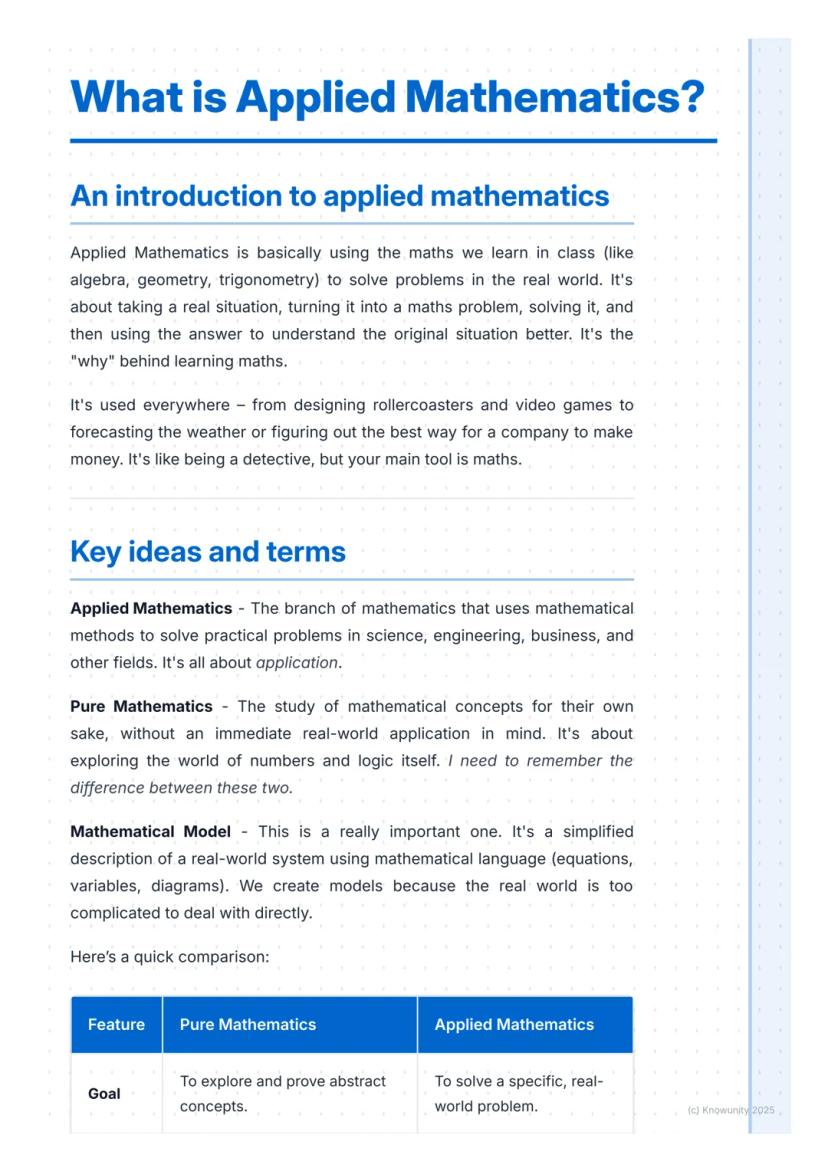
Ever wondered why you're learning algebra or trigonometry? Applied Mathematics is the answer - it's about taking those classroom concepts and using them to solve actual problems in the real world.
Unlike Pure Mathematics (which explores mathematical concepts just for the sake of it), applied maths has a clear goal: solve something practical. Whether it's figuring out the best angle for a football free kick or helping companies make more profit, you're always working towards a real solution.
The secret weapon in applied maths is the mathematical model - basically a simplified maths version of a complex real-world situation. Since the real world is incredibly messy and complicated, we create these models using equations and variables to make problems manageable.
Remember: Pure maths asks "What if?" whilst applied maths asks "How can we fix this?"
2
of 6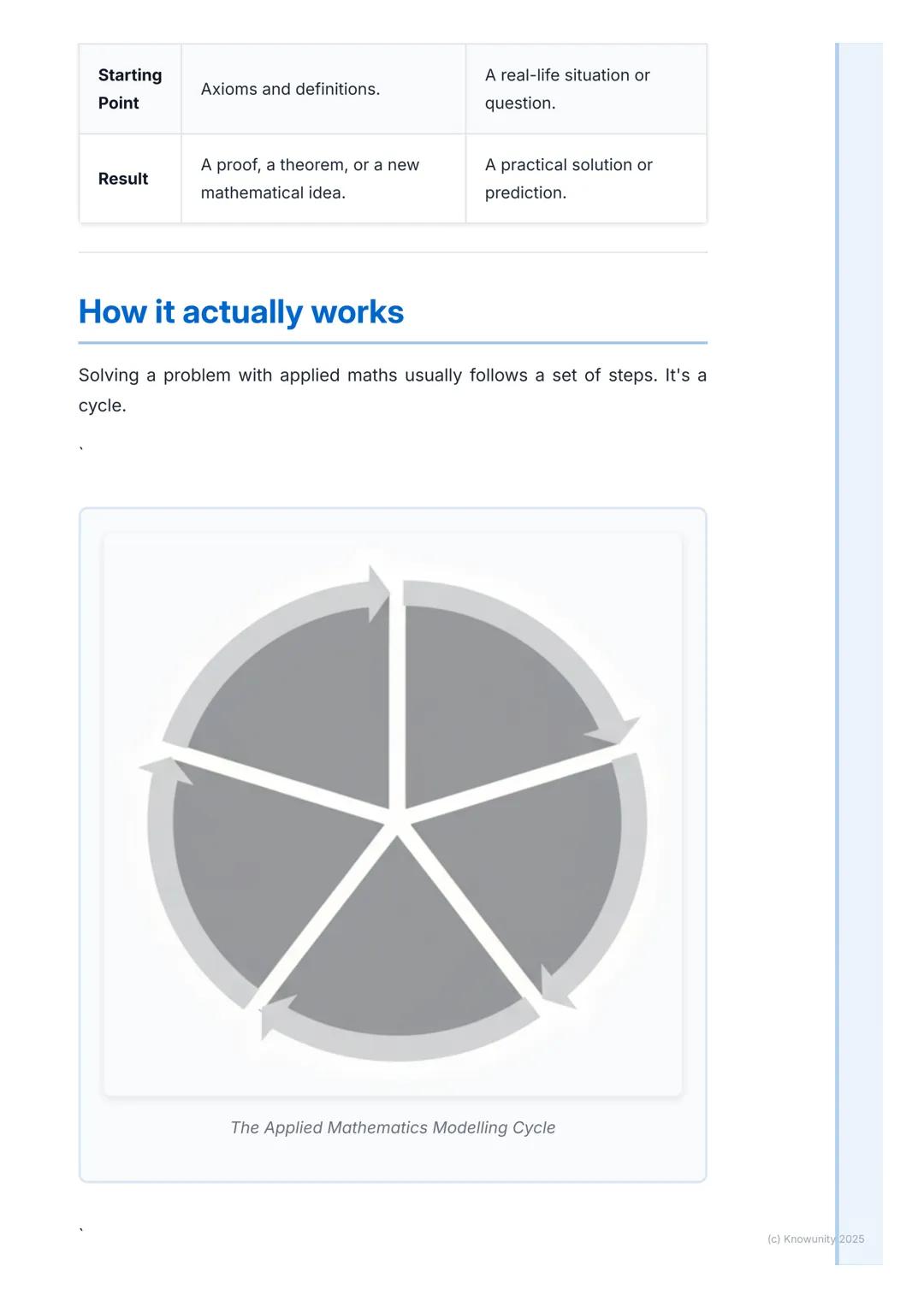
The Applied Mathematics Process
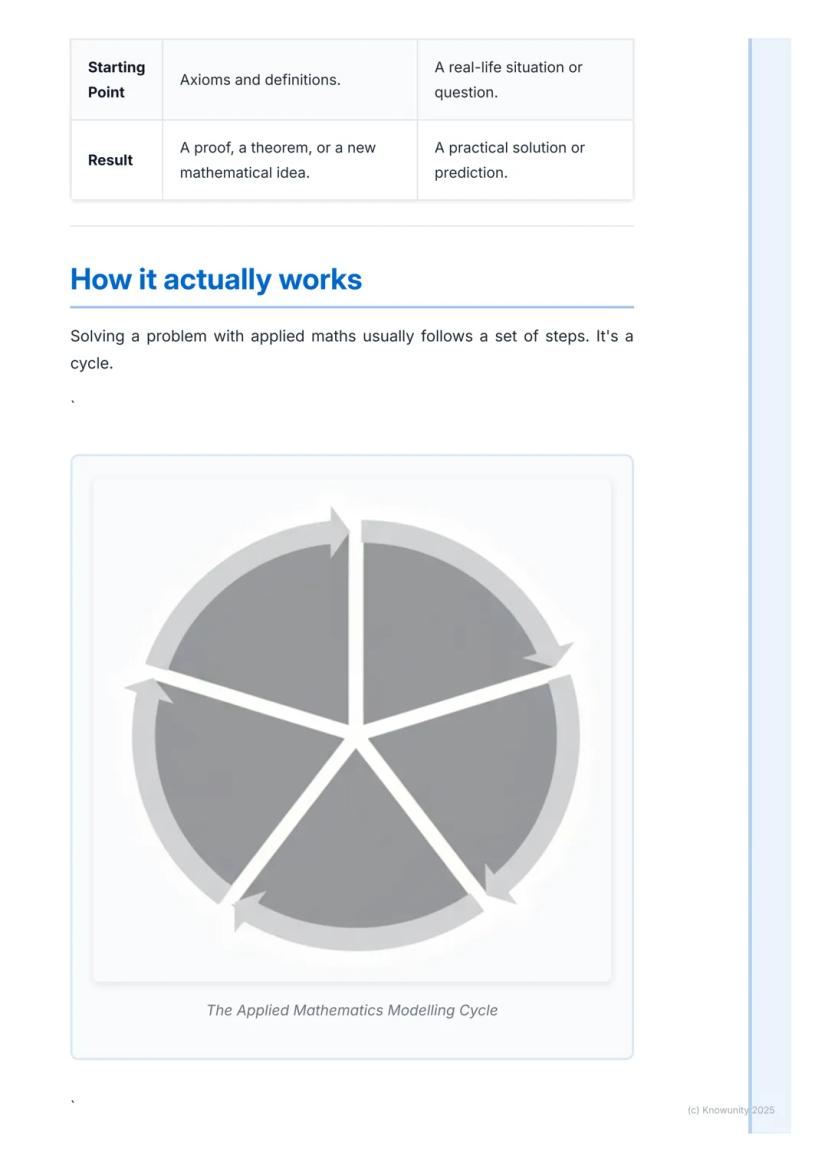
Solving problems with applied mathematics follows a clear cycle that you'll use again and again. It's like having a recipe for tackling any real-world challenge.
The process starts with a real-world problem and moves through several stages: making assumptions, creating a mathematical model, solving it, and interpreting your results. Think of it as translating between two languages - from real life to maths, then back to real life.
This modelling cycle is crucial because it shows that applied maths isn't just about getting the right answer. It's about understanding whether that answer actually makes sense in the original situation.
Key insight: The cycle often repeats - if your answer seems wrong, you go back and refine your model!
3
of 6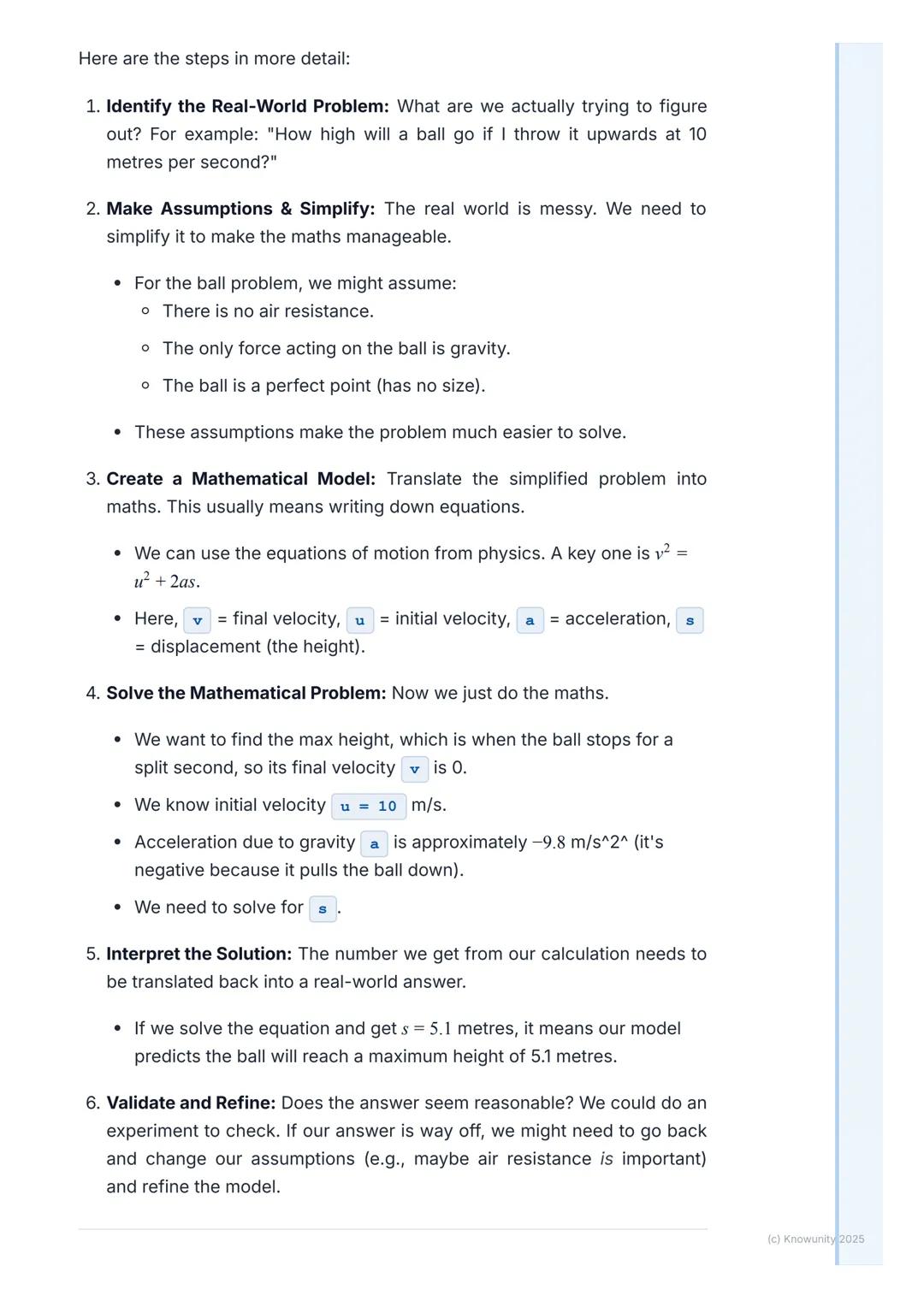
Breaking Down the Steps
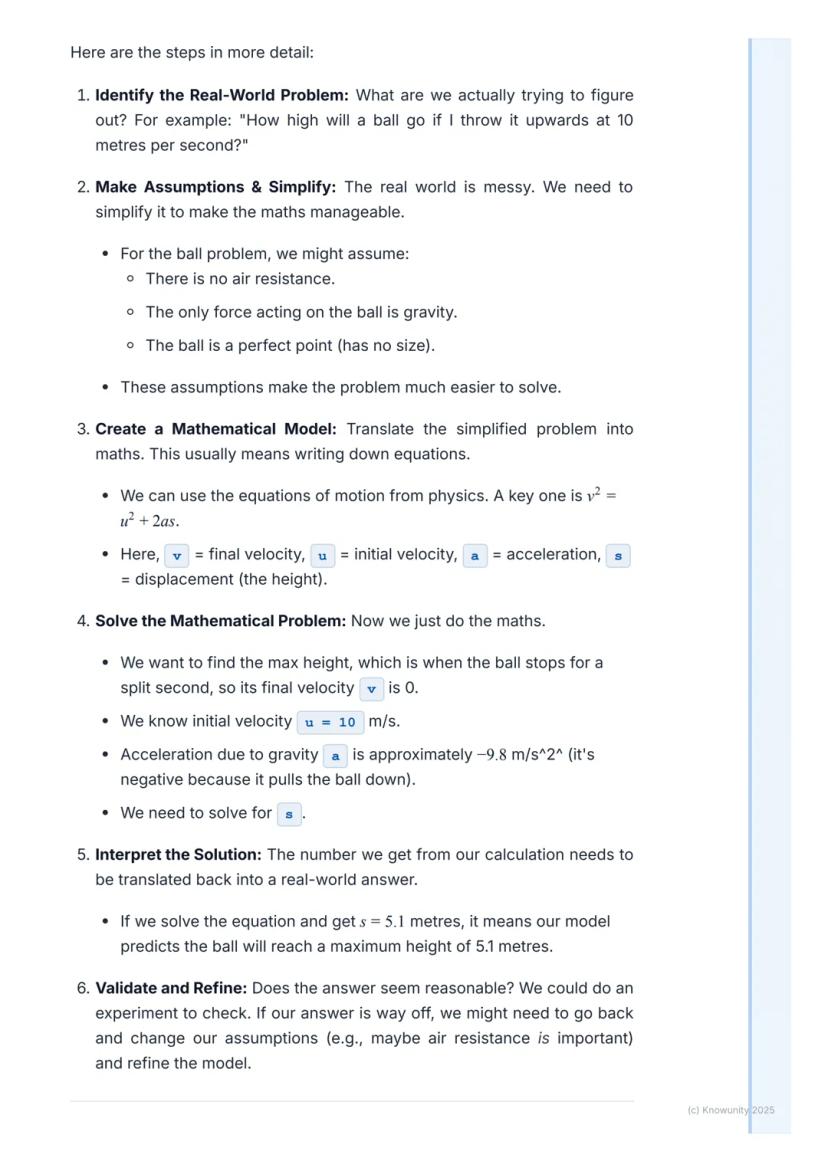
Let's follow the mathematical modelling process with a simple example: "How high will a ball go if I throw it upwards at 10 metres per second?"
First, you identify the problem clearly. Then comes the crucial step of making assumptions - this is where you simplify reality. For our ball, we'll ignore air resistance and assume only gravity affects it.
Next, you create a mathematical model using equations. Here, we'd use physics equations like v² = u² + 2as, where the letters represent velocity, acceleration, and displacement. After solving the maths (plugging in numbers and calculating), you get a numerical answer.
The final steps are interpreting your solution and validating it . If something seems off, you might need to revisit your assumptions.
Pro tip: Always state your assumptions clearly in exams - it shows you understand that you're simplifying a complex problem!
4
of 6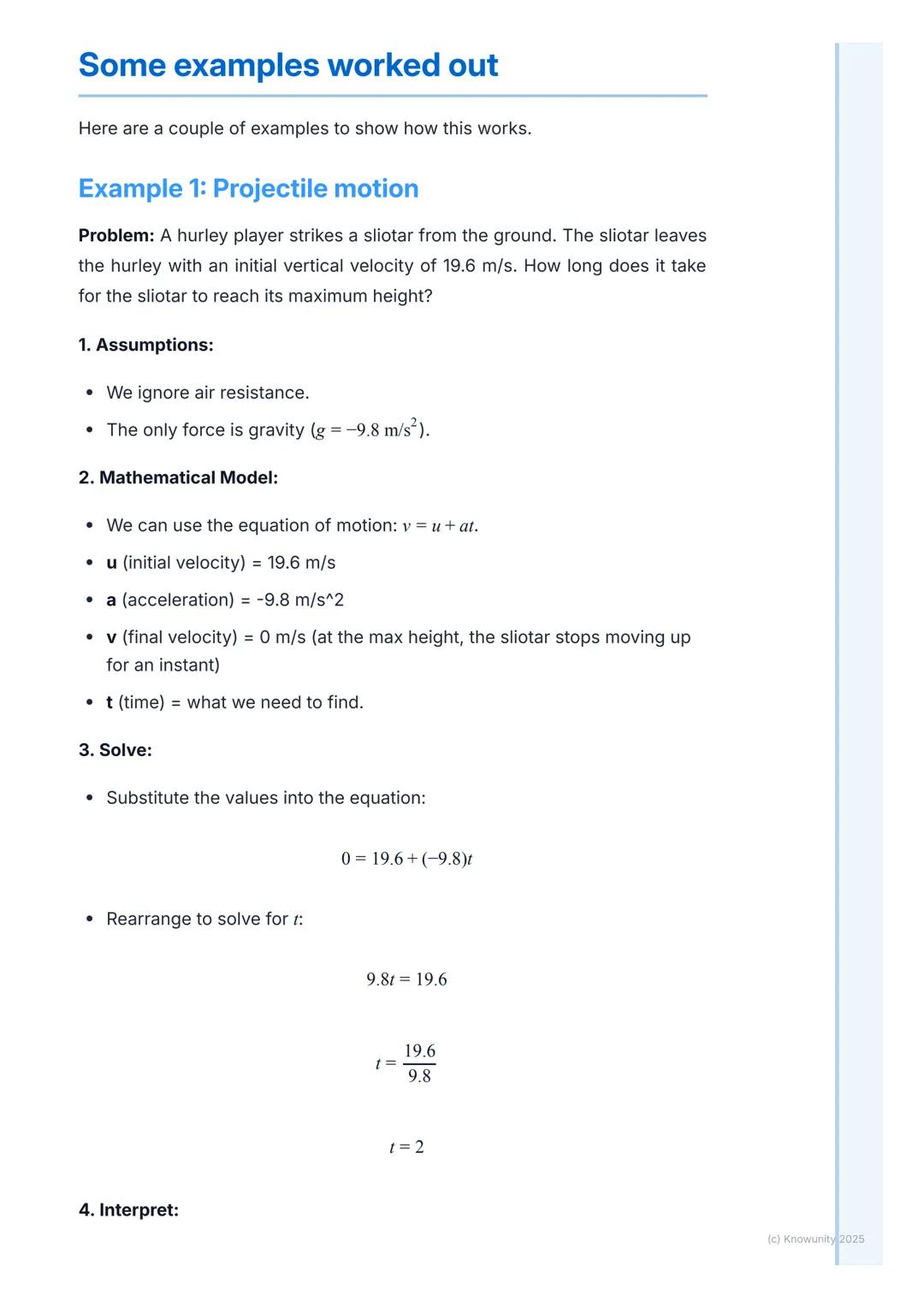
Worked Example: Hurling Physics
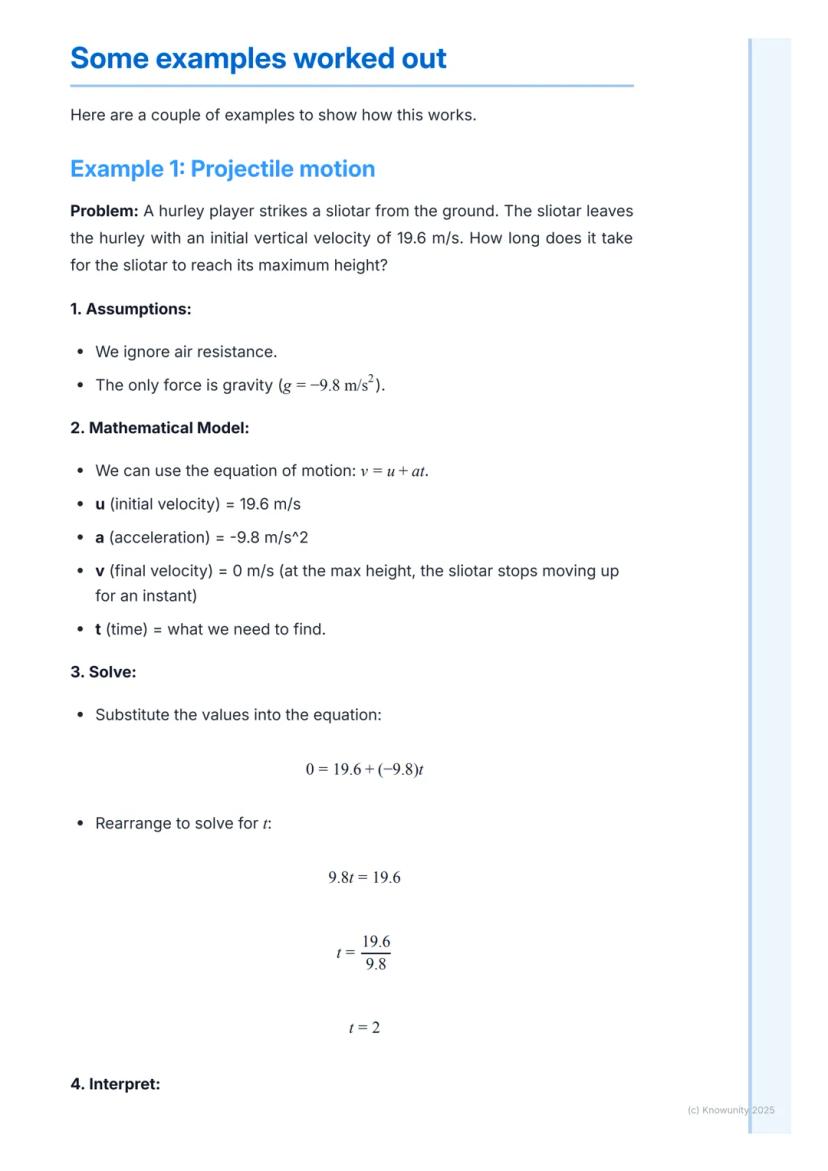
Here's how applied mathematics works with a proper Irish example: A hurler strikes a sliotar with an initial vertical velocity of 19.6 m/s. How long until it reaches maximum height?
Starting with assumptions: we ignore air resistance and only consider gravity . Our mathematical model uses the equation v = u + at, where v (final velocity) = 0 at maximum height, u (initial velocity) = 19.6 m/s, and a (acceleration) = -9.8 m/s².
Solving the equation: 0 = 19.6 + (-9.8)t, which rearranges to t = 19.6/9.8 = 2. The interpretation is straightforward: the sliotar takes 2 seconds to reach its maximum height.
This demonstrates how mathematical modelling transforms a sports scenario into a solvable equation, then translates the numerical result back into practical knowledge.
Reality check: Does 2 seconds seem reasonable for a sliotar to reach its peak? Trust your instincts!
5
of 6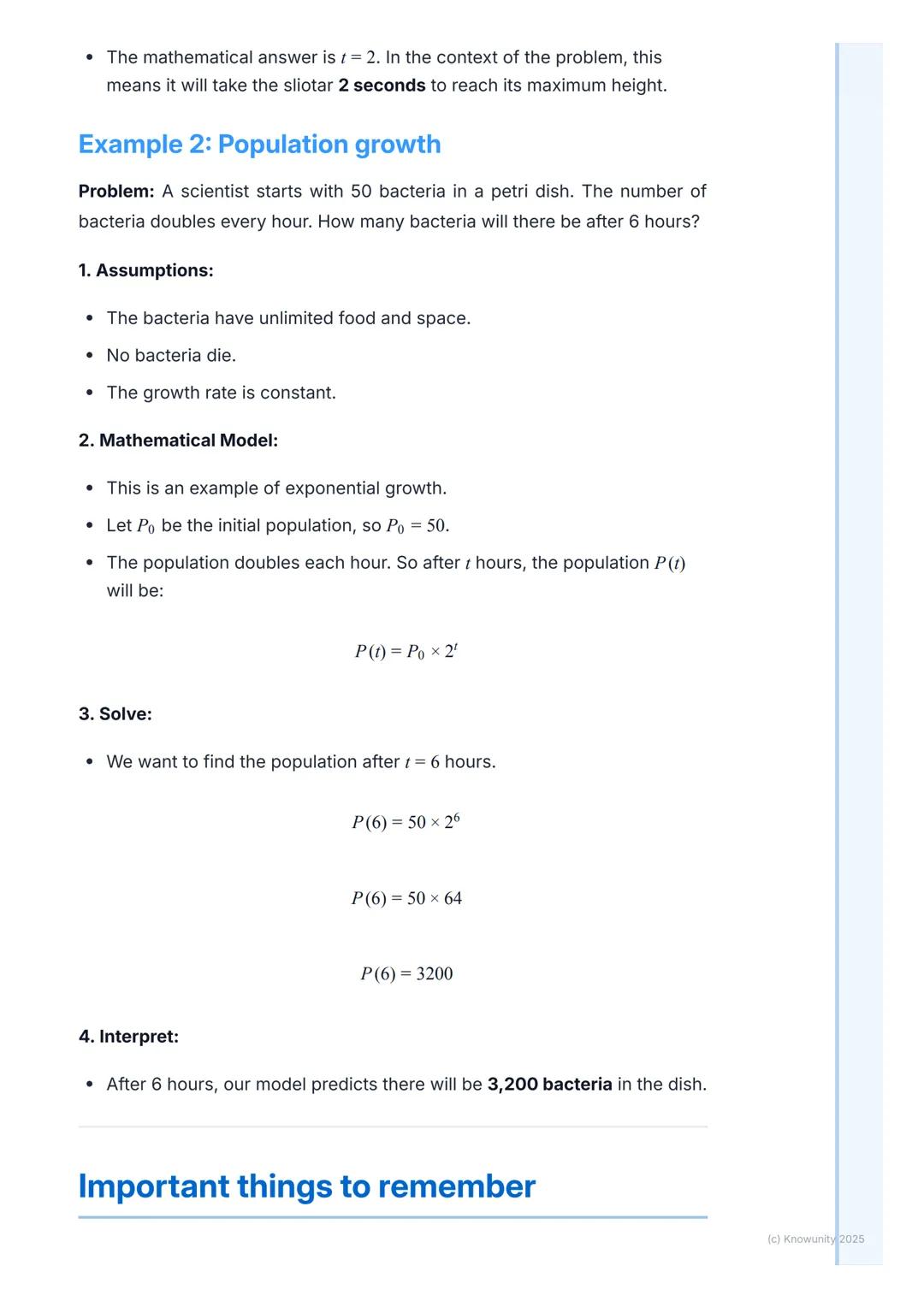
Population Growth Example
Applied mathematics also tackles biological problems brilliantly. Consider: 50 bacteria double every hour - how many after 6 hours?
Our assumptions include unlimited food, no deaths, and constant growth rate. The mathematical model for this exponential growth is P(t) = P₀ × 2ᵗ, where P₀ = 50 bacteria and t = time in hours.
Solving: P(6) = 50 × 2⁶ = 50 × 64 = 3,200 bacteria. The interpretation shows how quickly bacterial populations can explode under ideal conditions.
This example demonstrates how mathematical modelling applies across different fields - from sports physics to biological sciences. The same systematic approach works whether you're dealing with projectiles or populations.
Important: Notice how different real-world situations need completely different mathematical models!
6
of 6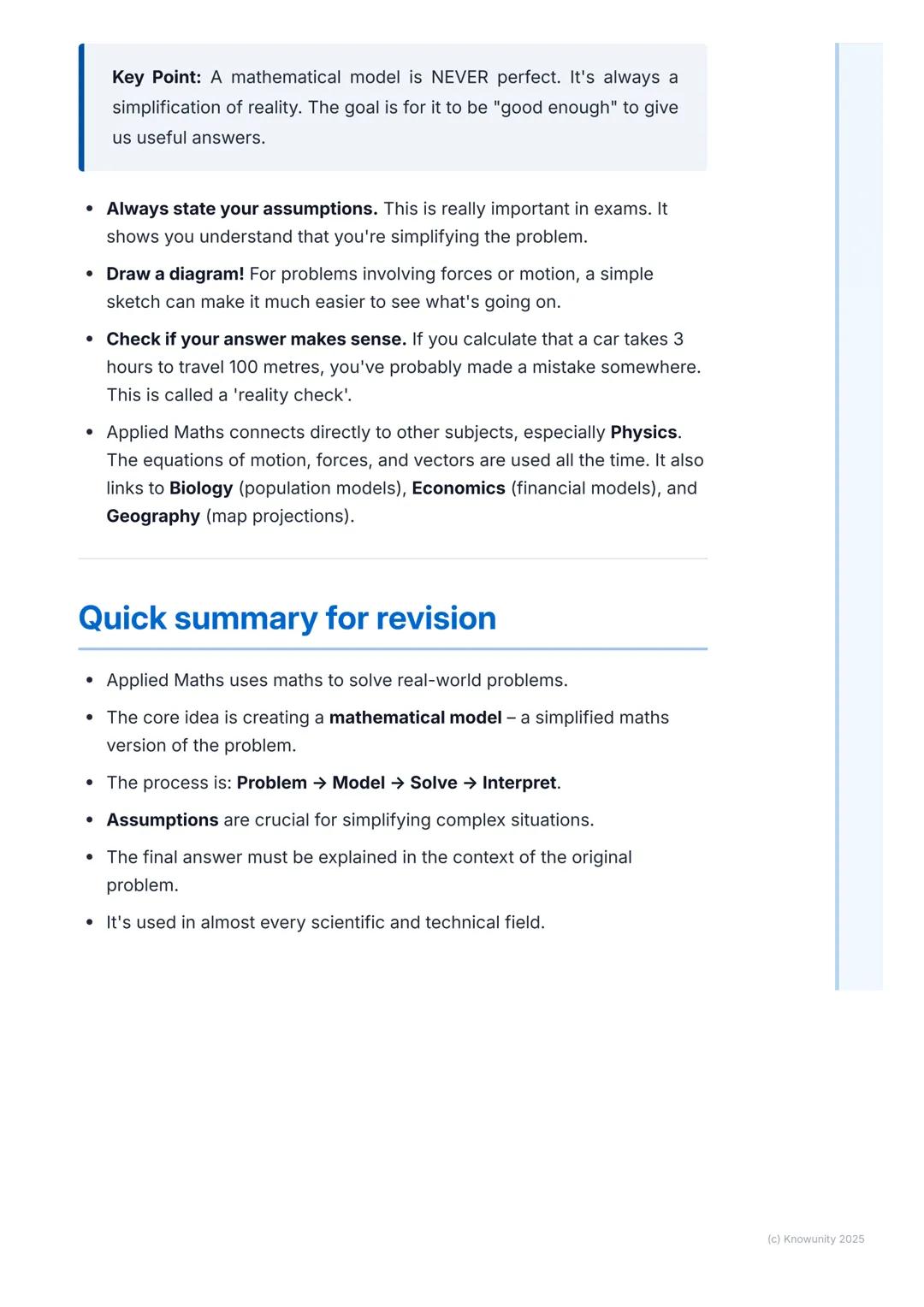
Key Points for Success
Remember that mathematical models are never perfect - they're always simplified versions of reality. The goal is making them "good enough" to provide useful answers, not to capture every tiny detail.
Always state your assumptions clearly and draw diagrams for physics problems. Your applied mathematics solutions should pass the reality check - if a car supposedly takes 3 hours to travel 100 metres, something's gone wrong!
Applied mathematics connects directly to Physics (motion and forces), Biology (population models), Economics (financial planning), and Geography (map projections). It's the bridge between classroom maths and real-world problem-solving.
The core process remains constant: Problem → Model → Solve → Interpret. Master this cycle, and you'll be able to tackle everything from engineering challenges to environmental predictions.
Exam success tip: Always explain your final answer in the context of the original problem - numbers alone aren't enough!
Achamos que você nunca perguntaria...
O que é o assistente de IA da Knowunity?
Nosso companheiro de IA foi criado especificamente para atender às necessidades dos estudantes. Com base nos milhões de conteúdos que temos na plataforma, podemos oferecer respostas realmente relevantes e significativas. Mas não se trata apenas de respostas, o companheiro também está aqui para guiar você pelos desafios diários de aprendizado, com planos de estudo personalizados, quizzes ou conteúdos no chat e 100% de personalização com base nas suas habilidades e desenvolvimentos.
Onde posso baixar o app da Knowunity?
Pode descarregar a aplicação na Google Play Store e na Apple App Store.
Como posso receber meu pagamento? Quanto posso ganhar?
Sim, tem acesso gratuito ao conteúdo da aplicação e ao nosso companheiro de IA. Para desbloquear determinadas funcionalidades da aplicação, pode adquirir o Knowunity Pro.
Conteúdos mais populares
9 Irish
IrishIrish oral questions and answers
Questions and answers for the leaving cert oral
5th Year4264
 English
Key Quotes : Sive
Key Quotes and explanations: Sive
6th Year2842
IrishIrish oral questions
Outline of oral questions
5th Year2055
IrishIníon- le hÁine Durkin
Aine Durkin’s poem, Iníon: Themes & summary
5th Year850
IrishIrish poetry 2027
Iníon + Dínit an Bhróin
5th Year1133
IrishLC HL notes- Iníon (poem)
Includes poem in English and Irish, theme, key words & phrases
5th Year2284
EnglishCultural Context : Shawshank Redemption : Sive : Small Things Like These
Comparative Study : Cultural Context : Shawshank Redemption, Sive and Small Things Like These
6th Year1430
IrishMo Ghrá-sa (Idir Lúibíní)
Notes on mo ghrá-sa
5th Year380
IrishAn Gaeilge Aiste
Irish Language essay
6th Year1320
Não encontrou o que procurava? Explore outras matérias.
Avaliações dos nossos usuários. Eles gostaram de tudo — e você também vai gostar.
4.6/5App Store
4.7/5Google Play
O app é muito fácil de usar e bem projetado. Encontrei tudo o que estava procurando até agora e consegui aprender muito com as apresentações! Definitivamente vou usar o app para uma tarefa de classe! E, claro, também ajuda muito como inspiração.
Stefan Susuário de iOS
Este app é realmente ótimo. Tem muitos materiais de estudo e ajuda [...]. Minha matéria problemática é o francês, por exemplo, e o app tem tantas opções de ajuda. Graças a este app, eu melhorei meu francês. Eu recomendaria para qualquer pessoa.
Samantha Klichusuária de Android
Uau, estou realmente impressionado. Eu experimentei o app porque vi muitos anúncios e fiquei absolutamente maravilhado. Este app é A AJUDA que você quer para a escola e, acima de tudo, oferece muitas coisas, como treinos e resumos, que têm sido MUITO úteis para mim pessoalmente.
Annausuária de iOS
Applied Mathematics11 visualizações·Atualizado Jun 16, 2026·6 páginasExploring Applied Mathematics: Tools for Real-World Problems
Applied Mathematics is basically using the maths you learn in class to solve real-world problems - from designing rollercoasters to predicting weather patterns. Think of it as being a detective where your main tool is maths instead of a magnifying... Mostrar mais
1
of 6Cadastre-se para ver o conteúdo. É grátis!
- Acesso a todos os documentos
- Melhore suas notas
- Junte-se a milhões de estudantes
What is Applied Mathematics?
Ever wondered why you're learning algebra or trigonometry? Applied Mathematics is the answer - it's about taking those classroom concepts and using them to solve actual problems in the real world.
Unlike Pure Mathematics (which explores mathematical concepts just for the sake of it), applied maths has a clear goal: solve something practical. Whether it's figuring out the best angle for a football free kick or helping companies make more profit, you're always working towards a real solution.
The secret weapon in applied maths is the mathematical model - basically a simplified maths version of a complex real-world situation. Since the real world is incredibly messy and complicated, we create these models using equations and variables to make problems manageable.
Remember: Pure maths asks "What if?" whilst applied maths asks "How can we fix this?"
2
of 6Cadastre-se para ver o conteúdo. É grátis!
- Acesso a todos os documentos
- Melhore suas notas
- Junte-se a milhões de estudantes
The Applied Mathematics Process
Solving problems with applied mathematics follows a clear cycle that you'll use again and again. It's like having a recipe for tackling any real-world challenge.
The process starts with a real-world problem and moves through several stages: making assumptions, creating a mathematical model, solving it, and interpreting your results. Think of it as translating between two languages - from real life to maths, then back to real life.
This modelling cycle is crucial because it shows that applied maths isn't just about getting the right answer. It's about understanding whether that answer actually makes sense in the original situation.
Key insight: The cycle often repeats - if your answer seems wrong, you go back and refine your model!
3
of 6Cadastre-se para ver o conteúdo. É grátis!
- Acesso a todos os documentos
- Melhore suas notas
- Junte-se a milhões de estudantes
Breaking Down the Steps
Let's follow the mathematical modelling process with a simple example: "How high will a ball go if I throw it upwards at 10 metres per second?"
First, you identify the problem clearly. Then comes the crucial step of making assumptions - this is where you simplify reality. For our ball, we'll ignore air resistance and assume only gravity affects it.
Next, you create a mathematical model using equations. Here, we'd use physics equations like v² = u² + 2as, where the letters represent velocity, acceleration, and displacement. After solving the maths (plugging in numbers and calculating), you get a numerical answer.
The final steps are interpreting your solution and validating it . If something seems off, you might need to revisit your assumptions.
Pro tip: Always state your assumptions clearly in exams - it shows you understand that you're simplifying a complex problem!
4
of 6Cadastre-se para ver o conteúdo. É grátis!
- Acesso a todos os documentos
- Melhore suas notas
- Junte-se a milhões de estudantes
Worked Example: Hurling Physics
Here's how applied mathematics works with a proper Irish example: A hurler strikes a sliotar with an initial vertical velocity of 19.6 m/s. How long until it reaches maximum height?
Starting with assumptions: we ignore air resistance and only consider gravity . Our mathematical model uses the equation v = u + at, where v (final velocity) = 0 at maximum height, u (initial velocity) = 19.6 m/s, and a (acceleration) = -9.8 m/s².
Solving the equation: 0 = 19.6 + (-9.8)t, which rearranges to t = 19.6/9.8 = 2. The interpretation is straightforward: the sliotar takes 2 seconds to reach its maximum height.
This demonstrates how mathematical modelling transforms a sports scenario into a solvable equation, then translates the numerical result back into practical knowledge.
Reality check: Does 2 seconds seem reasonable for a sliotar to reach its peak? Trust your instincts!
5
of 6Cadastre-se para ver o conteúdo. É grátis!
- Acesso a todos os documentos
- Melhore suas notas
- Junte-se a milhões de estudantes
Population Growth Example
Applied mathematics also tackles biological problems brilliantly. Consider: 50 bacteria double every hour - how many after 6 hours?
Our assumptions include unlimited food, no deaths, and constant growth rate. The mathematical model for this exponential growth is P(t) = P₀ × 2ᵗ, where P₀ = 50 bacteria and t = time in hours.
Solving: P(6) = 50 × 2⁶ = 50 × 64 = 3,200 bacteria. The interpretation shows how quickly bacterial populations can explode under ideal conditions.
This example demonstrates how mathematical modelling applies across different fields - from sports physics to biological sciences. The same systematic approach works whether you're dealing with projectiles or populations.
Important: Notice how different real-world situations need completely different mathematical models!
6
of 6Cadastre-se para ver o conteúdo. É grátis!
- Acesso a todos os documentos
- Melhore suas notas
- Junte-se a milhões de estudantes
Key Points for Success
Remember that mathematical models are never perfect - they're always simplified versions of reality. The goal is making them "good enough" to provide useful answers, not to capture every tiny detail.
Always state your assumptions clearly and draw diagrams for physics problems. Your applied mathematics solutions should pass the reality check - if a car supposedly takes 3 hours to travel 100 metres, something's gone wrong!
Applied mathematics connects directly to Physics (motion and forces), Biology (population models), Economics (financial planning), and Geography (map projections). It's the bridge between classroom maths and real-world problem-solving.
The core process remains constant: Problem → Model → Solve → Interpret. Master this cycle, and you'll be able to tackle everything from engineering challenges to environmental predictions.
Exam success tip: Always explain your final answer in the context of the original problem - numbers alone aren't enough!
Achamos que você nunca perguntaria...
O que é o assistente de IA da Knowunity?
Nosso companheiro de IA foi criado especificamente para atender às necessidades dos estudantes. Com base nos milhões de conteúdos que temos na plataforma, podemos oferecer respostas realmente relevantes e significativas. Mas não se trata apenas de respostas, o companheiro também está aqui para guiar você pelos desafios diários de aprendizado, com planos de estudo personalizados, quizzes ou conteúdos no chat e 100% de personalização com base nas suas habilidades e desenvolvimentos.
Onde posso baixar o app da Knowunity?
Pode descarregar a aplicação na Google Play Store e na Apple App Store.
Como posso receber meu pagamento? Quanto posso ganhar?
Sim, tem acesso gratuito ao conteúdo da aplicação e ao nosso companheiro de IA. Para desbloquear determinadas funcionalidades da aplicação, pode adquirir o Knowunity Pro.
Conteúdos mais populares
9IrishIrish oral questions and answers
Questions and answers for the leaving cert oral
5th Year4264
EnglishKey Quotes : Sive
Key Quotes and explanations: Sive
6th Year2842
IrishIrish oral questions
Outline of oral questions
5th Year2055
IrishIníon- le hÁine Durkin
Aine Durkin’s poem, Iníon: Themes & summary
5th Year850
IrishIrish poetry 2027
Iníon + Dínit an Bhróin
5th Year1133
IrishLC HL notes- Iníon (poem)
Includes poem in English and Irish, theme, key words & phrases
5th Year2284
EnglishCultural Context : Shawshank Redemption : Sive : Small Things Like These
Comparative Study : Cultural Context : Shawshank Redemption, Sive and Small Things Like These
6th Year1430
IrishMo Ghrá-sa (Idir Lúibíní)
Notes on mo ghrá-sa
5th Year380
IrishAn Gaeilge Aiste
Irish Language essay
6th Year1320
Não encontrou o que procurava? Explore outras matérias.
Avaliações dos nossos usuários. Eles gostaram de tudo — e você também vai gostar.
4.6/5App Store
4.7/5Google Play
O app é muito fácil de usar e bem projetado. Encontrei tudo o que estava procurando até agora e consegui aprender muito com as apresentações! Definitivamente vou usar o app para uma tarefa de classe! E, claro, também ajuda muito como inspiração.
Stefan Susuário de iOS
Este app é realmente ótimo. Tem muitos materiais de estudo e ajuda [...]. Minha matéria problemática é o francês, por exemplo, e o app tem tantas opções de ajuda. Graças a este app, eu melhorei meu francês. Eu recomendaria para qualquer pessoa.
Samantha Klichusuária de Android
Uau, estou realmente impressionado. Eu experimentei o app porque vi muitos anúncios e fiquei absolutamente maravilhado. Este app é A AJUDA que você quer para a escola e, acima de tudo, oferece muitas coisas, como treinos e resumos, que têm sido MUITO úteis para mim pessoalmente.
Annausuária de iOS